
Mind map
Eating Behaviour
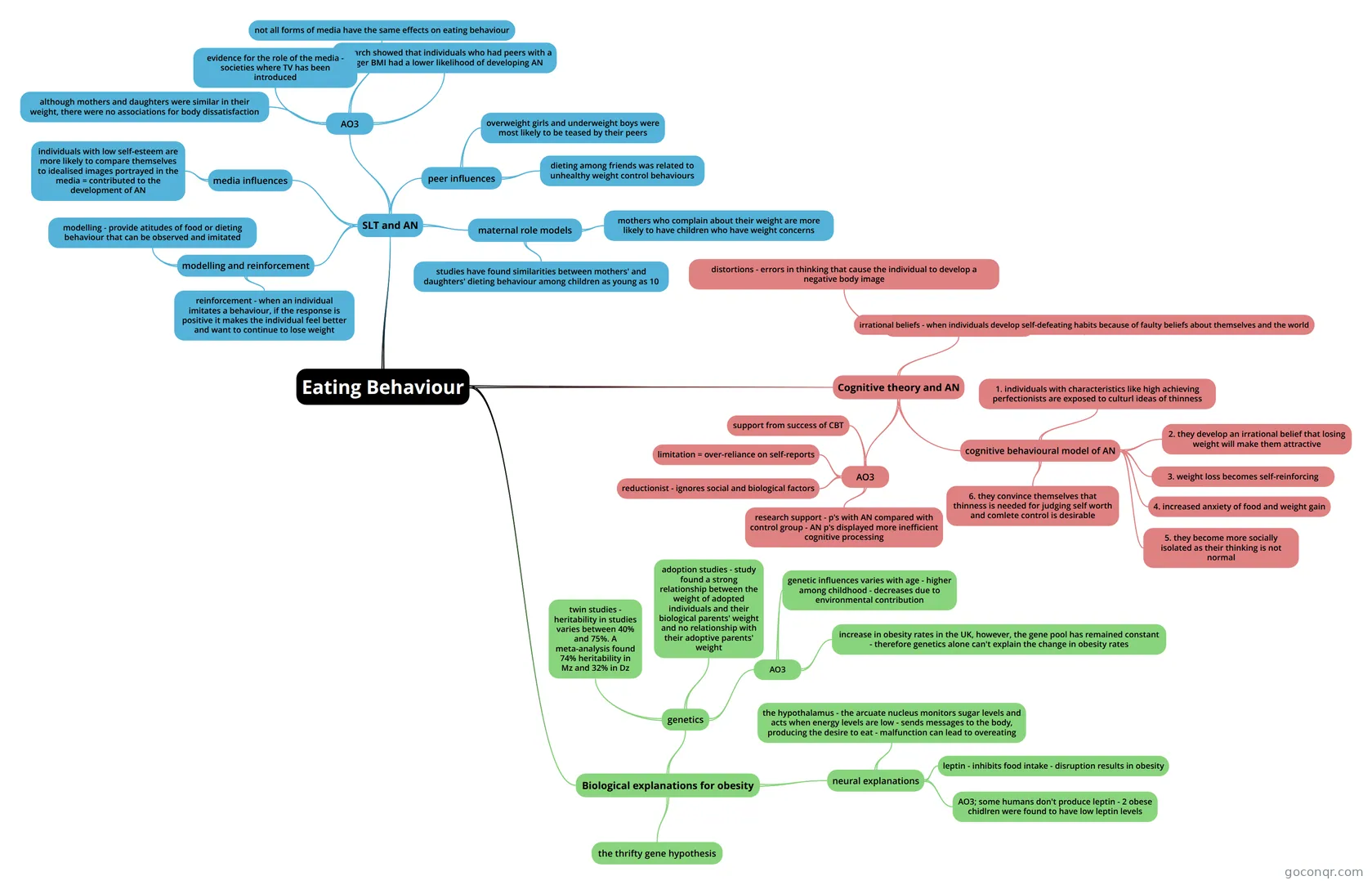
Mind map: Eating behaviour
Map content
Eating Behaviour
SLT and AN
- modelling and reinforcement
- modelling - provide atitudes of food or dieting behaviour that can be observed and imitated
- reinforcement - when an individual imitates a behaviour, if the response is positive it makes the individual feel better and want to continue to lose weight
- maternal role models
- studies have found similarities between mothers' and daughters' dieting behaviour among children as young as 10
- mothers who complain about their weight are more likely to have children who have weight concerns
- peer influences
- dieting among friends was related to unhealthy weight control behaviours
- overweight girls and underweight boys were most likely to be teased by their peers
- media influences
- individuals with low self-esteem are more likely to compare themselves to idealised images portrayed in the media = contributed to the development of AN
- AO3
- although mothers and daughters were similar in their weight, there were no associations for body dissatisfaction
- research showed that individuals who had peers with a larger BMI had a lower likelihood of developing AN
- evidence for the role of the media - societies where TV has been introduced
- not all forms of media have the same effects on eating behaviour
- modelling and reinforcement
Cognitive theory and AN
- distortions and irrational beliefs
- distortions - errors in thinking that cause the individual to develop a negative body image
- irrational beliefs - when individuals develop self-defeating habits because of faulty beliefs about themselves and the world
- cognitive behavioural model of AN
- 1. individuals with characteristics like high achieving perfectionists are exposed to culturl ideas of thinness
- 2. they develop an irrational belief that losing weight will make them attractive
- 3. weight loss becomes self-reinforcing
- 4. increased anxiety of food and weight gain
- 5. they become more socially isolated as their thinking is not normal
- 6. they convince themselves that thinness is needed for judging self worth and comlete control is desirable
- AO3
- support from success of CBT
- research support - p's with AN compared with control group - AN p's displayed more inefficient cognitive processing
- limitation = over-reliance on self-reports
- reductionist - ignores social and biological factors
- distortions and irrational beliefs
Biological explanations for obesity
- genetics
- twin studies - heritability in studies varies between 40% and 75%. A meta-analysis found 74% heritability in Mz and 32% in Dz
- adoption studies - study found a strong relationship between the weight of adopted individuals and their biological parents' weight and no relationship with their adoptive parents' weight
- AO3
- genetic influences varies with age - higher among childhood - decreases due to environmental contribution
- increase in obesity rates in the UK, however, the gene pool has remained constant - therefore genetics alone can't explain the change in obesity rates
- neural explanations
- the hypothalamus - the arcuate nucleus monitors sugar levels and acts when energy levels are low - sends messages to the body, producing the desire to eat - malfunction can lead to overeating
- leptin - inhibits food intake - disruption results in obesity
- AO3; some humans don't produce leptin - 2 obese chidlren were found to have low leptin levels
- the thrifty gene hypothesis
- genetics
Information
- Description
- Mind Map on Eating Behaviour, created by Rachael Sherburn on 17/05/2017.
- Created by
- Rachael Sherburn
- Views
- 0
- Rating