
Notes
1.1 - Monomers and Polymers
Content of the notes (3)
Page 1
Monomers and Polymers
A Monomer is a molecule which can bond with other identical molecules to create Polymers.
Monomers are small chemical units, from which larger chemical compounds can be formed. Polymers are large molecules made up of the repetition of small chemical units, joined by chemical bonds.
Some examples of monomers are:
Monosaccarides
Amino Acids
Nucleotides
Some polymers are produced by a Condensation Polymerisation Reaction. When this type of reaction occurs, a simple molecule, usually water, is produced as a by-product.
This reaction would occur many times, forming the links between monomers and creating the polymer.
Page 2
Condensation Polymerisation Reactions
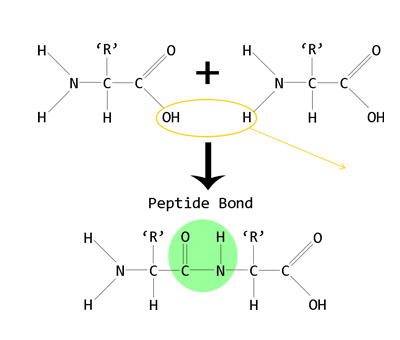
Condensation polymerisation reaction of an amino acid. As you can see in the image, one side loses a (H) atom and one loses a hydroxide ion (OH), together forming water (H20). The two amino acids then form a Peptide Bond, linking the two monomers together.
Page 3
Hydrolysis
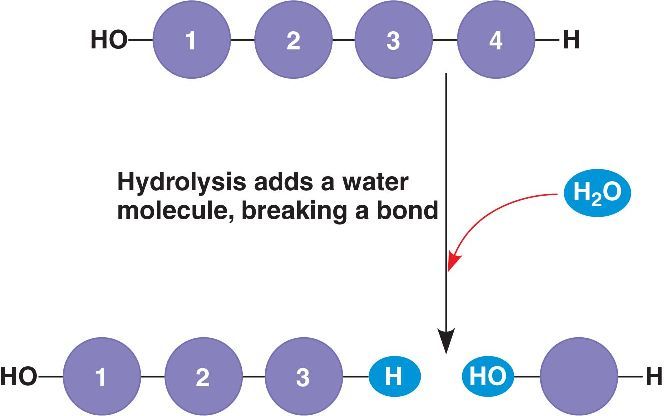
Hydrolysis is the breaking of chemical bonds, due to a reaction with water.
Information
- Description
- A level Biology (Topic 1 - Biological Molecules) Note on 1.1 - Monomers and Polymers, created by Lewis Humphrys on 01/09/2016.
- Created by
- Lewis Humphrys
- Views
- 90
- Rating