
Notes
Yr 12 Biology Mid-Year Exam Notes Part 1
Content of the notes (1)
Page 1
Cells
C8: Cells arise from pre-existing cells, and cell division leads to an increase in cell number
Learning Objective
Understand that cell division is the basis of growth, reproduction and repair
Explain why chromosomes must be replicated by semi-conservative replication before a cell divides to ensure that daughter cells are identical to the parent cell
Describe how prokaryotes divide by binary fission
Describe the cell cycle
Illustrate the process of mitosis in eukaryotic cells.
Why do Cells Divide?
Cell division is the basis of: Growth, Repair, Reproduction
The ratio of cell membrane Surface Area: Volume Ratio is a factor that limits cell size
When a cell reaches its OPTIMUM size the NUCLEUS initiates cell divisioin
Why DNA replicates in a cell before division
All cells contain Deoxyribose Nucleic Acid (DNA)
In prokaryotes the DNA is found in the cytoplasm in the form of a circular chromosome
In eukaryotes the DNA is found in chromosomes located in the nucleus as linear DNA. When a cell divides to form 2 identical daughter cells, then the amount of DNA in a cell must be doubled before the cell divides to maker sure that both daughter cells receive a copy of the DNA.
This process is called semi-conservative replication of DNA
What are chromosomes?
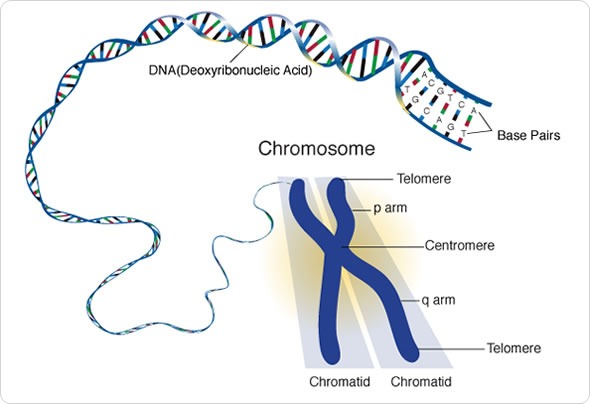
Chromosomes around found with the nucleus of cells
When NOT dividing chromosomes are in the form of chromatin granules
When the cell is preparing to divide these thread like chromatin granules become shorter and fatter and we refer to them as chromosomes.
Chromosomes contain GENES. Genes determine an individuals characteristics such as eye colour, nose shape etc.
http://www.news-medical.net/health/Genes-What-are-Genes.aspx
What are Genes?
Genes are arranged along chromosomes like a string of beads on a necklace. Each gene controls a specific characteristic (sometimes several characteristics are controlled by several genes working together)
These genes are made of DNA (A,T,C,G)
DNA carries the code to synthesis all the proteins required to carry out life processes as well as codes to replicate, It is very important that chromosomes are replicated prior to cell division
This process enables daughter cells to be an identical replica of the parent cell
To enable the chromosomes to be divided evenly between daughter cells the chromosomes behave in an ORDERLY way to prepare for cell division along the CELL CYCLE
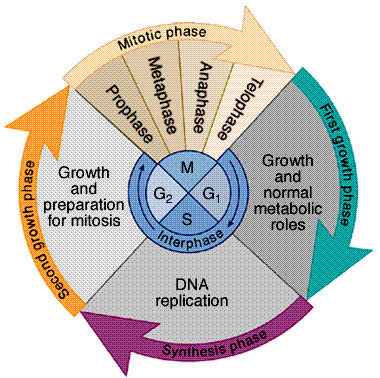
http://www.bristol.k12.ct.us/page.cfm?p=7093
The Cell Cycle
The cell cycle has two main parts;
Growth and preparation (Interphase)
Cell Division (MITOSIS)
Cell division is split further into two stages
MITOSIS (Nuclear Division)
Cytokinesis (Cytoplasm Division)
Mitosis
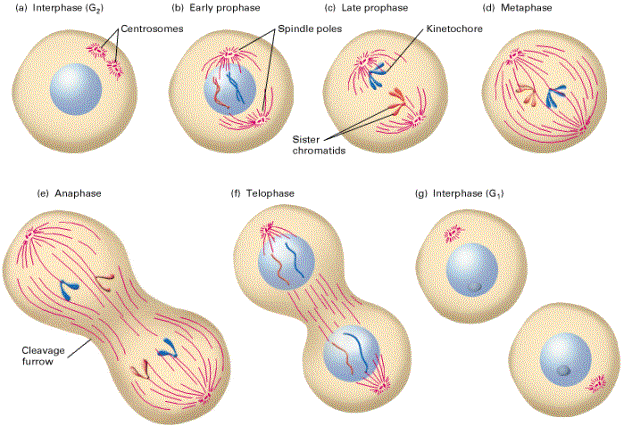
Mitosis, the division of the nucleus is divided into four stages (IPMAT)
Prophase
Metaphase
Anaphase
Telophase
Interphase
Cells spend the majority of their life in Interphase
Interphase is occurs between divisions and is characterised by GROWTH and DEVELOPMENT
Interphase was once thought to be a 'resting period' because when viewed through a microscope at this time of the cell cycle there are no clear indicators or anything occuring
Now it is known that Interphase is the longest part of the cell cycle, in which the cell is busy producing materials for growth and synthesising DNA 'semi-conservative replication' in readiness for division
Interphase is divided into THREE parts:
G1 or Gap 1: The first growth and development period following division
S or Synthesis: The second stage of Interphase where the cell replicates its chromosomes and commits to division (see checkpoint information C9)
G2 or Gap 2: The final growth stage, organelle synthesis
Mitosis
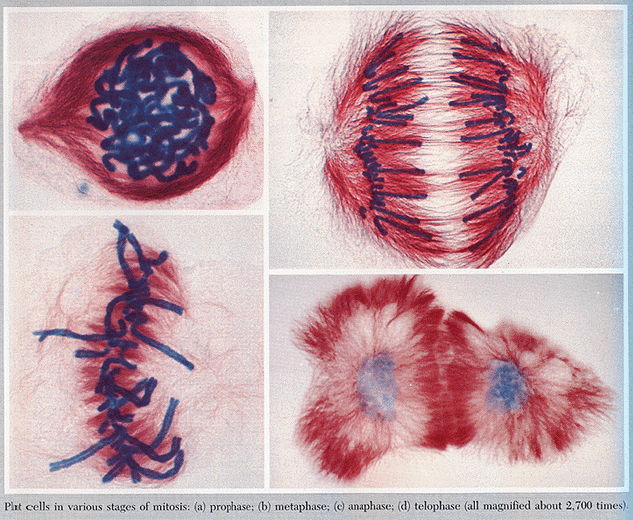
Prophase
Chromosome become shorter and fatter
The Nuclear Membrane Disappears
Centrioles start to move to opposite poles of the cell and spindle fibres start to form
Metaphase
Chromosomes line up on the spindle fibres across the equator of the cell (one chromosome per spindle fibre)
Anaphase
The centromeres split moving to opposite poles of each cell, carrying an identical chromosome
Telophase
Daughter chromosomes reach opposite ends of the cell and nuclear membranes reform around the two separate chromosome bundles
Cytokinesis occurs and the cell splits into two identical daughter cells
Mitosis Animation: https://highered.mcgraw-hill.com/sites/0072495855/student_view0/chapter2/animation__mitosis_and_cyto...
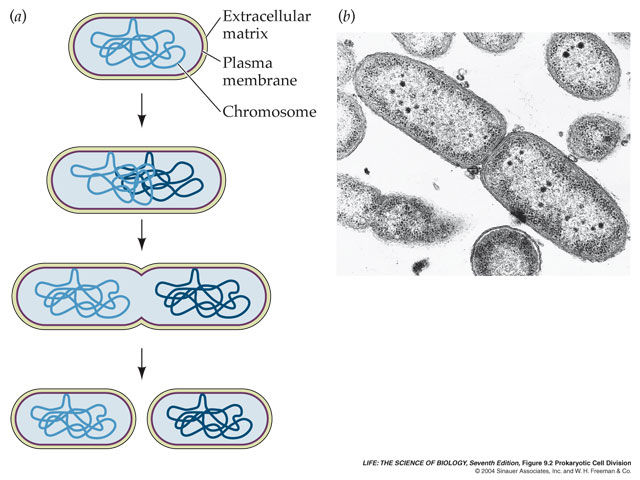
Prokaryotic Cells Divide by Binary Fission (bacteria etc.)
Bacteria reproduce by binary fission which literally means 'dividing in half'
The DNA in a bacteria replicates prior to cell division and then the plasma membrane and the cell wall grow inward to constrict the cell and divide it into two (cytokinesis)
Each daughter cell is genetically identical to the parent cell
This process takes 20 minutes and thus bacteria can multiply exponentially
If environmental conditions change and one bacteria dies, all are likely to die as they are identical, unless there has been a mutation in their DNA
http://danielscienceblogg.blogspot.com.au/2011/08/324-mitosis.html
http://alevelnotes.com/Eukaryotic-Cellular-Division-Process/147?tree=
http://biology200.gsu.edu/houghton/2107%20'14/lecture11.html
C9: Division may be regulated by internal and external factors
Learning Objective
Know that cells produce gene products (proteins) that regulate the cell cycle
Understand that hormones may regulate cell division
Understand that carcinogens upset the normal controls of cell division by causing MUTATIONS
Cell division may be regulated by internal and external factors
In multicellular organisms the division of cells MUST be carefully controlled and cannot go 'unchecked'
The effects of 'uncontrolled cell division' = MUTATIONS, such as CANCER
The CELL CYCLE controls the process of division
Differentiation
Cells that divide are called STEM CELLS
When stem cells divide, one daughter cell remains a stem cell while the other DIFFERENTIATES
A differentiated cell is one that has become 'SPECIALISED' in structure and function
These cells tend not to divide or at least divide at a greatly reduced rate. Differentiated cells cannot revert back to their former state (stem cells)
A cell that has differentiated is said to be in G0. Its division apparatus is disabled and if it is ever stimulated to divide again it will occur very slowly
Specific gene products inside cells regulate the cell cycle
G1 - A cell goes through growth phase, if specialisation occurs the cell goes into G0 phase
S - DNA is replicated
G2 - Further growth phase and preparation for mitosis
M - Mitosis where cell division occurs PMAT
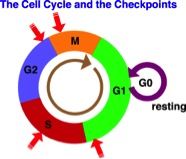
The cell cycle is dependent on whether the conditions are correct at three different checkpoints
Checkpoint 1: Restriction Point (R)
Towards the end of G1 phase - the cell cycle will only proceed into S phase if :-
intracellular (eg cell size, large) and extracellular conditions (temperature and growth factors) are met.
Checkpoint 2
At the end of G2 - the cell cycle only enters mitosis if :-
DNA replication was successful
Environmental conditions are met
MPF (Mitosis Promoting Factor) levels must rise - made up of an enzyme, Cdk and a protein, cyclin
Checkpoint 3: (M)
Metaphase checkpoint - the cell cycle only continues when
Chromosomes are aligned
MPF levels must fall
Checkpoint genes exist with the sole purpose of arresting development until the cell can be made ready for progression by independent genes.
Control of the Cell Cycle
Research has shown that there are important factors which influence the time and rate of division.
Triggers of cell division
1. SIZE
When cells are fully grown their SA/V ratio is smaller and therefore can be a reason to divide
2. SIGNALS FROM THE ENVIRONMENT
nutrient dependence: if certain nutrients are not present in the fluid surrounding a cell it will not divide
anchorage dependence: some cells will only divide if they are attached to a certain substrate
density dependence: closely packed cells will usually not divide, especially if their membranes are touching
* The regulation of cell division is achieved by a set of proteins that interact at the CHECKPOINTS to allow the cell to proceed to the NEXT PHASE.
MPF's = mitosis promoting factors trigger a cell to proceed from interphase to mitosis
Checkpoint 1 - Divide?
The role of growth factos
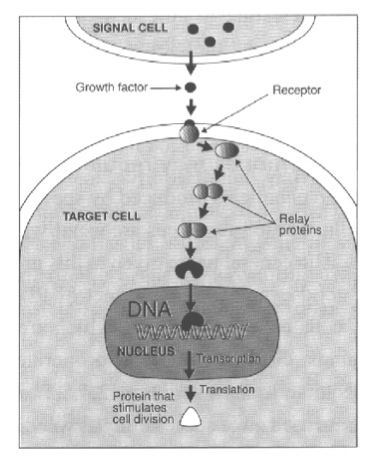
Growth Factors (GF) are protein molecules that regulate cell division (prompted by hormones)
If cells are deprived of GF's they WILL NOT DIVIDE = G0 phase
Growth Factors travel in animal blood and plant sap (in the extracellular environment). They attach to specific receptor molecules on the cell membrane of Target cells
The target cell relays a message across the membrane to a series of 'relay proteins', which activate the process of transcription to produce proteins that stimulate cell division.
PDGF (platelet derived growth factors) control the division of fibroblasts and are important in the clotting of blood.
The weedicide 'round-up' contains a plant GF 2, 4, 5, T and glycol which stimulates plant cells to divide too rapidly causing the plant to die
There are over 50 known proteins that act as growth factors
Checkpoint 2 - Continue?
The basis of regulation at the second checkpoint rests with two types of proteins
One is an enzyme (kinase) and the other a regulatory protein called cyclin which activates the enzyme
When the two molecules combine they form a complex called the mitosis promoting factor (MPF)
ENZYME (kinase) + CYCLIN = MPF
An increase in cyclin stimulates the start of MITOSIS
ANAPHASE cannot commence at Checkpoint 3 until there is a decrease in MPF - so the MPF self destructs!
Understand that carcinogens upset the normal controls of cell division by causing mutations
Cancer = the uncontrolled division of cells
Begins with a single abnormal cel
Caused by a mutation or a series of mutations to genes in body cells
These mutations interfere with genes which control and regulate cell division
This mutation then leads to an abnormal growth of cells which invades other tissues and may move to other parts of the body
If change was not passed onto the next generation of cells, new cells would receive UNALTERED DNA and be NORMAL!
CANCER CEKKS have abnormal cell cycles
In some cases checkpoints are not functioning and no GF's are required to control movement to the next phase of the cycle
In other cases, the cancer cells manufacture their own GF's and proceed through the cell cycle without restriction!
Chemotherapy works o interrupt the cell cycle as do antimitotic drugs
Mutations
A mutation = a spontaneours or induced change in a cells DNA
There is a strong correlation between CARCINOGENESIS (the onset of cancer) and MUTAGENESIS (a change in DNA sequence)
3 Main Causes/Agents
=> CHEMICAL CARCINOGENS: Change the nucleotide sequence in DNA
=> RADIATION: produce chromosome breaks
=> VIRUSES: Ass foreign DNA sequences to the host DNA
Usually a single exposure to these agents will not cause cancer - an accumulation or several exposures is needed.
Mutagens increase the rate of cancer, especially carcinogens which include: asbestos, cigarette smoke, radiation and excessive heat.
New chemicals are now tested for mutagenicity by exposing them to microbes growing on agar plates before they are available for general use.
Continued Top Right Hand Corner of Page
Testing for Malignancy
A biopsy is used to test cells to see if they are malignant
There are 3 main types of cancer:
=> Carcinomas: originate in the external or internal coverings of the body such as intestines, the skin or in glands such as the breasts
=> Sacromas: originate in connective tissue in the bosy
=> Leukaemias and lymphomas: originate in tissues which from white blood cells such as the spleen, lymph and bone marrow
Cancer is treated with surgery, radiotherapy and chemotherapy which are all aimed at interfering with the process of cell division, but they have significant side effects
Early detection is still the best treatment!
C10: Existing cells are the products of evolution
Learning Objective
Understand that there is evidence the prokaryotic cells existed before eukaryotic cells
Explain how the ancestry of most existing eukaryotic cells probably involved endosymbiotic events
First Life on Earth
Fossil evidence suggest the earth was formed 4.5 billion years ago (BP)
The conditions on earth were very different to those found today: The atmosphere
The earliest form of life one earth is about 3.5 billion years old. Current thinking = first cells were prokaryotes that anaerobically respired (without oxygen)
This Suggests life began in the ocean in a primordial soup of organic molecules
Primordial Definition: of a cell, part, or tissue at the earliest stage of development OR existing at or from the beginning of time OR basic and fundamental
Support for Simple Cellular Formation
In 1953 chemist - STANLEY MILLER mixed primordial gases and subjected them to similar conditions as early as Earth. He was able to form organic molecules including amino acids, nucleotides and ATP!
He showed that molecules spontaneously polymerise (join together) to from simple proteins and nucleic acids
Since 1953 other studies have shown that these molecules polymerise in the presence of lipids - when this occurs simple membranes form!
These discoveries support the idea that cells could have developed billions of years ago
Formation of Prokaryotic Autotrophs
The earliest form of prokaryotes are 3 billion years old, called stromatolites
These simple bacteria could photosynthesis and changed the composition of the atmosphere (produced oxygen) to enable other organisms to evolve
Endosymbiosis
The term SYMBIOSIS describes a pattern of living in which two organisms help each other for mutual benefit. ENDO means inside, therefore ENDOSYMBIOSIS = 'living inside for mutual benefit'
It is though that the evolution from prokaryotes to eukaryotes occurred through an ENDOSYMBIOTIC EVENT
INFOLDING OF MEMBRANES
The first step thought to have led to the evolution of eukaryotic cells from prokaryotic cells was the infolding of the cell membrane of protists (bacteria)
This is thought to have formed the endoplasmic reticulum, nucleus and golgi apparatus
ENDOSYMBIOSIS
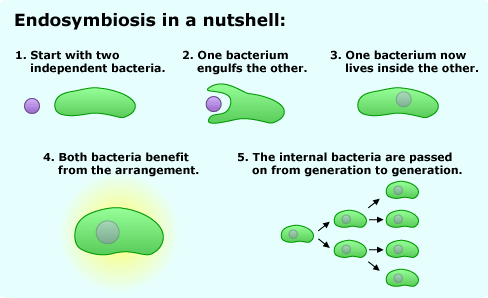
The second step was endosymbiosis of small prokaryotic cells by larger cells producing mitochondria and chloroplasts within the larger cell
Simply a large cell engulfed a smaller cell when the gave benefit to both cells, the larger cell protected the smaller cell and the smaller cell provided energy of some form to the larger cell
http://evolution.berkeley.edu/evolibrary/article/_0/endosymbiosis_03
Evidence for Endosymbiosis
CHLOROPLASTS & MITOCHONDRIA
BOTH have their own DNA. Separate from the DNA in the nucleus of the eukaryotic cell. Their DNA resembles prokaryotic DNA = circular
BOTH contain their own ribosomes that closely resemble bacterial ribosomes (prokaryotic)
BOTH can self replicate independently of the cell. This replication resembles binary fission (division of prokaryotic cells)
BOTH have two membranes. The outer is similar to the 'host' cell. The inner contains enzymes and transport proteins found in the membranes of bacteria!
C11: Human beings culture cells for a variety of purposes
Learning Objective
Understand that to culture cells specific conditions must be maintained
Animals cells are cultured for a variety of medical uses and are also used to test cosmetics instead of live animals
Plant cells are cultured for propagation
Propagation Definition: the process of spreader to a larger area or greater number
Humans Culture Cells
Humans culture cells for a variety of purposes
Biologists and medical scientists have developed methods to grow cells in a laboratory
These are called 'cell culture' techniques
The techniques to culture plant and animal cells is slightly different
WHY MIGHT THIS BE?
General Cell Culture Techniques
DISSECTION
1. The tissue of interest is carefully dissected to expose cells of the same type
SUPSENSION
2. Add proteolytic (protein digesting) enzymes to the dissected tissue to digest the intracellular matrix of connective tissue and release the cell.
CELL CULTURE
3. Cells are placed in a culture medium which contains the necessary sugars and salts. In some cases small amounts of antibiotics are added to prevent bacterial growth
4. Culture is kept in a flat flask at the optimum temperature (human cells 37°C)
The cells quickly cover the bottom of the flask from where they can be removed for experimental work
The Hayflick Limit: Most cultured cells will usually grow 30-40 generations
Laboratory or (in vitro) techniques enable tissue cultures to be grown in a lab and safely stored for many years
Plant Tissue Culture
Biologists can culture cells using the following technique
Techniques for plant tissue culture:
Select healthy cells from actively growing tissue (eg buds, leaf tips)
Wash in a sterilising solution (hypochlorite) to remove any contaminating bacteria or fungi
Place on sterile growing media (usually an agar gel). The growing media should contain all the materials required for growth growth hormones and nutrients such as minerals
Incubate in a stable warm light environment
The tissue will develop into a thallus and eventually leaves and roots will develop. The tissue can then be further divided or planted out
Thallus Definition: a plant body that lacks differentiation into distinct parts (as stem, leaves, and roots)
Application:
Plant tissue culture is used in agriculture to produce large numbers of genetically identical plants to improve the consistency of plants. Depending on the concentration and type of hormones used the tissue can be made to divide/differentiate into roots or shoots or both.
This technique is used to clone valuable plants
Animal Tissue Culture
Biologists can culture cells using the following technique:
Techniques for animal tissue culture:
Select healthy growing cells and sterilise the surface of the tissue sample
Separate the cells by adding enzymes. This overcomes any contact inhibition
Place in a sterile nutrient solution (containing glucose, amino acids, minerals and growth hormones) and incubate at body temperature
At intervals it will be necessary to remove cells to allow the remaining cells to divide
Cultured cells are kept at optimal temperatures and will grown and divide for 30-40 generations.
Application:
This technique is used to grow skin for burn victims and one day may be used to grow new organs for transplant
Used widely in medicine to provide skin tissue and reserve cells for organs
Used instead of live animals for testing cosmetics and drugs
Difficulty:
Unlike bacteria and plant cells, animals cells are unable to synthesise most of their requirements from simple compounds in the culture medium. All vitamins and other necessary organic compounds must be supplied and the osmotic balance and temperature carefully monitored. The medium must be aerated unless grown as a monolayer.
Bioethics is the study of what controls should be placed on the use of cell cultures, such as growing human embryos without a womb
C12: Chemical can interfere with cell metabolism
Learning Objective
Discuss possible benefits and/or harmful effects of chemicals that human being use
Understand the bioaccumulative potential of synthetic chemicals
Bioaccumulation Definition: (of substances, esp. toxins) to build up within the tissue of organisms
Human Chemical Legacy
The major task facing scientists this millennium will be to clean up the chemicals that pollute our air and water supplies and to ensure that our planet is sustainable for future generations
There are no specific examples you need to know at least 3 different chemicals that have both beneficial and harmful effects (from at least 3 different categories)
Chemical Wrap in a Nutshell
Antibiotics
Kill bacteria that cause disease
Also kill beneficial organisms
Can trigger allergic reactions
Can encourage bacterial resistance
Insecticides like DDT
Kill harmful insects and have increase crop yield and quantity
Can kill helpful insects like bees and other pollinators
Can accumulate in the food chain and affect other organisms (e.g. prevent calcium deposition in birds eggs leading to falling birth rates)
Inorganic Fertilisers
Can increase plant growth, productivity and so profitability
There may be damage to the environment in extraction (e.g. phosphate mining on pacific islands)
There may be damage due to run off causing eutrophication (blooms of blue-green algae that can kill organisms in fresh water environments due to reduced oxygen levels)
c8
c9
C10
C11
C12
Information
- Description
- Year 12 Biology Note on Yr 12 Biology Mid-Year Exam Notes Part 1, created by gbridgland on 06/06/2014.
- Created by
- gbridgland
- Views
- 970
- Tags
- Rating