
Notes
Chapter 9
Content of the notes (1)
Page 1
A. Basic Characteristics of Factorial Designs
i. This is a research design that examines the influence of two or more independent variables/grouping variables on the outcome of interest
ii. Factor= IV/ grouping variable
a. Referred to by letters
1. Factor A, Factor B, Factor C
b. Each factor can have 2 or more levels
iii. We can describe a particular factorial design referring only to the number of levels of each factor
a. 2x2= 2 total factors (A and B) with 2 levels of each
b. 2x3 = 2 total factors (A and B); A has 2 levels, B has 3 levels
c. 2x4x2=3 total factors (A,B, and C); A and C have 2 levels, B has 4 levels
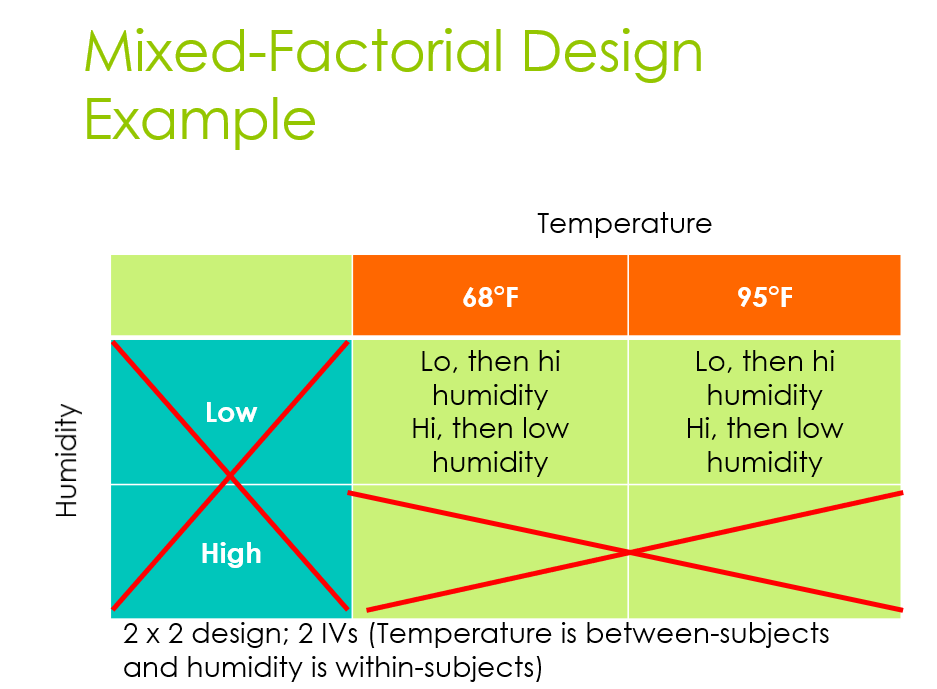
iv. Example 1
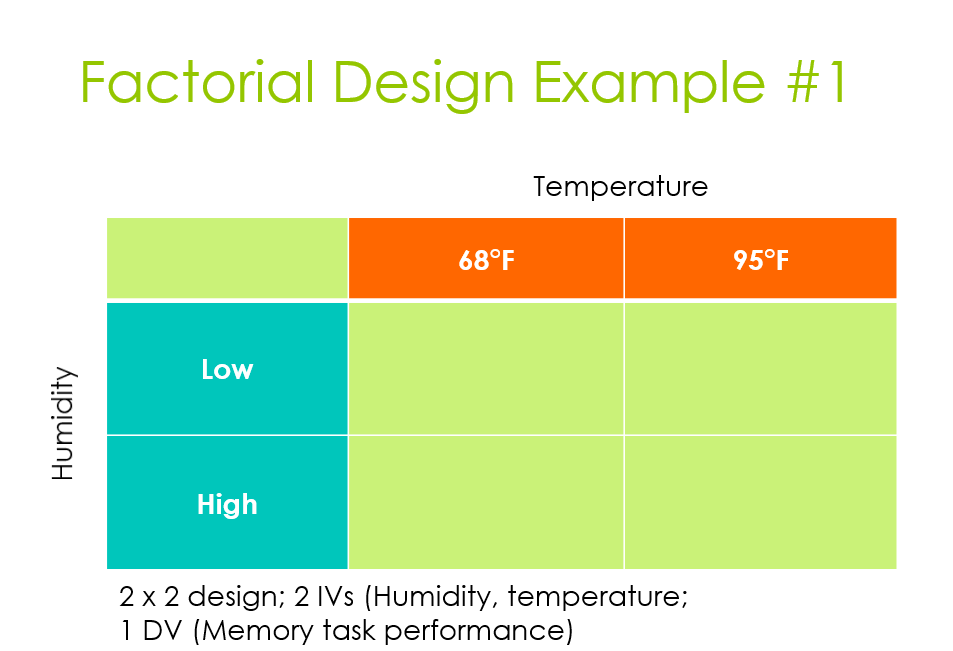
a. Humidity x Temperature
1. 2x2 design; 2 IVs
- Humidity: High & Low
-Temperature: 95F & 68F
2. 1 DV (memory task performance
v. Example 2
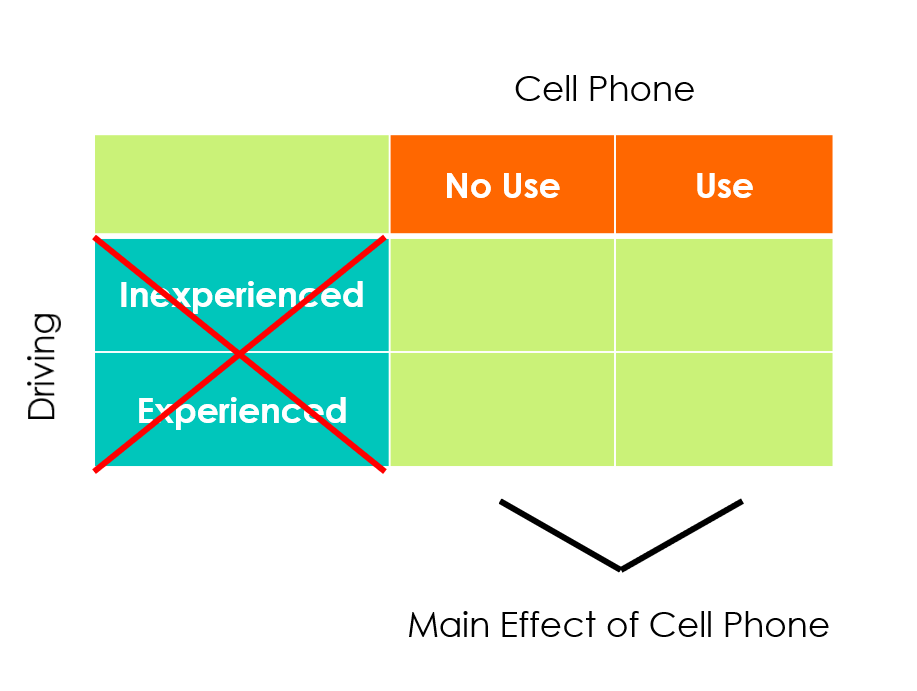
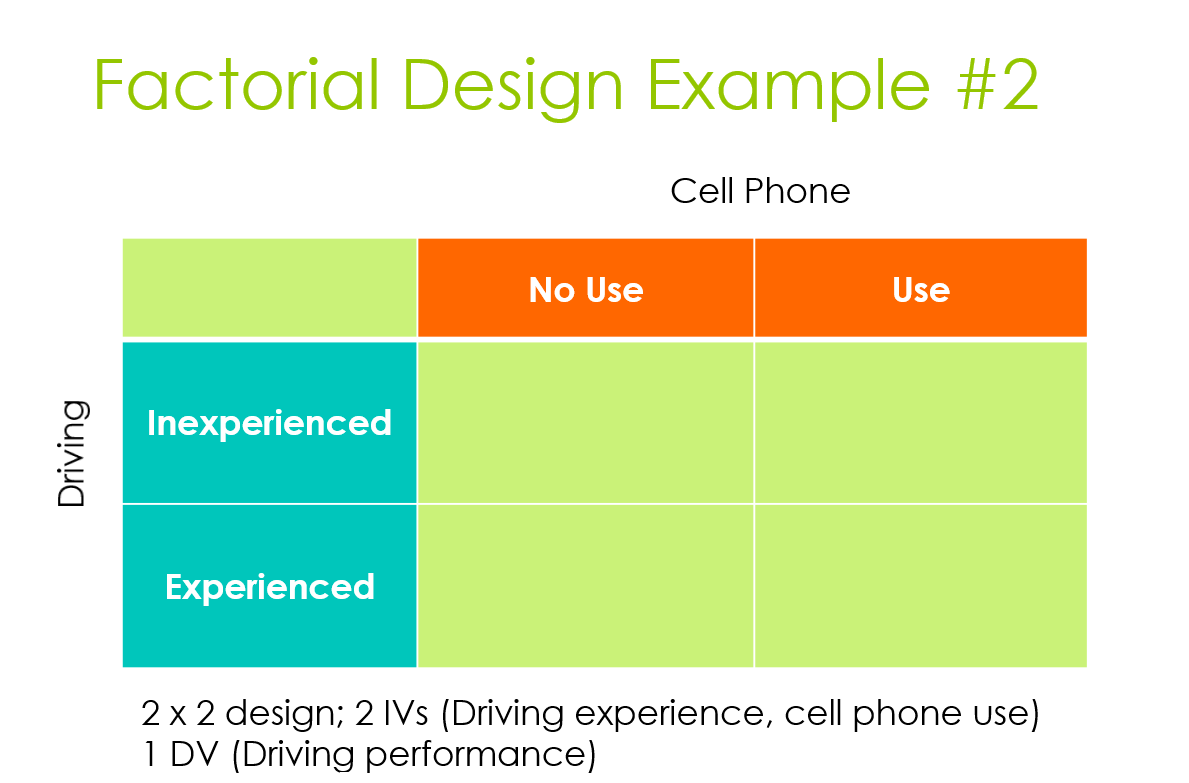
a. Driving x Cells Phones
1. 2x2 design; 2 IVs
- Cell phone: Not use & use
- Driving: Experienced & inexperience *
* A quasi-experimental design because you can’t assign driving experiment
vi. Pros
a. Main effect (* “main effects” is a non-plagiaristic word usable in literature by everyone)
1. This occurs when an IV has an overall effect on a DV
2. Examples
-Main effect for room temp- as room temp changes, this influences task performance
- Main effect for humidity- as humidity changes, this influences task performance
b. Why not just conduct two separate experiments?
1. Study 1: Do inexperienced or experienced drivers drive better?
2. Study 2: Does talking on a cell phone lead to better or worse driving compared to not talking on a cell phone
3. We are interested in the possibility that the two factors interact
-This occurs when the way in which an IV influences behavior differs, depending on the level of another IV
- A factorial design allows us to ask whether cell phone use interacts with driving experience to impact driving
- Factorial design saves time
c. In a factual design there are as many main effects as there RE FACOTS
1. One main effect per factor
d. There are as many interactions as there are potential combinations of the factors
1. 2 factors= 1 interactions (A*B)
2. 3 factors= 4 interactions (A*B, A*C, B*C, A*B*C)
vii. Cons
a. As the number of independent variables and levels of IV’s increases…
1…The total number of conditions in an experiment can rapidly increase beyond manageable proportions
2. Example
-5 temp levels and 5 humidity levels means 25 experimental conditions
viii. Factual Design Options
a. Between-subjects factorial design
1. Each participant engages in only one condition
b. Within- subject factorial design
1. Each subject engages in every condition
c. Mixed-factorial design
1. At least one between-subject variable and at least one within-subject variable is included
2. Simplest
3. Both variables are IVs
4. Example
- It is possible to include quasi-independent variable in mixed-factorial design studies
- Which is the quasi-independent variable?
- IV (between-subject): age (older, younger)
- IV (within-subject): distraction (eyes closed, eyes looking at blank wall, eyes looking at a wall with pictures)
-DV: memory
5. Pros
- Researchers benefit from the strengths of both between-subject and within-subject designs
- Within-subjects part of the study provides less random error than between-subjects only due to:
- Multiple measurement opportunities
- Individual differences are accounted for
- Higher internal and external validity than a within-subject design only
6. Con
- This approach is not appropriate for every question
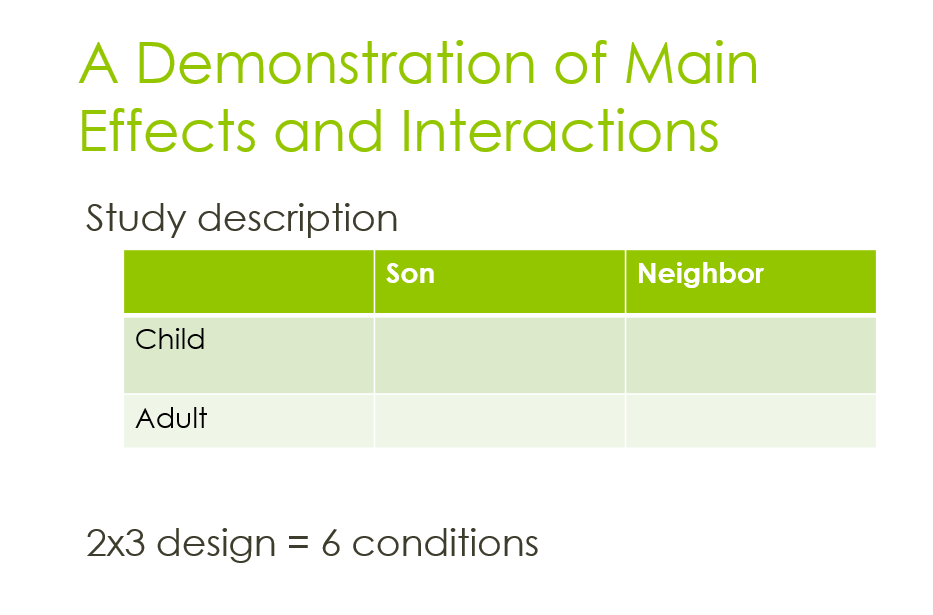
d. A demonstration of Main Effect and Interactions
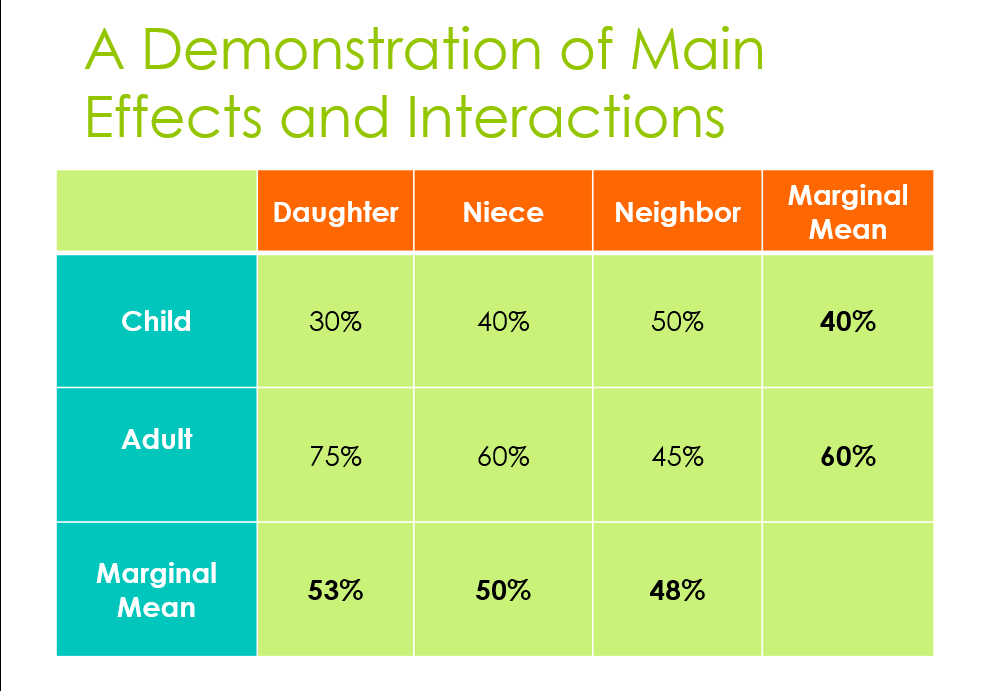
1. Question: Is there a main effect of witness age? (Main effect #1)
2. Question: Is there a main effect of witness-suspect relationship? (Main effect #2)
3. Question: Is there a witness age x witness-suspect relationship interaction? (Interaction)
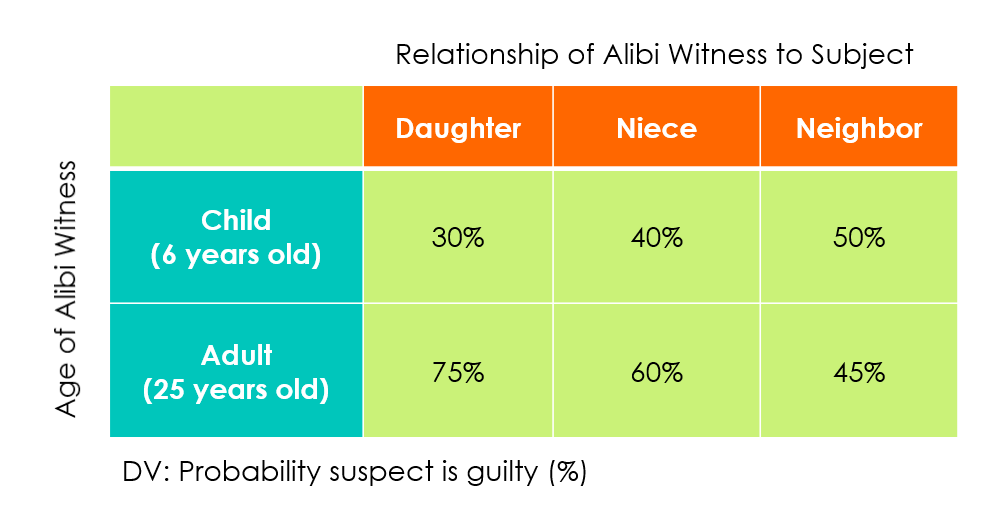
e. A Demonstration of Main Effects and Interactions
1. Question: Is there a main effect of witness age? (Child, Adult)
YES
2. Question: Is there a main effect of witness-suspect relationship? (Daughter, Niece, Neighbor
NO
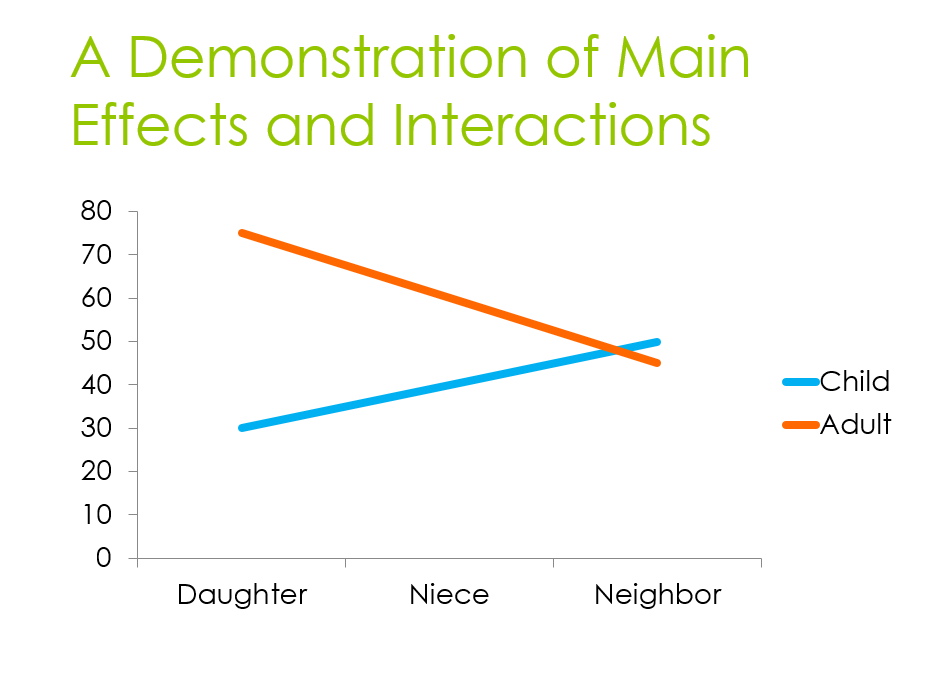
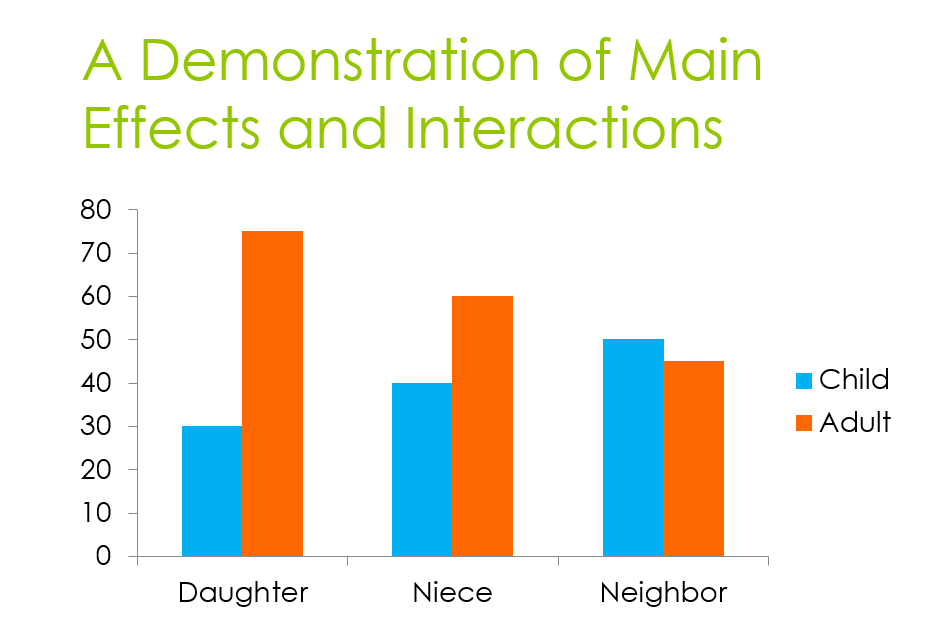
3. Question: Is there a witness age x witness-suspect relationship interaction? (Interaction)
Yes
f. Interpreting the interaction
1. If the witness is a child, the probability that the suspect committed the crime goes down depending on whether the witness is a daughter, niece, or neighbor of the suspect
2. If the witness is an adult, the probably that the suspect committed the crime goes up depending on whether the witness is a daughter, niece or neighbor of the subject
B. The Basics of Single-Subject Designs
i. Information to note
a. Single subject can be more than one person…but the groups are extremely small like only a handful of people
b. Case study doesn't manipulate IV. It is weaker than a single subject
ii. Single-subject designs
a. Research designs that use the results from a single participant to establish the existence of cause-and -effect relationship
b. To qualify as experiments, these designs bust include manipulation of an independent variable and control of extraneous variables to prevent alternative explanations for the research results
c. Often used in applied research, such as a clinician examining the influence of a treatment on a single client
d. Changes in the behavior of a single individual will be examined
e. Cannot compute means or measures of variability, therefore no tests of statistical significance (graphs are used instead)
f. Can be difficult to assess whether changes in behavior are sue to treatment, random chance or extraneous factors.
iii. Phases of single-subject designs
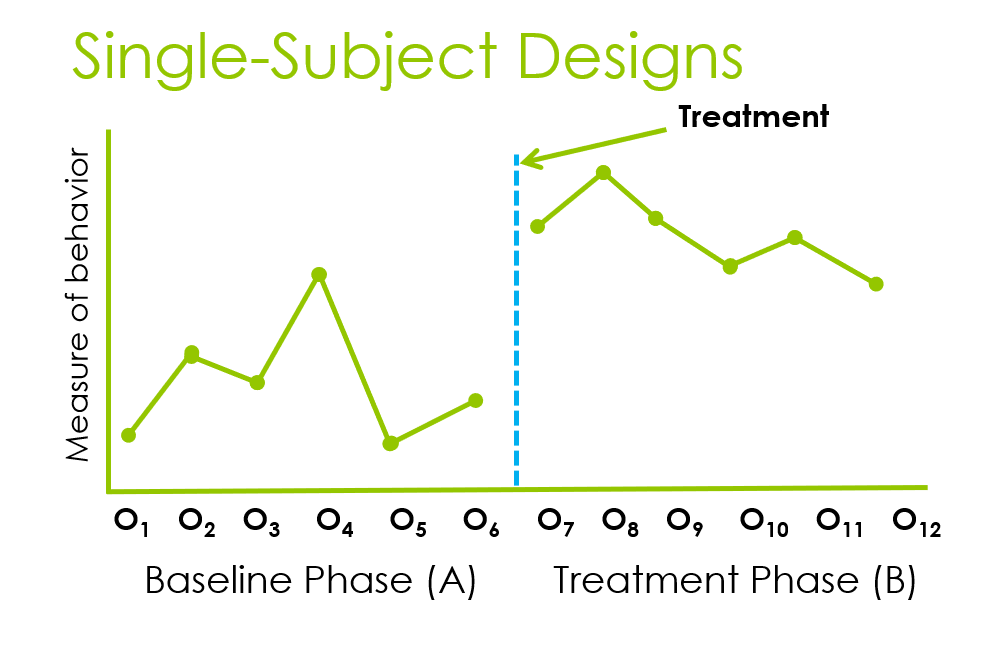
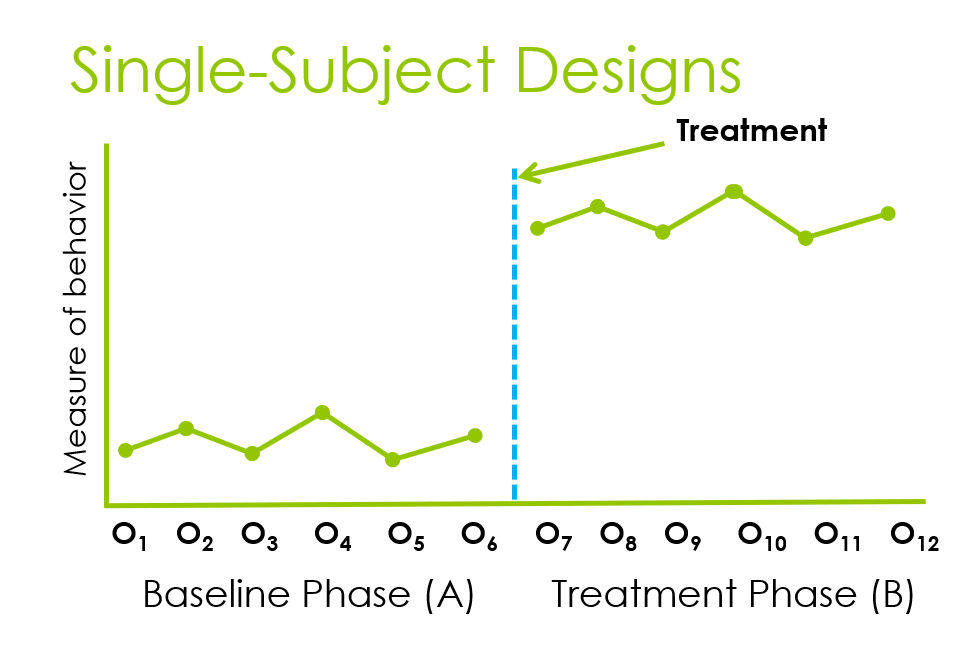
a. Phase: Series of observations of the same individual under the same conditions
1. Baseline phase: series of observations of the same individual when no treatment is being administered.
- Identified by letter A
2. Treatment phase: series of observations of the same individual after a treatment is administered.
-Identified by letter B
- If additional treatments are administered, identified by the next letter (e.g. C, D)
3. Design is referred to by the sequence of phases used- AB, ABAB, ABCAC
b. The purpose of a phase is to establish a clear picture of the participant’s behavior under the specific conditions that define the phase, and then observe how behavior changes with a new phase
1. In particular, researchers look to identify:
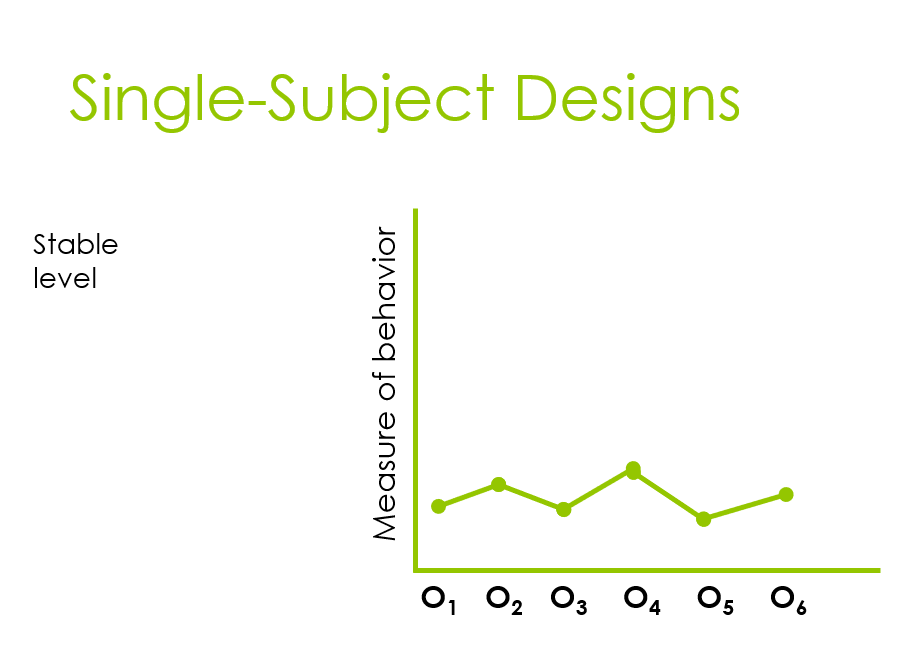
- Stable level: when a series of measurements are appropriately the same magnitude- i.e. all points cluster around a horizontal line
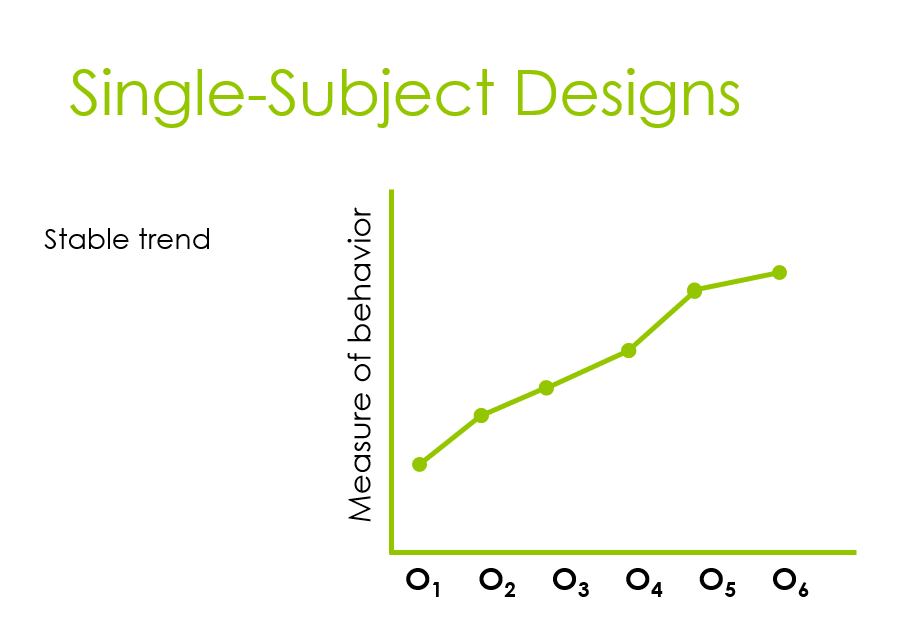
- Stable trend: when the difference from one measurement to the next are consistently in the same direction and are of a similar magnitude- i.e. all points cluster around a sloping line
iv. Unstable data
a. How to deal with unstable data
1. Wait for the data to stabilizer and reveal a clear pattern
2. Average a set of two more observations
- E.g. plotting individual’s behavior averaged across 3 days instead of every day
3. Loot at patterns within the inconsistent
-E.g observing disruptive behavior of student in a classroom, disruptive behavior is grater on days when there is no gym class
v. Phase change
a. A phase change involves changes the conditions under which the participant’s behavior is observed, usually by administering or stopping a treatment
b. When to initiate a phase change
1. In general, phase changes are best initiated when a clear pattern has been detected in the previous phase
c. However…
1. When moving from baseline to treatment, no phase change should be initiated if there is a stable change should be initiated if there is a stable pattern of behavior improvement
- Don’t intervene when it is not necessary to do so
- Cannot draw conclusions about effective of treatment
2. In contrast, if behavior is dangerous or threatening, treatment should be initiated immediately
vi. Visual inspection
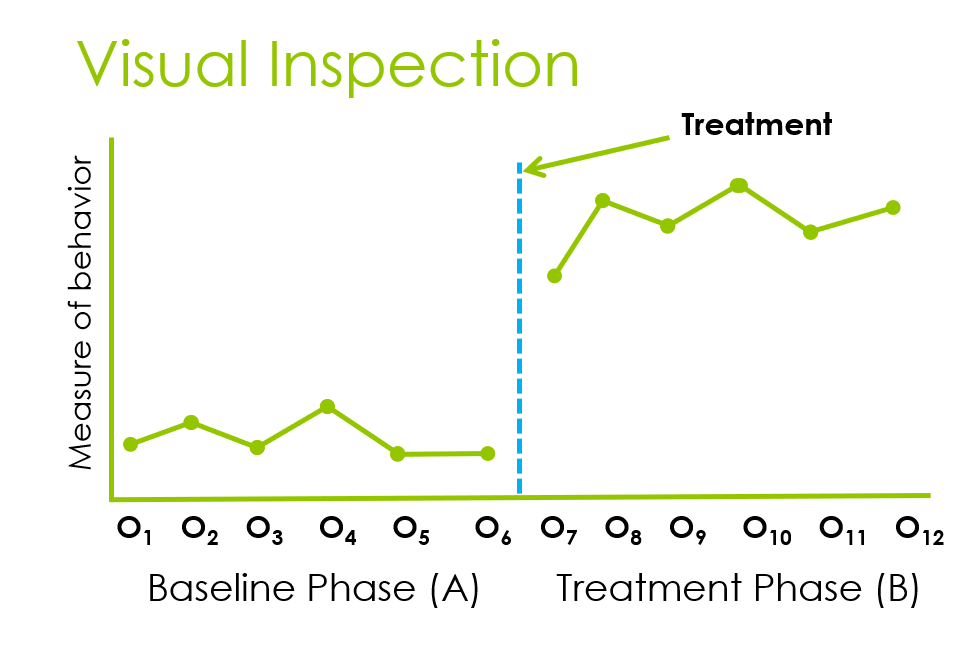
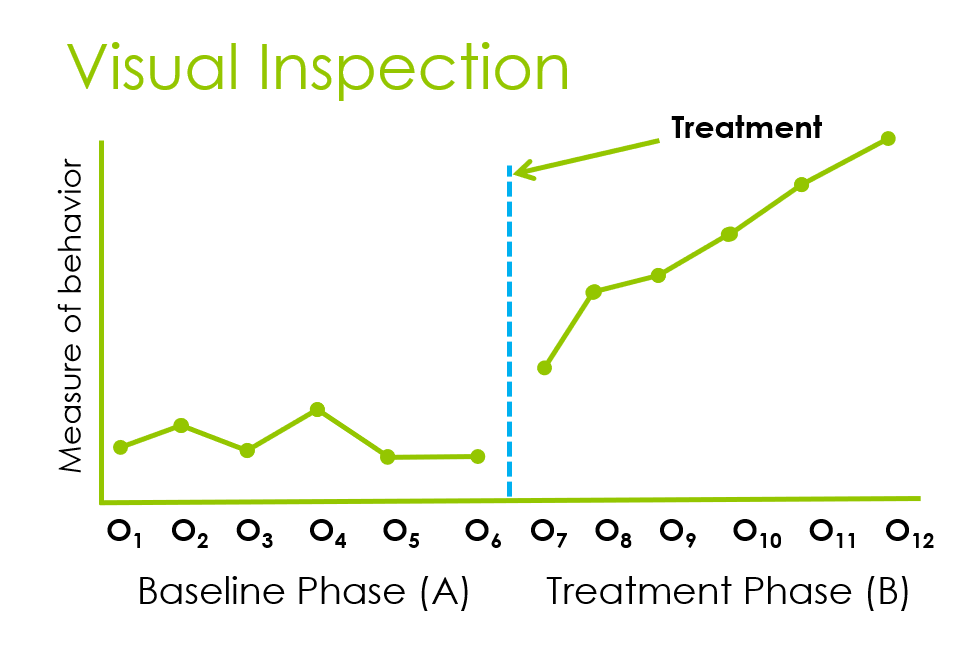
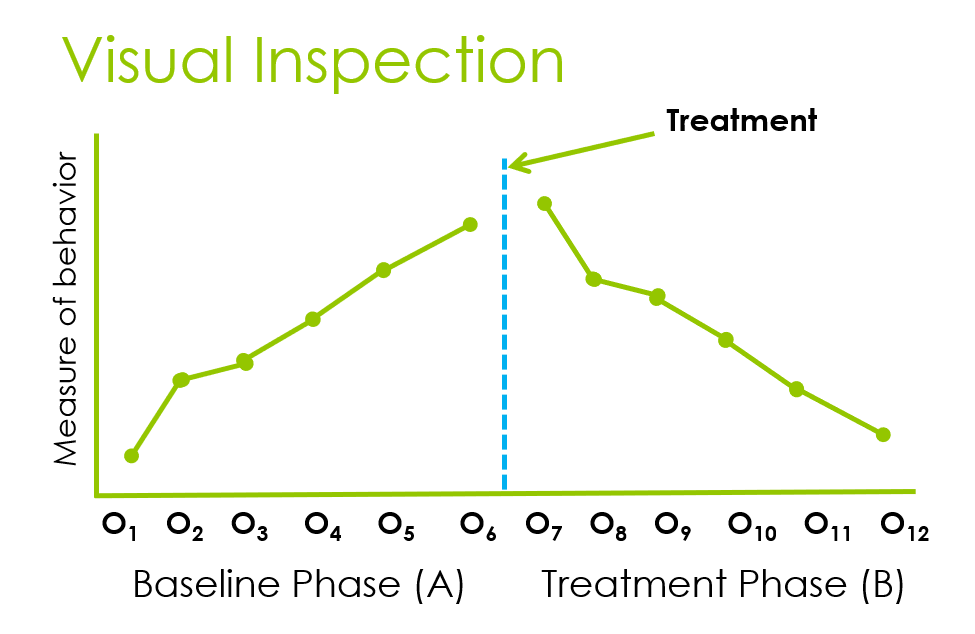
a. Goal of a single-subject design is to observe behavioral changes that correspond to the phase changes. This id done by visual inspection
1. Change in average level
2. Immediate change in level
3. Change in trend
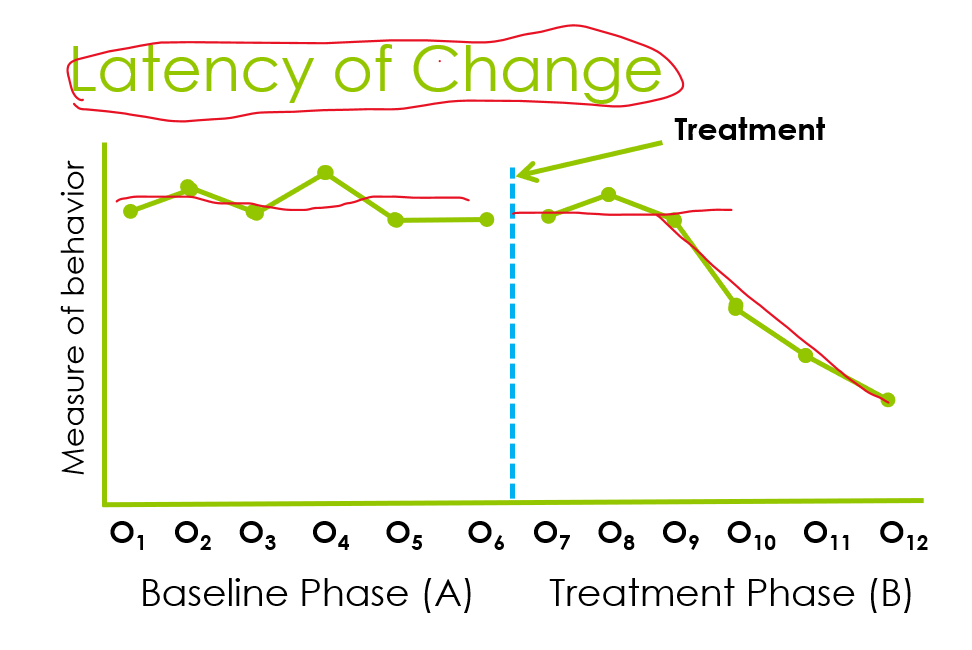
b. Potential difficulty interpreting data when there is a:
1. Latency of change
vii. Pros
a. Cause and effect (BUT with only one participant)
1. High internal validity
b. Everyone received treatment
c. Efficacy of a new treatment
d. Many design options
viii. Cons
a. Continuous observation and measurement are needed
b. Analysis relies on visual inspection rather than statistics
c. Low external validity
C. ABAB (Reversal) Design
i. The purpose of this design is to show that treatment leads to a change in a participant’s behavior
ii. Causal inference is improved if the researcher can demonstrate the ability to turn the behavior “off” and “on” repeatedly
iii. Included four phases:
a. Baseline phase
b. Treatment phase
c. Return to baseline
d. Repetition of treatment
iv. Critique
a. Pro
1. Treatment is brought back after being withdrawn
b. Cons
1. Behavior may not return to baseline when treatment is removed
- The client is “cured” but we do not know why
- It might be unethical to withdraw an efficacious treatment
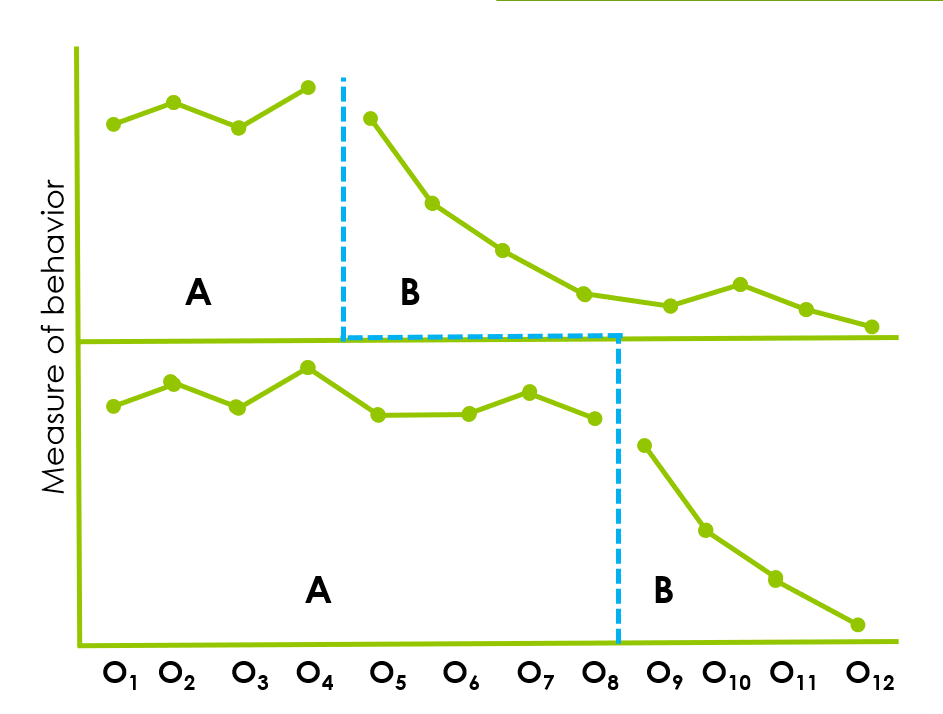
D. Multiple Baseline Design
i. Simple AB design, but:
a. Implemented for two or more participants
b. Phase change occurs at different time points
ii. Pros
a. Demonstrates the effect of treatment at least twice (however many you enroll)
b. Treatment is not removed, so ethical concerns are handled
iii. Cons
a. Some participants will be in the baseline phase longer than others
Information
- Description
- The Basics of Factorial Design
- Created by
- Shelby Klein · Mar 2018
- Updated
- Mar 30, 2018
- Views
- 18
- Rating