
Notes
Nazi Regime
Content of the notes (1)
Page 1
Censorship
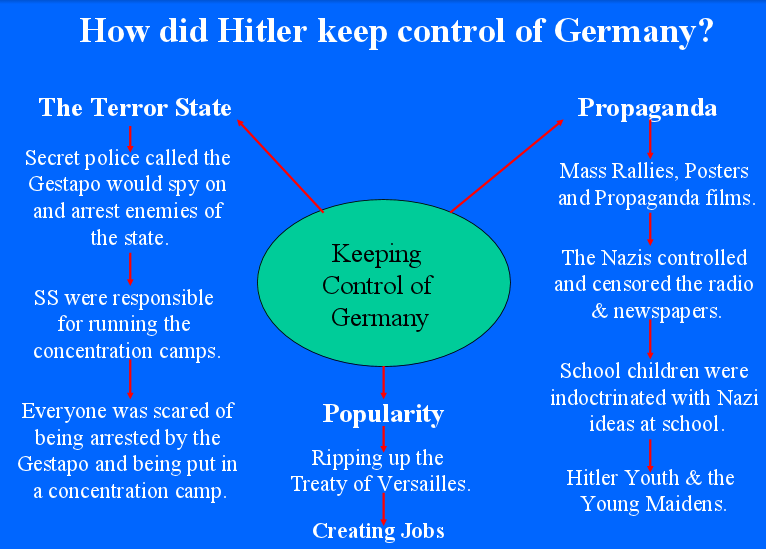
Censorship was enforced by a number of methods.
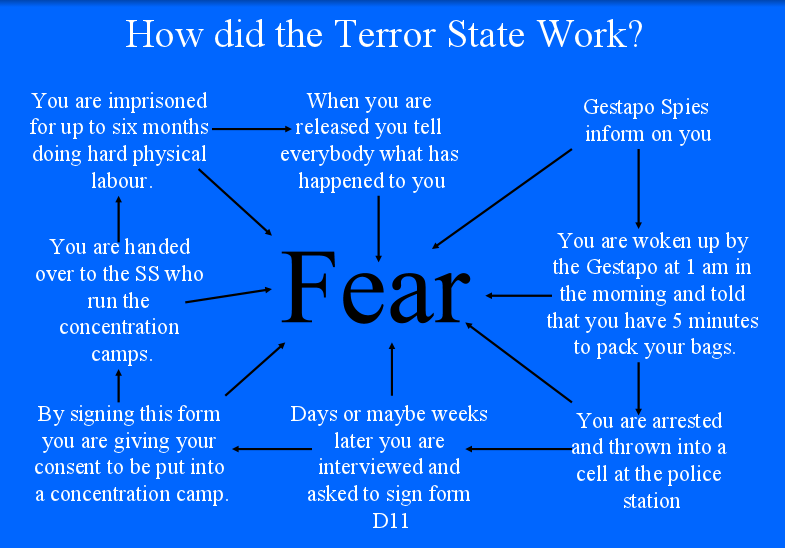
the secret police or the 'normal' police ensured that the rules were kept to.
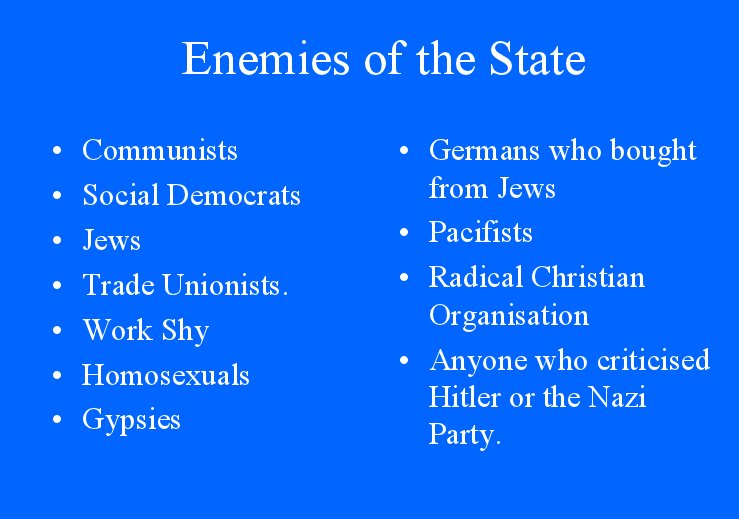
anyone who wanted to go outside of the desired party norm faced the most serious of consequences.
people in general were expected to report anything unacceptable to their local party chief. Those who knew something but did not report it were deemed as guilty as those who went against the system.
Censorship ensured that the Nazis had the German public in their grip as they bombarded them on a daily basis on how their lives had been improved from the day Hitler became Germany's leader.
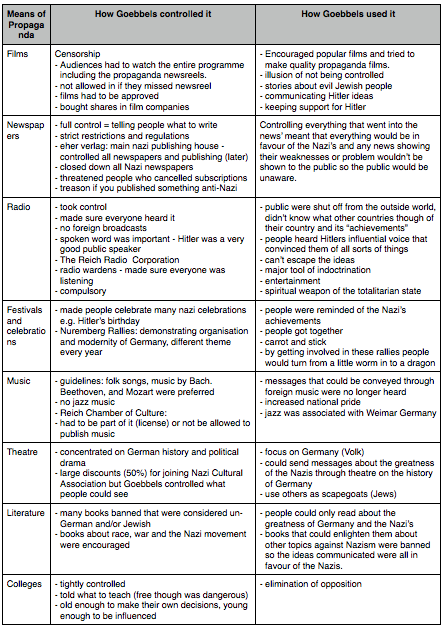
The prime mover in censorship was the Minister of Propaganda, Joseph Goebbels. It was his responsibility to see that the German people were fed with material acceptable to the Nazi state.
Newspapers, radio and all forms of media were put under the control of the Nazis. Even the film industry became controlled by the Nazis where the leading light was Leni Riefenstahl - who, though favoured by Hitler, did not enjoy a good relationship with Goebbels. Music was controlled by the Nazis. Music by Gustav Mahler and Felix Mendelssohn was banned as they were both Jews. Jazz was also banned. Even telling jokes about Hitler became a serious offense - one to send you to the concentration camps and potentially death.
Propaganda
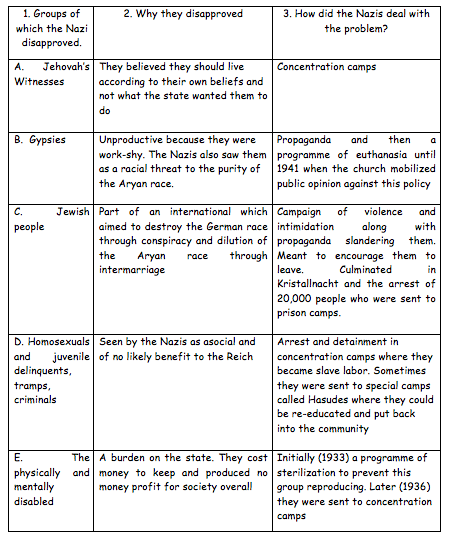
Nazi policies towards:
women
young people
the churches
Jews
J
Jews:
http://www.westexetc.devon.sch.uk/documents/resources/history/ElleM.pdf
(1) The Nazis sought to control young people through the education system:
- They altered the curriculum to encourage the spread of their ideas. With boys this meant an emphasis on physical education and for girls it included needlework and home crafts such as cookery
- New subjects such as racial science were put on the curriculum to ensure that young people had an understanding of the differences between Aryans and the so-called inferior races.
- School teachers had to swear an oath of loyalty to the Fuhrer and were expected to join the Nazi Teachers’ League. Those who did not support Nazi ideals were removed from their jobs.
- Textbooks were rewritten to include Nazi versions of events. In History books the emphasis would be on the unfairness of the Treaty of Versailles and the evils of communism.
(2) The Nazis also wanted to control the young in their spare time.
- formed youth groups designed to ensure that even after school young people were exposed to Nazi ideas.
- Germans boys joined the Hitler Youth and were trained in military activities to prepare them for the army
- German girls joined the League of German Maidens = encouraged to take an interest in domestic tasks
- they were made aware of the importance of physical fitness in preparation for motherhood.
- Both groups encouraged young people to look up to Hitler as the one true leader.
- In 1935 the Nazis made membership of such groups compulsory for all young people.
- Over 1.5 million girls joined the League of German Maidens and there were 2.3 million boys in the Hitler Youth.
(3) Those young people who decided to defy the Nazis faced severe punishments.
- They were targeted and intimidated by members of the Hitler Youth and many were sent to labour camps for re-education.
- The Nazis even executed some members of the Edelweiss Pirates who refused to conform (6 members of this group were hung in 1944).
- Such coercive strategies served as a deterrent for other young people who might have thought of defying the Nazis.
PHASE 1: WORKING WITH THE CHURCHES 1933 – 1935
1) THE CONCORDAT WITH THE CATHOLIC CHURCH - This was signed on June 1933 - Hitler promised that Catholics could carry on their religious work, and that Catholic - In return, the Pope promise the Vatican would stay out of politics.
2) THE REICH CHURCH (ALSO KNOWN AS THE GERMAN CHRISTIANS)
- The Reich Church united all Protestant churches together - It was led by pro Nazi Reich Bishop. - The symbol was a Swastika - The slogan was ‘The swastika on our breast and the cross on our hearts.’
HOWEVER, at the same time that the Nazis were cooperating with both the Catholic and the Protestant Churches, they also started their own religion which was intended to replace Christianity. This was called the GERMAN FAITH MOVEMENT and its followers were known as NEO-PAGANS.
- What type of worship did it promote?
- Describe the flag of the movement.
- Read the sources and describe a service within this religion. schools and youth groups would be left alone.
Pagan-style worship.
It was a golden sun an a blue background, often with a swastika attached. Marriage Ceremony: the Church and Nazis controlled the marriage, there was ‘a yellow sun discs made of flowers on a blue background.’ There were German songs and music were played. The pair were ‘offered bread (representing germinating force of earth) and salt (the symbol of purity) on silver vessels.
PHASE 2: ATTACKING THE CHURCHES – 1935 + (p. 98)
After 1935, when the Nazis were more securely established, they started to attack and control the Churches.
TASK: Create a more succinct version of the timeline on p.98. Also add the following events: 1935- Hitler set up a new Department for Church Affairs to control the churches. The Festapo arrested 700 Protestant ministers who were opposed to the Nazis.
1936- the Reich Church dropped the cross and the Bible and instead has the swastika and a copy of Mein Kampf on the altar
1936- The Nazis ran campaigns pressuring students not to attencd Church youth groups. Hundreds of priests and nuns were taken to court and charged with offences ranging from illegal currency to homosexuality. 1937- the Concordat with the Catholic Church ends and the Pope publicly expresses doubt about the Nazis 1937-Christmas carols and nativity plays banned from school. 1938- Priests were stopped from teaching religious classes in schools.
1
1939- All church schools were ended/abolished.
Some Christian leaders became public critics of the regime.
TASK (p. 96-97): Pick ONE Protestant leader and ONE Catholic leader. For each one, write a
brief biography, explaining what they opposed about the Nazis and how they showed their
opposition.
Martin Niemöller
A WWI hero he had won Germany’s highest decoration of bravery. In the 1930s, he became the
most prominent critic on the Nazis. He despised all Nazis and the ‘German Christians’. He was
put in a concentration camp. Hitler ordered his death at the end of the war, but he surviced.
Cardinal Galen
Publically attacked the Nazi policies in the beginning of 1934. In 1941, he revealed that the
Nazis wer secretly killing mentally and physically handicapped people and led a campaign
against Hitler. As The Nazi Party did not wish to make Galen a matyr, they made no comments
against this accusation, however 3 priests were killed while distributing Galen’s sermons to
soldiers. Hitler wished for Goebbels to hand Galen however, Goebbels refused.’
HOW SUCCESSFUL WAS THE NAZI POLICY TOWARDS THE CHURCHES?
It is difficult to say how successful the Nazi policy towards the churches was as their aims were so contradictory and inconsistent.
TASK: Look at the statistics at the bottom of p.98. Explain how these statistics suggest that it wasn’t very successful.
The Nazi policy wasn’t successful as still many people considered themselves to be Protestant, 42,636,000 people, and only 2,746,000 people considered themselves to be the ‘German Christians’, or the Neo-pagan. Although the number of neo-pagans are higher then the Roman Catholics, we can tell, that the Protestants still strongly believe in their faith, although the Roman Catholics don’t. From this we can tell that still many believed in their original faith, rather then the Nazi faith.
http://www.st-dunstans-school.org.uk/docs/KS4_Coursework_Controlled_Assessment/History/Unit_2-German...
Censorship and Propaganda
Police/Terror State
Nazi Policies
Economic Policies
Youth
Information
- Description
- IGCSE History (Germany) Note on Nazi Regime, created by ShreyaDas on 09/04/2014.
- Created by
- ShreyaDas · Apr 2014
- Updated
- Sep 28, 2016
- Views
- 720
- Tags
- Rating