
Notes
Module B: Speeches (The Rhetorical Triangle)
Content of the notes (1)
Page 1
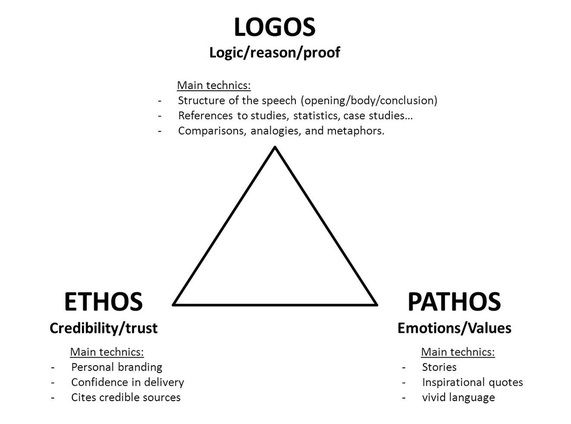
The Rhetorical Triangle: Speeches
Logos: The appeal to reason
Consistency and clarity to the logic of reasons
Cause and effect
Deductive reasoning from principles
Inductive reasoning from experience
Contradictions
Ethos: The persuasive appeal of one’s character
Credibility through tone and style
Persuasion through credibility
Trustworthiness
Similarity with audience and their values
Special/expert knowledge
Pathos: The appeal to emotion
Grabs people’s emotions by manipulating listeners with a combination of concrete information and emotive examples, or phraseology.
Appeals to negative emotions (fear, discrimination, revenge)
Appeals to positive emotions (love, charity, brotherhood, justice)
Use of figurative speech (metaphors, rhetorical questions, parallelism)
Construction:
Introduction (drawing the initial interest)
Narration (defines the problem)
Confirmation (details about the arguments)
Refutation (addresses counter arguments and considers the audience)
Conclusion (satisfying close)
New Page
Information
- Description
- Secondary Advanced English (Module B: Speeches) Note on Module B: Speeches (The Rhetorical Triangle), created by Hunter Lynch on 26/06/2014.
- Created by
- Hunter Lynch · Jun 2014
- Updated
- May 28, 2016
- Views
- 387
- Tags
- Rating