
Essay 3: action potentials
Slides in this set (12)
-
- Caption: Amelia Reece - UoL - Brain, behaviour and Cognition
-
- Some atoms have an electrical charge, when they move they carry electricity with them
- A nerve impulse is a sequence of small movement of these charged atoms into and out of the nerve cell - more precisely a nerve impulse is actually a sequence of small movements of atoms into and out of the axon of the neuron. each movement is an action potential
- The first small movement triggers the second, the second triggers the third, etc.
- Sodium (Na+) Potassium (K+)
-
- Sodium has a positive electric charge and inside the axon is a strong negative charge
- atoms normally have the same number of positively charged protons and negatively charged electrons
- if it loses an electron it becomes overall more positive
- if it gains an electron it becomes overall more negative
- inside the axon is a strong negative charge ( opposites attract)
- there are two positive forces that make these electrically charged atoms (ions) move
- electrostatic pressure - the negative charge inside the cell attracts all positively charged atoms into the cell and repels all negatively charged atoms into the cell
- pressure from the concentration gradient - atoms move from a location of high concentration to an area of low concentration
- Despite the pressure, sodium does not automatically enter the cell because the channels may not be open
- this is the state of the neuron during the resting potential sodium channels are almost shut
-
- Despite the electrostatic pull on the positively charged potassium atoms (Na+) to enter the neuron, the concentration inside is so great that it overwhelms this
- therefore the overall pressure on potassium atoms is to move out of the cell
- this does not happen automatically because the potassium channel may also be shut
- this is the state of the neuron during the resting potential channels are almost shut
-
- there is a great pressure on k+ atoms to exit the cell
- There is a great pressure on Na+ atoms to enter the cell
- They do this with difficulty because of the channels through the membrane are almost shut
- Despite this a few passes through
- the sodium-potassium pump fixes this and keeps the concentrations constant
- the sodium-potassium pump moves 3 sodium ions out and moves 2 potassium ions
-
- The pressure from the concentration gradient can be measured
- the pressure from the electrostatic force can be measured
- For chloride (Cl-) the two pressures are equal
- This is the state of the neuron during the resting potential sodium channels are open
-
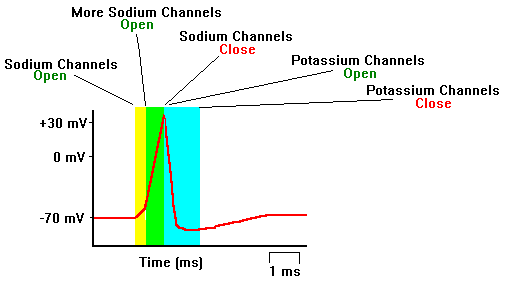
- The threshold of excitation (-70 microvolts to -50mv)
- sodium channels open
- sodium rushes in = +50mv
- potassium rushes out
- sodium channel closes, potassium still comes in
- potassium channel closes
-
- A neuron can be 'quiet' in a resting state.
- - the resting membrane potential
- A Neuron can be active in an active state
- - an action potential - firing
-
The Resting Membrane Potential
- using an electrode to measure the membrane potential of a neuron reads -70v
- the inside of the neuron is more negative than the outside and vice versa
- the resting membrane potential has different concentrations of ions inside and outside the neuron
- it takes a lot of hard work to maintain the RMP
- bow and arrow analogy - at rest it is like a taut bow - ready to fire, resting is a misnomer
- there are more Na+ ions outside the cell
- there are more k+ ions inside the cell
- the inside of the cell has large -ve charged protein molecules. that's why it's negative
- 3 forces/pressures act to maintain the unequal distribution of ions in the resting membrane potential
- electrochemical pressure
- concentration gradient
- sodium potassium pump
-
Resting Membrane Potential Ionic Basis
- salts in a solution exist as negative and positive ions - positive cations and negative anions
- atoms normally have the same number of positively charged protons and negatively charged electrons
- if it loses an electron it becomes overall positive and vice versa
-
- Two passive forces 'work' on these ions
- electrostatic pressure - the negative charge inside the cell attracts cations - positive ions into the cell
- the negative charge inside the cell repels all negatively charged atoms in the cell
- pressure from the concentration gradient
- - ions move from a location of high concentration to an area of low concentration
- One active force 'works' on these ions
- Sodium-potassium pump. there is a great pressure on Na+ atoms to enter the cell. there is great pressure on k+ atoms to exit the cell. they do this with difficulty because of the channels through the membrane are almost shut. despite this, a few pass through. for every 3 Na+ ions that are moved out, 2 K+ ions are moved in. this takes a lot of energy. there is great pressure for Na+ ions to 'flood' into the neuron and for K+ ions to rush out (pulling the bow taut)
-
- the threshold of excitation (-70 to -50mV), sodium channels open, Na+ rushes in = + 50mV, k+ ions rushes out, sodium channel closes k+ ions still comes in. potassium channel closes
- polarized - the neuron in the resting membrane potential -70mV
- depolarized - in the action potential +50mV
- repolarized back to - 70 mV
- hyperpolarized drops below -70mV
Information
- Description
- reading: Pinel and Barnes, chapter 4
- Created by
- Liv Miles · Apr 2018
- Updated
- Apr 25, 2018
- Views
- 55
- Tags
- Rating