
Notes
IB Biology Year 2 Metabolic Processes Unit
Content of the notes (1)
Page 1
Chemical Fundamentals:
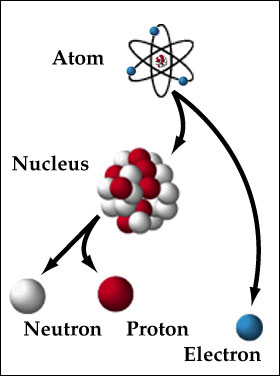
Structure of an Atom
Protons: Positive subatomic particles in the nucleus
Neutrons: Neutral subatomic particles in the nucleus
Electrons: Negative subatomic particles floating outside the nucleus
Isotopes: Are atoms with the same atomic number but different mass
Uses of Radioisotopes
Radioactive Tracers: Follow chemicals through chemical reactions to trace their path as they move through cells and bodies of organisms.
Smoke Detectors: Americium
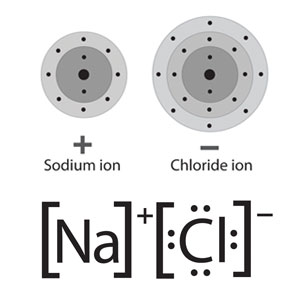
Formation of Ionic Bonds
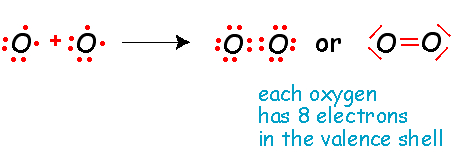
Formation of Covalent Bonds
Electronegativity & Polarity

Water
-------------------------------------------------------------------------------------------------------------------------------------------------------------
|
|
|
|
|
|
|
|
|
|
|
|
|
|
|
|
|
|
|
|
|
|
|
|
|
|
|
|
|
|
|
|
|
|
|
|
Versatile Solvent: Due to its polarity and the dipole between hydrogen and oxygen allows it to dissociate ionic compounds as well as dissolve most covalent molecules. Water only rejects non-polar substances like oils and gasoline.
Cohesive: Water molecules form hydrogen bonds with each other which creates high surface tension, this enables water striders to walk across ponds.
Adhesive: Water molecules form hydrogen bonds with other polar molecules which results in capillary action, whcih allows water to creep up a narrow glass tube and paper.
High Specific Heat Capacity: Hydrogen bonding causes water to absorb a large amount of heat before its temperature increases and causes it to lose large amounts of heat before its temperature decreases significantly which results in temperature moderation and helps keep lake cities like Kingston moderately warm.
High Specific Heat of Vapourization: Hydrogen bonding causes liquid water to absorb a large amount of heat to become a vapour which causes evaporative cooling which makes many organisms dissipate body heat by evaporation of water from our skin by sweating.
Highest Density at 4 Degrees Celsius: As water molecules cool below 0 degrees celsius they form a crystalline lattice and the hydrogen bonds create v-shaped molecules which spread the moleules apart reducing the density below that of liquid water which is why ice floats on liquid water and is a reason why fish and other aquatic organisms are able to survive in winter.
-------------------------------------------------------------------------------------------------------------------------------------------------------------
|
|
|
|
|
|
|
|
|
|
|
|
|
|
|
|
|
|
|
|
|
|
|
|
|
|
|
|
|
|
|
|
|
|
|
|
Intermolecular Forces
London Dispersion Forces: Temporary electron clouds of dipole-dipole (Non-Polar)
Dipole-Dipole: Definitive partial positive and partial negative ends
Hydrogen Bond: Dipole-dipole with Hydrogen as a partial positive and (N,O,F) as a partial negative
---------------------------------------------------------------------------------------------------------------------
---------------------------------------------------------------------------------------------------------------------
---------------------------------------------------------------------------------------------------------------------
---------------------------------------------------------------------------------------------------------------------
Acid Vs Base
Acid: Universal Proton Donor
Base: Universal Proton Acceptor
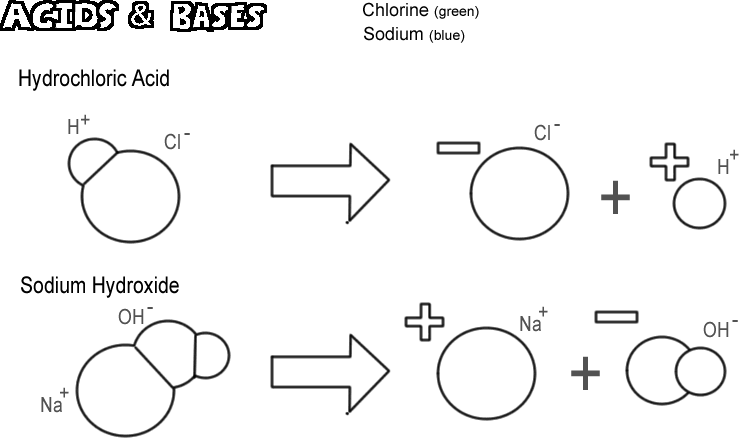
Strong Acids: Ionize a lot more than weak acids (dilution has nothing to do with it)
Strong Bases: Dissociates a lot more than weak bases
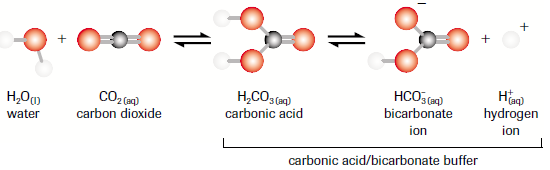
Acid-Base Buffers
Chemicals systems containing a substance that can donate H+ Ions when they are required an containing a substance that can remove H+ ions when there is too much
----------------------------------------------------------------------------------------------------------------------------------------------
----------------------------------------------------------------------------------------------------------------------------------------------
|
|
|
|
|
|
|
|
|
|
|
|
|
|
|
|
|
|
|
|
|
|
|
|
|
|
|
|
|
|
|
|
|
|
|
|
Chemicals of Life:
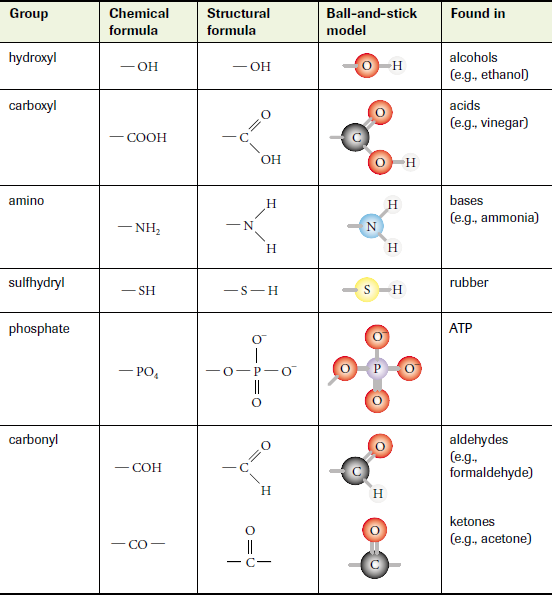
Functional Groups
Macromolecules
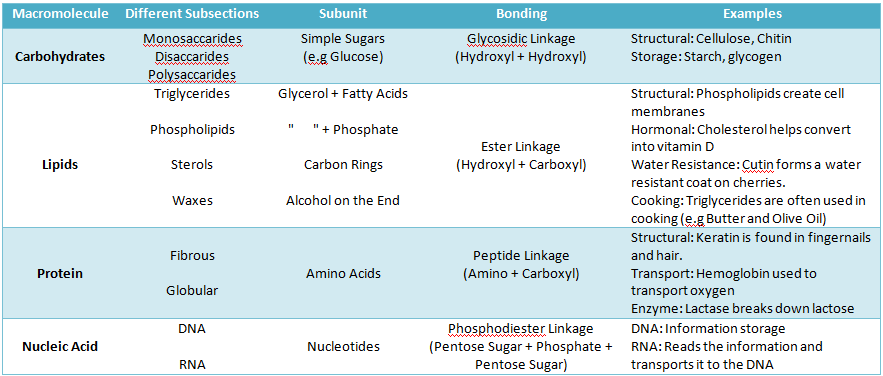
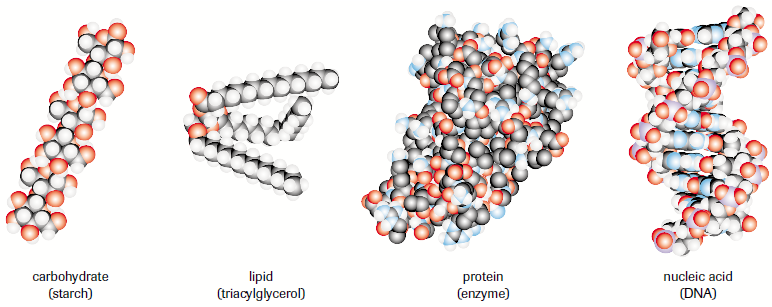
Large molecules sometimes composed of a large number of repeating subunits.
Macromolecules
perform most of the essential processes in biology including energy storage,
structural support, enzymatic catalysis and reproduction
Macromolecules
are made up of monomers put together,
often in repetition
Macromolecules
are built up through anabolic reactions involving the removal of a water
molecule (dehydration synthesis)
Carbohydrates
Definitions
Dehydration Reaction: A reaction that creates a covalent bond between two interacting subunits and a water molecule
Hydrolysis Reaction: A catabolic reaction in which a water molecule is used to break the covalent bond holding subunits together
Anabolic Reaction: A reaction that produces larger molecules from smaller subunits
Catabolic Reaction: A reaction that breaks down macromolecules into constituent individual subunits
Carbohydrates are used by organisms as sources of energy, as building materials, and as cell surface markers for cell-to-cell identification and communication.
Empirical Formula: CH2O
Molecules
|
|
|
|
|
|
|
|
|
|
|
|
|
|
|
|
|
|
|
|
|
|
|
|
|
|
|
|
|
|
|
|
|
|
|
|
|
|
|
|
|
|
|
|
|
----------------------------------------------------------------------------------------------------------
----------------------------------------------------------------------------------------------------------
----------------------------------------------------------------------------------------------------------
Chemical Fundamentals
Chemicals of Life
Information
- Description
- IB Biology Year 2 (Unit 1: Functional Groups/Macromolecules/Cell Structure) Note on IB Biology Year 2 Metabolic Processes Unit, created by brandon.hoon.lee on 21/09/2013.
- Created by
- brandon.hoon.lee · Sep 2013
- Updated
- Jan 16, 2017
- Views
- 964
- Tags
- Rating