
Mind map
Unit 3
Map content
Unit 3
CH 11: Sexual Reproduction and Meiosis
- SEXUAL LIFE CYCLES
- HAPLOID
- HAPLOID CELLS
- 1 copy of each chromosome
- GAMETES
- HAPLOID CELLS
- DIPLOID
- DIPLOID CELLS
- 2 copies of each chromosome
- GERMLINE CELLS
- undergo meiosis and reduce chromosome from 2n to 1n into gametes
- ZYGOTE
- undergoes mitosis to continue to produce diploid cell
- to become a viable organism/offspring; needs to get bigger thru mitosis (growth)
- in most animals diploid dominates
- DIPLOID CELLS
- HAPLOID
- SEXUAL REPRODUCTION
- meiosis and fertilization constitute a cycle of reproduction
- inherit 23 chromosomes from both parents
- MOTHER
- MATERNAL HOMOLOGUE
- EGG
- XX
- FATHER
- PATERNAL HOMOLOGUE
- SPERM
- XY
- male sperm determines gender of offspring
- MOTHER
- sperm and egg fuse for fertilization to take place resulting in a zygote
- FERTILIZATION restores diploid # (1n plus 1n equals 2n)
- MEIOSIS
- 2 ROUNDS OF DIVISION
- MEIOSIS I
- PROPHASE I
- chromosomes condense, nuclear envelope disappears, spindle apparatus forms, synapsis, crossing over
- SYNAPIS
- homologous chromosomes become closely associated
- CROSSING OVER
- genetic material exchange
- allows for genetic variety
- genetic material exchange
- SYNAPIS
- chromosomes condense, nuclear envelope disappears, spindle apparatus forms, synapsis, crossing over
- METAPHASE I
- chiasmata hold homologues together, homologues align at metaphase plate, spindles attach to homologues
- ANAPHASE I
- chiasmata break, chromosomes pulled to opposite poles (each pole has complete haploid), separates homologues
- TELOPHASE I
- nuclear envelope reforms, sister chromatids not identical (diversity)
- PROPHASE I
- MEIOSIS II
- PROPHASE II
- chromosomes
- METAPHASE II
- ANAPHASE II
- TELOPHASE II
- 4 daughter cells (1 copy of each chromosome)
- PROPHASE II
- MEIOSIS I
- ERRORS OF MEIOSIS
- ANEUPLOID GAMETES
- missing or extra chromosomes in gametes
- NONDISJUNCTION
- genetic disorder, too many or too less chromosomes
- ANEUPLOID GAMETES
- MEIOSIS FUNCTION
- production of gametes
- mitosis function is growth and repair
- MEIOSIS FEATURES
- (compare mitosis and meiosis)
- synapsis + crossing over
- sister chromatids joined in meiosis I
- kinetochores of sister chromatids attach to same pole
- DNA replicating suppressed
- independent assortment
- 2n to 1n
- also referred to as REDUCTION DIVISION
- chromosome #s reduce, divides cell into four daughter cells
- 2 ROUNDS OF DIVISION
- SEXUAL LIFE CYCLES
CH 12: Patterns of Inheritance
- PRINCIPLE OF INDEPENDENT ASSORTMENT
- PRINCIPLE OF SEGREGATION
- 2 alleles for a gene segregate during gamete formation (meiosis)
- rejoined at random, one from each parent, during fertilization
- 2 alleles for a gene segregate during gamete formation (meiosis)
- in dihybrid cross, alleles for each gene assort differently
- traits separate independently in gamete formation
- PRINCIPLE OF SEGREGATION
- EPIGENTICS
- EPISTASIS
- behaviour of gene products change ratio
- how genes react w/ other molecules
- EPISTASIS
- POLYGENIC INHERITANCE
- PLEIOTROPHY
- GENE
- ALLELE
- DIHYBRID CROSS
- MONOHYBRID CROSS
- *punnet square
- F1 GENERATION
- F2 GENERATION
- breed F1 offspring
- offspring in first cross
- F2 GENERATION
- two traits; four outcomes ---> 16 outcomes
- MONOHYBRID CROSS
- different forms of the same gene
- DIHYBRID CROSS
- segment of DNA found on chromosome, codes for protein
- ALLELE
- GENE
- DOMINANT
- INCOMPLETE DOMINANCE
- CODOMINANCE
- heterozygote shows both traits (co means with)
- RECESSIVE
- masked by dominant allele
- HOMOZYGOUS RECESSIVE
- HOMOZYGOUS DOMINANT
- HETEROZYGOUS
- GENOTYPE
- PHENOTYPE
- physical characteristic
- genetic makeup
- PHENOTYPE
- GENOTYPE
- HETEROZYGOUS
- HOMOZYGOUS DOMINANT
- blend, alleles do not mask eachother
- CODOMINANCE
- dominant allele masks recessive allele
- INCOMPLETE DOMINANCE
- PLEIOTROPHY
- PRINCIPLE OF INDEPENDENT ASSORTMENT
CH 13: Chromosomes, Mapping, and the Meiosis-Inheritance Connection
- SEX LINKAGES
- sex linked conditions reside on X or Y chromosome
- certain genetic disease affect males to a greater degree than females
- X CHROMOSOME
- is larger than Y chromosome
- more sex linked conditions because it's bigger
- in FEMALES, one X chromosome is inactivated
- carries essential genes
- GENETIC MOSAICS
- Y CHROMOSOME
- smaller than X chromosome, not a lot of info
- CHROMOSOME THEORY EXCEPTIONS
- GENOMIC IMPRINTING
- "Which parent contributed the alleles?"
- SEX LINKAGES
CH 14: DNA: The Genetic Material
- DNA STRUCTURE
- DNA is a nucleic acid
- nucleic acid is made up of NUCLEOTIDES
- NUCLEOTIDES
- are made up of:
- DEOXYRIBOSE
- PHOSPHATE GROUP
- NITROGENOUS BASE
- PURINES
- Adenine and Guanine
- PYRIMIDINES
- Thymine and Cytosine
- Uracil (RNA)
- COMPLEMENTARY BASE PAIRING
- A to T
- AMOUNT OF A = AMOUNT OF T
- G to C
- AMOUNT OF G = AMOUNT OF C
- A to T
- HYDROGEN BONDS joins nitrogenous bases
- "easy to make, easy to break"
- PURINES
- are made up of:
- PHOSPHODIESTER BONDS
- joins two nucleotides
- NUCLEOTIDES
- nucleic acid is made up of NUCLEOTIDES
- DNA is a double stranded molecule
- "COOLING STRAND"
- "TEMPLATE STRAND"
- *template means pattern
- used to make mRNA
- DNA is a nucleic acid
- CELLS REPLICATE DNA TO REPRODUCE
- DNA is replicated during SYNTHESIS
- DNA is made in 5 PRIME TO 3 PRIME direction
- DNA POLYMERASE
- ENZYMES RESPONSIBLE FOR MAKING DNA
- DNA STRUCTURE
CH 15: Genes and How They Work
- CENTRAL DOGMA OF BIOLOGY
- information flows in one direction
- DNA ---> RNA
- RNA ---> PROTEIN
- EXCEPTION:
- RETROVIRUSES use the enzyme, REVERSE TRANSCRIPTASE to convert RNA to DNA
- information flows in one direction
- PROTEIN SYNTHESIS
- TRANSCRIPTION
- RNA POLYMERASE
- used to make RNA
- NOT a good proofreader
- used to make RNA
- RNA POLYMERASE
- TRANSLATION
- tRNA, TRANSFER RNA, transfers amino acids to ribosomes
- RIBOSOMES: site of protein synthesis
- ribosomes are made of two subunits
- peptide bond forms between amino acids on protein
- RIBOSOMES: site of protein synthesis
- tRNA, TRANSFER RNA, transfers amino acids to ribosomes
- IMPORTANT FOR PROTEIN SYNTHESIS:
- mRNA
- tRNA
- rRNA
- TRANSCRIPTION
- DIFFERENCES IN RNA AND DNA
- RNA
- single stranded
- A-U
- ribose
- A-U
- single stranded
- DNA
- double stranded
- A-T
- deoxyribose
- A-T
- double stranded
- RNA
- CODONS
- STOP CODONS
- terminates translation; stops process
- UUA, UGA, UAG
- terminates translation; stops process
- START CODONS
- start of translation
- AUG
- start of translation
- a codon is 3 NUCLEOTIDES in a row
- code is degenerate; multiple codons code for the same amino acid
- "WOBBLE EFFECT"
- mutation of the third nucleotide does not affect amino acid
- STOP CODONS
- MUTATIONS
- POINT MUTATION
- alters a single base, can be SPONTANEOUS or INDUCED
- SPONTANEOUS MUTATIONS
- cause: DNA polymerase proofreads incorrectly
- INDUCED MUTATIONS
- cause: radiation, chemicals
- SPONTANEOUS MUTATIONS
- alters a single base, can be SPONTANEOUS or INDUCED
- FRAMESHIFT MUTATION
- more profound effects than point mutation
- changes reading frame
- the addition or deletion of a base
- changes reading frame
- TRIPLET REPEAT EXPANSION MUTATION
- more profound effects than point mutation
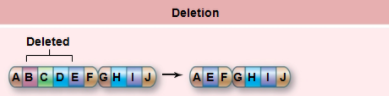
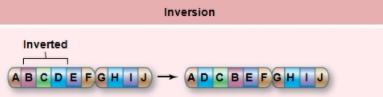
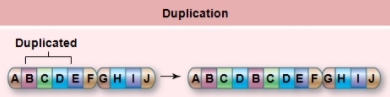
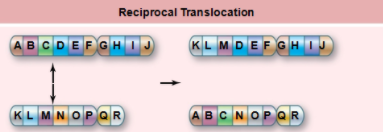
- CHROMOSOMAL MUTATIONS
- changes structure
- DELETION
- genes deleted from chromosome, chromosome lacks gene
- DUPLICATION
- INVERSION
- genes become inverted (flip-flopped)
- RECIPROCAL TRANSLOCATION
- moving genes from one place to another
- genes duplicated, multiple copies of genes on chromosome
- INVERSION
- DELETION
- changes structure
- POINT MUTATION
- CENTRAL DOGMA OF BIOLOGY
EUKARYOTES
- DNA in EUKARYOTES is LINEAR
- PLANTS, ANIMALS, FUNGI, AND PROTISTS
PROKARYOTES
- DNA in PROKARYOTES is CIRCULAR
- BACTERIA and ARCHEA
SICKLE CELL DISEASE
- single point mutation of one base
- causes red blood cell to take on a sickle shape
- spleen filters out sickle shaped red blood cells
- person does not have enough red blood cells to carry oxygen to cells
- person gets anemia, anemic people are tired
- person does not have enough red blood cells to carry oxygen to cells
- spleen filters out sickle shaped red blood cells
- causes red blood cell to take on a sickle shape
- single point mutation of one base
Images and files in the map
Information
- Description
- User has deleted their subject information Mind Map on Unit 3, created by Deleted user on 11/11/2021.
- Created by
- Deleted user · Nov 2021
- Updated
- Nov 11, 2021
- Views
- 9
- History
-
- Created by dumb himbo · Oct 14, 2021
- Copied by dumb himbo · Nov 11, 2021
- Rating