
Notes
Diffusion and Osmosis - Cell Membranes
Content of the notes (1)
Page 1
Cellular Membranes
All the membranes in a cell, biological membranes, are similar in structure and in the way they operatie. This means that the cell or plasma membrane is the same as the membrane around the organelles such as the mitochondria and chloroplasts. A membrane is said to be permeable to a substance if the substance can pass through it and impermeable if it cannot pass through.
Selectively Permeable Cell Membranes
A selectively permeable membrane allows some but not all substances to pass through. Biological membranes are said to be selectively permeable, as at materials such as cellophane, visking tubing and dialysis tubing. These membranes allow molecules such as water, oxygen and carbon dioxide to pass through freely. They do not however, allow sugars, proteins and salts to pass through easily. Although membranes are relatively impermeable to some substance, cells have specialised mechanisms in their membranes to allow these substance to pass through when necessary. For example, Glucose has to pass in through the plasma or cell membrane to allow for respiration.
Example of Selectively Permeable Cell Membrane
An example of a semi-permeable membrane is the Lipid Bilayer. The plasma membrane that surrounds all cells is based on this. A group of Phospholipids (consisting of a phosphate head and two Fatty Acid tails) arranged into a double-layer, the phospholipid bilayer is a semipermeable membrane that is very specific in its permeability. The hydrophilic phosphate heads are in the outside layer and exposed to the water content outside and within the cell. The hydrophobic
tails are the layer hidden in the inside of the membrane. The
phospholipid bilayer is the most permeable to small, uncharged solutes.
Protein channels float through the phospholipids, and, collectively,
this model is known as the fluid mosaic model.
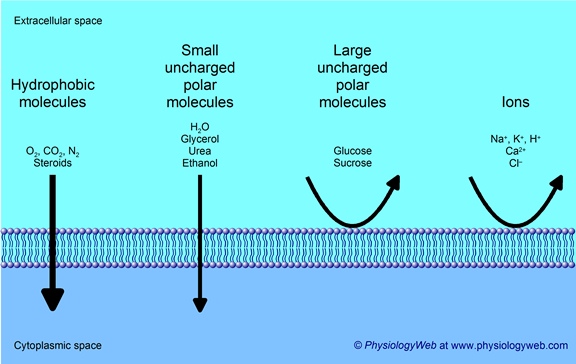
Selectivity of Cell Membranes
Information
- Description
- This note introduces the importance of cell membranes in the process of diffusion and osmosis and how cell membranes prevent certain molecules crossing into the cytoplasm of the cell. This would appeal to anyone studying intermediate level biology.
- Created by
- daniel.praecox · Dec 2013
- Updated
- Dec 12, 2016
- Views
- 477
- Tags
- History
-
- Created by jill.examtime · Dec 10, 2013
- Copied by daniel.praecox · Dec 10, 2013
- Rating