
Mind map
Chemistry (C3)
Map content
Chemistry (C3)
C3.1 - The periodic table
- The early periodic table
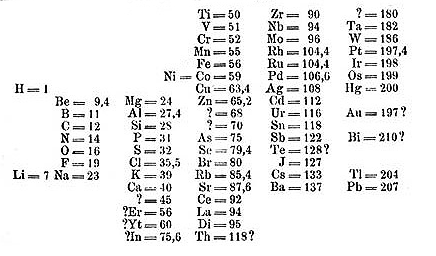
- -During the 19th century, many elements had been discovered BUT scientists didn't know about their structure. -Tried to classify and group the elements based on their properties and atomic weights.
- 1863 - Newlands
- -Law of octaves: similar properties are repeated every 8th element. -At the time, he put 62 elements into 7 groups, according to atomic weights. -After calcium, their properties didn't march well within the group so other scientists didn't accept his ideas very well.
- 1869 - Mendeleev
- -Produced a better table. -Left gaps for undiscovered elements so that the groups would have similar properties. -When new elements were found, they were inserted into the relevant slot. -Became the basis of the periodic table.
- Modern periodic table
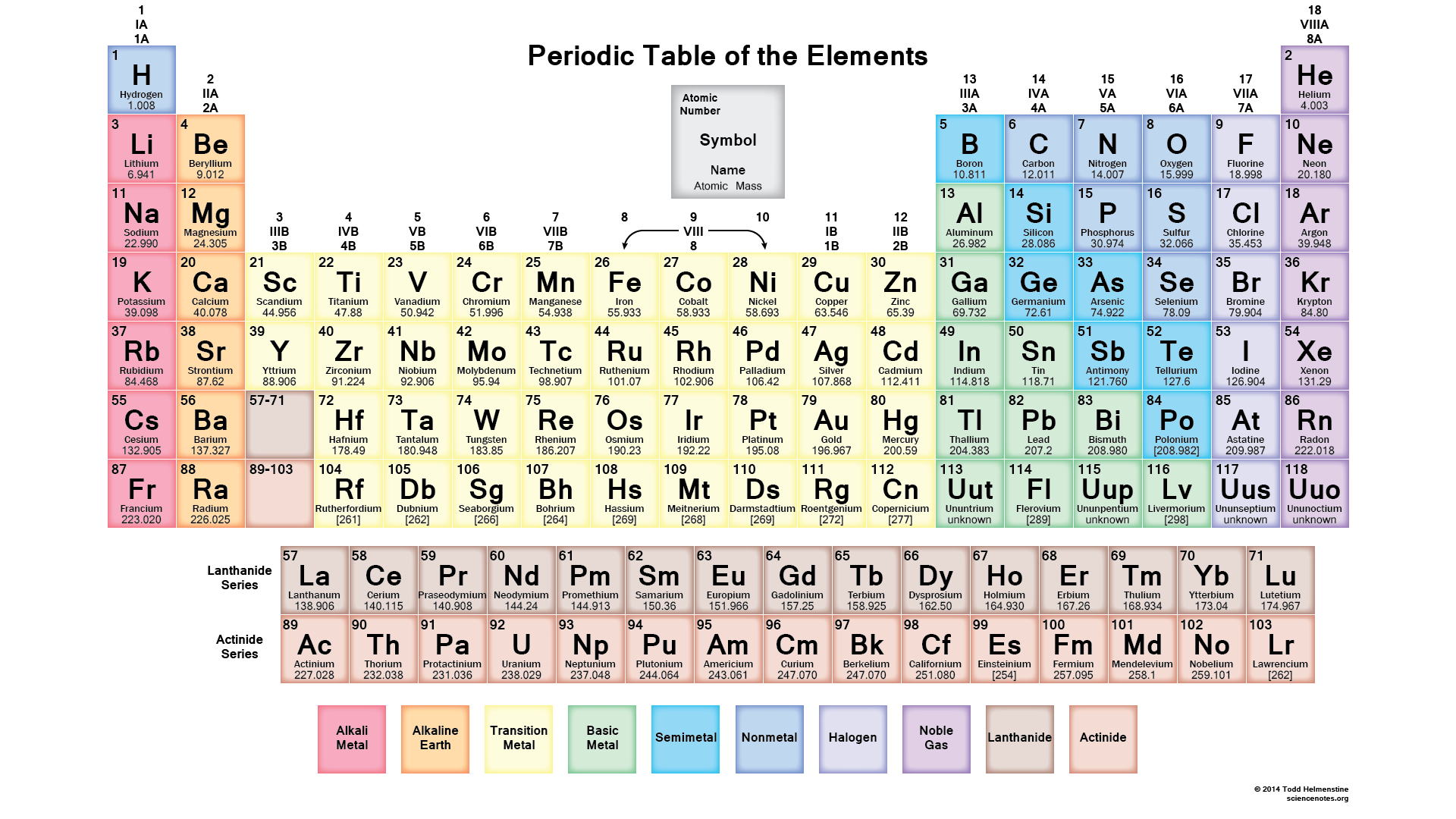
- When electrons, protons and neutrons were discovered early in the 20th century, the periodic table was arranged in order of atomic (proton) numbers. When this was done, all elements were placed in appropriate groups.
- Arrangement
- The modern periodic table can be seen as an arrangement of the elements in terms of their electronic structures. Elements in the same group have the same number of electrons in their highest occupied energy level (outer shell).
- Explaining the trends
- -The distance between the outermost electrons and the nucleus. -The number of energy levels in the atom.
- Metals
- -Reaction causes loss in electrons. -Reactivity of metals in a group increases going down the group.
- Non-metals
- -Reactions cause a gain in electrons. -The reactivity of non-metals decreases going down a group.
- Group 1 - The alkali metals
- Properties
- They have a very low density (lithium, sodium and potassium float on water).
- They react with non-metals to form ionic compounds in which the metal ion carries a charge of +1. The compounds are white solids that dissolve in water to form colourless solutions.
- React with water to produce hydrogen.
- Form hydroxides that dissolve in water to give alkaline solutions
- Reactivity
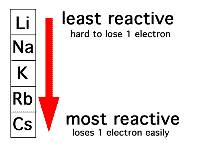
- -Reactivity increases as you go down the group. -Outer electron less strongly attracted to the nucleus. -Since number of occupied energy levels increases and the atoms get larger.
- -As you go down the group, the melting and boiling point decrease.
- Properties
- Transition elements
- -Elements found between group 2 and 3. -All metals.
- Properties (compared with group 1
- -Higher melting points. -Higher densities. -Stronger and harder. -Much less reactive.
- Reactions
- -DO NOT react vigorously with oxygen or water. -Produce positive ions with various charges.
- Uses
- -Produce coloured compounds so are used in some paints. -Important industrial catalysts.
- Group 7 - The halogens
- -Exist as small molecules made up of pairs of atoms. -All form ions with a single negative charge in their ionic compounds with metals.
- Reactivity
- -Less reactive as you go down the group. -Attraction of outer electrons to the nucleus decreases as the number of shells increases. -Electrons aren't as easily gained.
- Melting and boiling points increase as you go down the group.
- Displacement
- A more reactive halogen can displace a less reactive halogen from an aqueous solution of one of its salts.
- Halide ion
- -Halogens have 7 electrons in their outer shell. -Halide ion (the halogen) has a charge of 1-.
- Reactions
- -Halogens react with metals to form ionic compounds. -Halogens react covalently with non-metals, forming molecules.
- The early periodic table
C3.2 - Water
- Hard water
- -Uses more soap to produce lather and to wash effectively. -Because hard water contains dissolved compounds that react with soap to form an insoluble solid (precipitate) called SCUM.
- Soapless detergents
- These do not react with hard water to form scum.
- Formation
- -When water is in contact with rocks some compounds dissolve. -If the water contains dissolved magnesium or calcium ions, these will react with soap to form scum and so the water is hard.
- Scale
- -When heated, temporary hard water produces an insoluble solid called scale. -Scale can be deposited in kettles, boilers and pipes. -This reduces the efficiency of heating systems and causes blockages.
- Calcium ions
- These are good for our health by: -Helping to develop strong bones. -Reducing the risk of heart disease.
- Study tips
- ScuM is formed when Soap reacts with dissolved coMpounds in hard water.
- When temporary hard water is heated it produces SCALE which COVERS pipes and heating elements (SCALES COVER FISH).
- Soft water
- Water that lathers easily with soap.
- Removing hardness
- Soft water
- Soft water doesn't contain salts that produce scum or scale.
- Hard water
- Can be softened by removing the salts that produce scum and scale (calcium and magnesium salts).
- Temporary hard water
- -Softened by boiling. -When heated, magnesium and calcium compounds form insoluble scale. -Removes them from water.
- How this happens
- -Contains hydrogencarbonate ions. -Hydrogencarbonate ions decompose when heated to produce carbonate ions, water and carbon dioxide.
- Carbonate ions
- -Carbonate ions react with calcium and magnesium ions in the water. -This produces precipitates of calcium and magnesium carbonate that are deposited as scale.
- Permanent hard water
- -Not softened by boiling. -Does not produce scale when it is heated.
- Methods of softening
- Ion-exchange column
- -Packed with resin containing sodium or hydrogen ions. -Hard water is passed through resin. -Calcium and magnesium ions become attached to the resin and sodium or hydrogen ions take their place in the water. -Sodium ions and hydrogen ions do not react with soap.
- Precipitation
- -You can soften hard water by precipitating out the ions that cause hardness. -Adding washing soda, sodium carbonate, can do this. -Sodium carbonate reacts with calcium and magnesium ions in the water to form solid calcium and magnesium carbonate that cannot react with soap.
- Ion-exchange column
- Soft water
- Water treatment
- -Water shouldn't contain any harmful substances.
- Making water fit to drink
- Suitable source.
- -Removal of solids. -Sedimentation and filtration removes these solids.
- -Killing of microbes. -Chlorine is often added to kill microbes in water.
- Water filters
- -Used to improve taste of water. -Often contain carbon and an ion-exchange resin. -This removes some soluble substances and silver or another substance to prevent the growth of bacteria.
- Distillation
- -Pure water is made. -Requires a large amount of energy to boil the water. -Very expensive to do on a large scale.
- Water issues
- -There are advantages and disadvantages to any type of water treatment. -Water can be treated to remove hardness, to remove harmful microbes and to improve dental health.
- Hardness
- FOR: -Hard water has health benefits. -Hard water can be treated if not suitable for a particular purpose.
- AGAINST: -Hard water causes problems in heating systems and with washing. -Not suitable for all purposes.
- Chlorine
- FOR: -Effective in killing microbes in water so that it is safe to use.
- AGAINST: -Poisonous. -Can produce other toxic compounds. -MUST be carefully controlled to minimise risks.
- Fluoride
- FOR: -Added to toothpastes and water supplies to help prevent tooth decay.
- AGAINST: -People should be able to choose whether they should take extra fluoride or not.
- Hard water
C3.3 - Energy calculations
- Comparing the energy released by fuels
- Reacting with oxygen
- When fuels and food react with oxygen, energy is released in an exothermic reaction.
- Energy released
- -Usually measured in joules. -Can be measured in calories. -1 calorie = 4.2J.
- Calorimeter
- Used to measure the amount of energy released when substances burn.
- Glass beaker
- -The simplest calorimeter is some water in a glass beaker. -When a substance burns and heats the water, the temperature rise of the water depends on how much energy is released,
- Problems
- -Simple calorimeters do not give accurate results for the energy released. -This is because much of it is used to heat the surroundings. -Results CAN be used to compare the energy released by different fuels.
- Comparing
- You can use either: -Change in kJ/gram. -Change in kJ/mole. To compare the energy released by buring different substances.
- kJ/mol
- This can be calculated by multiplying the energy change in kj/g by the relative formula mass of the substance.
- Equation
- Q = mcΔT Where: -Q is the amount of energy transferred to the water, J. -m is the mass of the water, g. -c is the specific heat capacity of water in J/g°C. -ΔT is temperature change, °C.
- Reacting with oxygen
- Energy transfer in solutions
- When a reaction takes place in solution, energy is transferred to or from the surroundings.
- Isolated container
- We can do solution reactions in an insulated container to reduce energy transfers to the surroundings.
- Assumptions
- -In these calculations, we assume the solutions behave like water. -Volume of solution does not change. -1cm³ has a mass of 1g. -Specific heat capacity of solution is 4.2J/g°C.
- Energy level diagrams
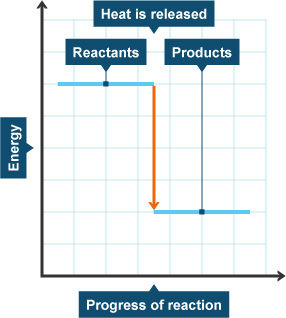
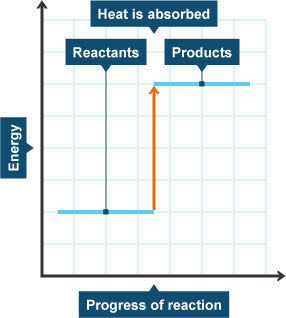
- We can show the energy changes for chemical reactions on energy level diagrams.
- Bonds
- Exothermic
- -New bonds in the products are formed. -Energy is released.
- Endothermic
- -Breaking bonds in the reactants. -Energy is taken in.
- Exothermic
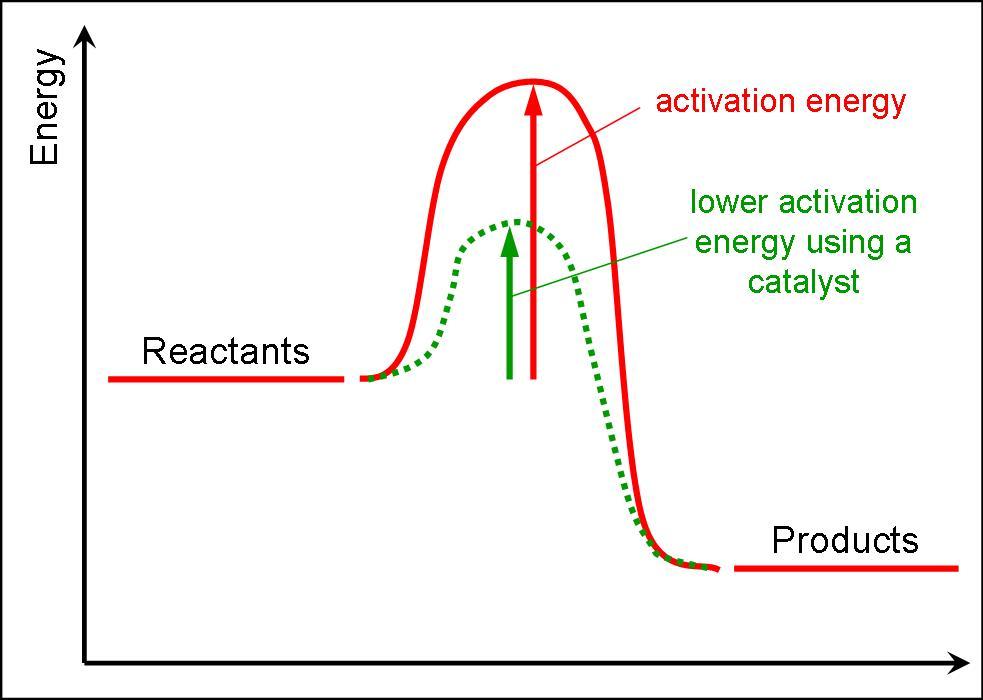
- Activation energy
- The minimum energy needed for the reaction to happen.
- Catalysts
- Catalysts increase the rate of reaction by providing a different pathway with an activation energy that is lower.
- Bond energies
- -The amount of energy needed to break the bond between two atoms. -An equal amount of energy is released when the bond forms between two atoms. -We can use bond energies to calculate the overall energy change for a reaction.
- In a reaction
- -In a chemical reaction, energy is needed to break the bonds in the reactants. -Energy is released when new bonds are formed in the products. -Difference in these energy changes make the reaction exothermic or endothermic.
- kJ/mol
- The measurement of bond energies.
- Calculating bond energies
- -The balanced equation. -The total amount of energy needed to break all the bonds of the reactants. -The total amount of energy released in making all the bonds in the products. -The difference between the two totals.
- ALWAYS draw out the substance for which you are trying to work out the bonds.
- Fuel issues
- Fossil fuels
- -Fossil fuels are non-renewable. -They cause pollution. -The need to develop alternative fuels is becoming URGENT.
- Hydrogen
- Pros
- -Burns easily. -Releases a large amount of energy per gram. -Produces no carbon dioxide when burned, only water. -Can be burned in combustion engines. -Can be use in fuel cells to power vehicles. -Produced by renewable sources.
- Cons
- -Supply. -Storage. -Safety problems. -Vehicles that use fuel cells need to match the performance, convenience and costs of petrol and diesel vehicles.
- Pros
- Fossil fuels
- Comparing the energy released by fuels
C3.4 - Analysis and synthesis
- Tests for positive ions
- Some positive ions can be identified using a flame test or by using sodium hydroxide solution.
- Flame test
- Different positive ions give different coloured flames.
- Lithium (Li⁺)
- Sodium (Na⁺)
- Potassium (K⁺)
- Calcium (Ca²⁺)
- Barium (Ba²⁺)
- Hydroxides
- -Hydroxides of most metals have ions with 2+ and 3+ charges. -Insoluble in water. -When sodium hydroxide is added to solutions of these ions a PRECIPITATE of the metal hydroxide forms.
- White precipitates
- -Aluminium, calcium and magnesium ions form white precipitates. -When EXCESS sodium hydroxide solution is added the precipitate of aluminium hydroxide dissolves.
- Hydroxide compounds
- Different hydroxide compounds are different colours.
- Copper(II) hydroxide
- Iron (II) hydroxide
- Iron (III) hydroxide
- Equations
- We can show the reactions of positive ions with sodium hydroxide solution by balanced ionic equations.
- For example: Fe³⁺ + 3OH⁻ → Fe(OH)₃(s) (aq) (aq)
- Tests for negative ions
- There are THREE tests for negative ions.
- Carbonate ions
- -Add dilute hydrochloric acid to the substance to see if it fizzes. -If it does and the gas produced turns limewater milky, the substance contains carbonate ions.
- 2HCl(aq) + CaCO₃(s) → CaCl₂(aq) + H₂O(l) + CO₂(g)
- Halide ions
- Add dilute nitric acid and then silver nitrate solution.
- AgNO₃(aq) + NaCl(aq) → AgCl(s) + NaNO₃(aq)
- Chloride ions
- Chloride ions give a white precipitate.
- Bromide ions
- Bromide ions give a cream precipitate.
- Iodide ions
- Iodide ions give a yellow precipitate.
- Sulfate ions
- -Add dilute hydrochloric acid. -Add barium chloride solution. -If a WHITE precipitate forms, sulfate ions are present.
- BaCl₂(aq) + MgSO₄ (aq) → BaSO₄(s) + MgCl₂(aq)
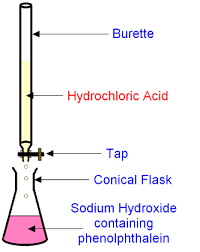
- Titrations
- A titration is used to measure accurately how much acid and alkali react together completely.
- Process
- 1. Fill burette with acid/alkali. 2. Measure sample of akali/acid with pipette in flask. 3. Add Phenolphthaline / Methyl Orange. 4. Put flask on white tile. 5. Add acid/alkali until end point (color change). 6. Repeat until two readings within 0.1ml. 7. Do a rough titration.
- End point
- The point at which the acid-base reaction is complete.
- Indicator
- Phenolphthaline
- Acid - Colorless Alkali - Pink
- Methyl Orange
- Acid - Red Alkali - Yellow
- Phenolphthaline
- Titration calculations
- -Concentrations can be calculated from the mass of solute dissolved in a known volume of solution. -The mass of solute in any volume of solution can be calculated from its concentration. -If the concentration of one of the solutions in a titration is known, the results can be used to find the concentration of the other.
- Concentrations
- Measured in either: -Grams per decimetre cubed. --g/dm³ -Mole per decimetre cubed. --mol/dm³
- Working out g/dm³
- Q: 50cm³ of solution made using 5.6g of potassium hydroxide.
- -1cm³ of solution contains (5.6/50)g. -So 1dm³ of solution contains (5.6/50) x 1000g = 112g. -Concentration = 112g/dm³
- Working out mol/dm³
- Q: 50cm³ of solution made using 5.6g of potassium hydroxide.
- -1 mole of KOH = (39 + 16 +1)g = 56g. -1dm³ of solution contains (5.6/50) x 1000g = 112g. 122g/56g = 2 mole -Concentration = 2 mol/dm³
- General method
- 1a) Find how much 1cm³ of the solution contains (of the substance). 1b) Find the mass of 1 mole of the substance. 2. Find how much 1 dm³ of the solution contains (of the substance). 3b) Divide the dm³ of solution by the mass of the mole. 4) Write out the answer with the appropriate units.
- Important formula
- Number of moles = mass in grams/relative formula mass
- Chemical analysis
- -Scientists working in environmental monitoring, medicine and forensic science all need to analyse substances. -The results of their analysis are often matched against existing databases to identify substances (or suspects in the case of forensics).
- Chemical equilibrium
- At equilibrium, the rates of the forward and reverse reaction are equal.
- Reversible reactions
- In a reversible reaction, the products of the reaction can react to re-form the original reactants.
- Closed system
- In a closed system, equilibrium is achieved when the rates of the forward and reverse reactions are equal.
- Reaction conditions
- Changing the reaction conditions can change the amounts of products and reactants in a reaction mixture at equilibrium.
- Changing concentration
- -Increasing the concentration of a reactant will causes more products to be formed. -If a product is removed, more reactants will react to try to achieve equilibrium and so more product is formed.
- Example
- ICl + Cl₂ ⇌ ICl₃ -If chlorine is added, the concentration of chlorine is increase and more ICl₃ is produced. -If chlorine is removed, the concentration is decreased and more ICl is produced.
- Alternating conditions
- If we change the conditions of a system at equilibrium, the position of equilibrium shifts as if to try to cancel out the change.
- Changing the pressure
- For reversible reactions that have DIFFERENT numbers of molecules of gases on one side of the equation than the other, changing pressure = change in position of equilibrium.
- Forward reaction produces more molecules of gas
- -An increase in pressure decreases the amount of products formed. -A decrease in pressure increases the amount of products formed.
- Forward reaction produces fewer molecules of gas
- -An increase in pressure increases the amount of products formed. -A decrease in pressure decreases the amount of products formed.
- Changing the temperature
- -Reversible reactions are EXOTHERMIC in one direction and ENDOTHERMIC in the other. -Increasing the temperature favours the reaction in the endothermic reaction. -The equilibrium shifts as if to lower the temperature by taking in energy.
- If the forward reaction is exothermic
- -An increase in temperature decreases the amount of products formed. -A decrease in temperature increases the amount of products formed.
- If the forward reaction is endothermic
- -An increase in temperature increases the amount of products formed. -A decrease in temperature decreases the amount of products formed.
- The Haber Process
- Used to manufacture ammonia.
- Uses of ammonia
- -To make fertilisers. -To make other chemicals.
- Process
- Nitrogen from the air and hydrogen, which is usually obtained from natural gas, are purified and mixed in the correct proportions.
- Conditions
- The gases are passed over an iron catalyst at a temperature of about 450°C and a pressure of about 200 atmospheres.
- Why?
- These conditions are chosen to give a fast rate of reaction and a reasonable yield of ammonia.
- Reaction
- The reaction is reversible: N₂(g) + 3H₂(g) ⇌ 2NH₃(g)
- Yield
- Some of the ammonia that is produced breaks down into nitrogen and hydrogen and the yield of ammonia is only about 15%.
- Recycling
- -The gases that come out of the reactor are cooled so the ammonia condenses. -The liquid ammonia is separated from the unreacted gases. -The unreacted gases are recycled so they are not wasted.
- The economics of the Haber Process
- Optimum pressure
- -The products have fewer molecules of gas than the reactants, so the higher the pressure, greater the yield of ammonia. -However, the higher the pressure the more energy is need to compress the gas. -A pressure of 200 atmospheres is normally used.
- High pressure
- -Strong reaction vessels and pipes. -This INCREASES the cost.
- Optimum temperature
- -Forward reaction - exothermic. -The lower the temperature the greater the yield of ammonia. -Reaction rate DECREASES as the temperature is lowered. -Iron catalyst becomes ineffective. -It would take a longer time to produce any ammonia.
- Balance
- Pressure - 200 atmospheres. Temperature - 450°C.
- Compromise
- A comprise temperature of 450°C is used to give a reasonable yield in a short time.
- Optimum pressure
- Tests for positive ions
C3.5 - Organic chemistry
- Structures of alcohols, carboxylic acids and esters
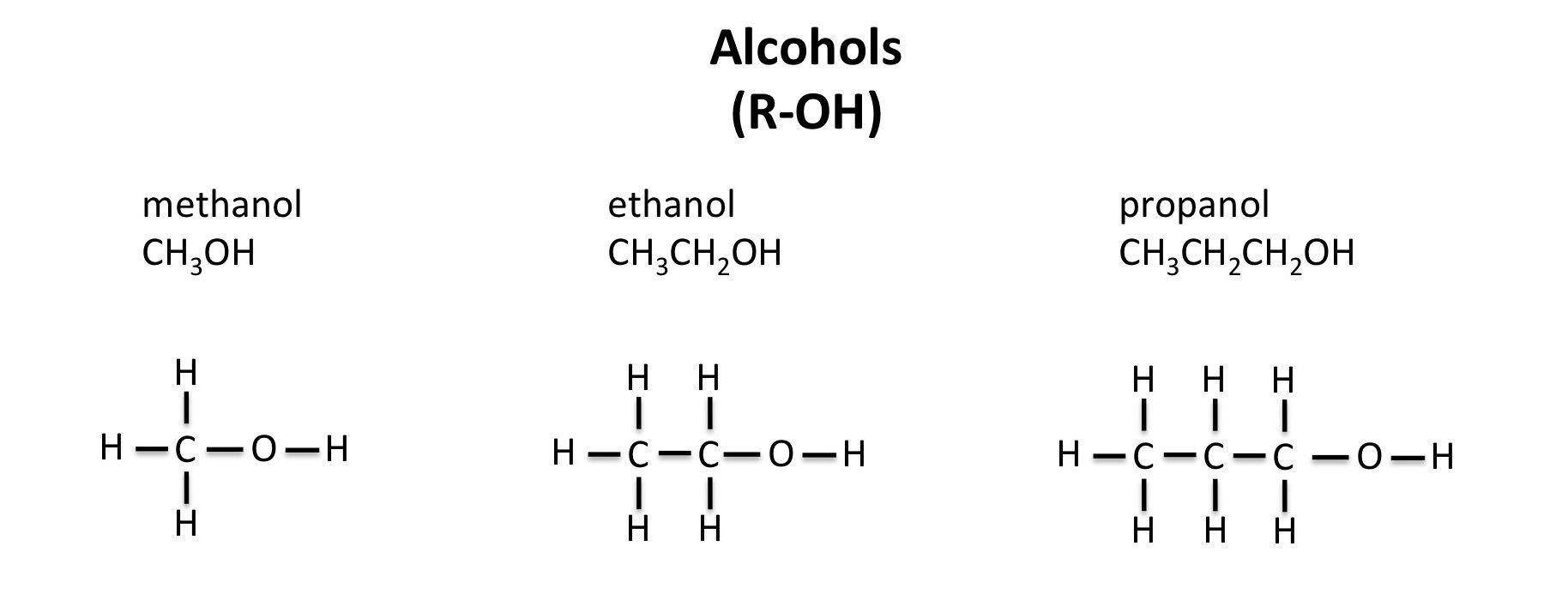
- Alcohols
- -Functional group - -O-H -If one hydrogen atom from each alkane molecule is replace with an -O-H group, we get a homologous series of alcohols.
- Structural formula
- Shows which atoms are bonded to each carbon atom and functional group.
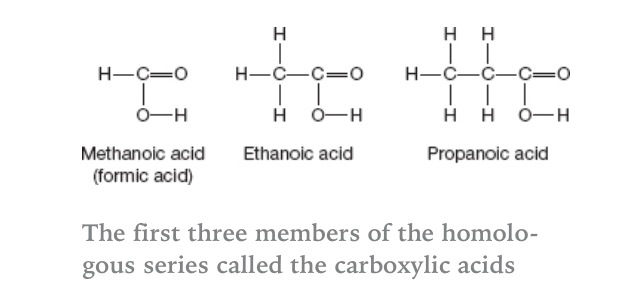
- Carboxylic acids
- -Functional group - -COOH. -First three members of the carboxylic acids are methanoic acid, ethanoic acid and propanoic acid.
- Structural formulas
- Methanoic - HCOOH Ethanoic - CH₃COOH Propanoic - CH₃CH₂COOH
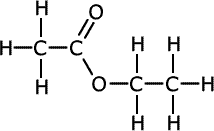
- Esters
- -Functional group - -COO- -If the H atom in the -COOH group of a carboxylic acid is replaced by a hydrocarbon group the compound is an ester.
- Ethyl ethanoate
- CH₃COOCH₂CH₃
- Organic molecules
- -Form the basis of living things. -All contain carbon atoms. -Carbon atoms covalently bond to each other to form the 'backbone' of many series of organic molecules.
- Homologous series
- -Series of molecules that have a general formula. -Alkanes and alkenes are two homologous series made of only hydrogen and carbon atoms.
- Alcohols
- Properties and uses of alcohols
- Uses
- -Smaller molecules mix well with water and produce neutral solutions. -Organic substances dissolve in alcohols and so this makes them useful solvents. -They are also used as fuels.
- Ethanol
- The main alcohol in wine, beer and other alcoholic drinks.
- Combustion of alcohols
- -Alcohols burn in air. -When burned completely, they produce carbon dioxide and water. -They are used as fuels, for example in spirit burners or in combustion engines. -They are also mixed with petrol.
- Reaction with sodium
- -Sodium reacts with alcohols to produce hydrogen gas. -The reactions are less vigorous than when sodium reacts with water.
- Oxidisation of ethanol
- Ethanol can be oxidised to ethanoic acid, either by chemical oxidising agents, like potassium dichromate, or by the action of microbes.
- Ethanoic acid
- -Turns alcoholic drinks sour. -Main acid in vinegar.
- Uses
- Carboxylic acids and esters
- Carboxylic acids
- In water
- Carboxylic acids dissolve in water to produce solutions of less than pH7.
- Reacting with carbonates
- -The acidic solution of a carboxylic acid reacts with a carbonate. -It causes a fizzing sound. -This means that they are producing carbon dioxide gas. -A salt and water are also produced.
- How are they different from other acids?
- They react with alcohols in the presence of an acid catalyst to produce esters.
- Strength
- Carboxylic acids are WEAK.
- Strong
- -In an aqueous solution. hydrochloric acid ionises COMPLETELY to hydrogen ions and chloride ions. -Acids that ionise completely in aqueous solutions are known as STRONG ACIDS.
- Weak
- -When ethanoic acid dissolves in water, it does not ionise completely and some of the ethanoic acid molecules remain as molecules in the solution. -Acids that DO NOT ionise completely in aqueous solution are known as WEAK ACIDS.
- Aqueous solutions of equal concentration
- Weak acids have a higher pH and react MORE SLOWLY than strong acids.
- In water
- Esters
- Formation
- A carboxylic acid reacts with an alcohol in the presence of an acid catalyst to produce esters.
- Example
- -Ethanol and ethanoic acid react together. -Happens when mixed with the catalyst, sulfuric acid. -Produces ethyl ehtanoate and water.
- Properties
- -Volatile compounds. -Have distinctive smells.
- Uses
- -Some esters have pleasant fruity smells. -Used as flavourings and in perfumes.
- Formation
- Carboxylic acids
- Organic issues
- There are both advantages and disadvantages to the use of organic substances in day-to-day life.
- Benefit
- -Alcohols, carboxylic acids and esters have many uses which benefit society. -For example: they are used in foods, drinks, as solvents and as fuels.
- Abuse
- Alcoholic drinks and solvents can be ABUSED and this can lead to health and social problems.
- Biofuels
- In future, the use of biofuels, such as ethanol and esters, could help society as crude oil supplies run out.
- Starvation
- The use of these substances for biofuels may conflict with the need to feed the world.
- Structures of alcohols, carboxylic acids and esters
Images and files in the map









Information
- Description
- A mindmap for Chemistry Unit 3 (C3) for the AQA.
- Created by
- Deleted user · Sep 2016
- Updated
- Dec 13, 2016
- Views
- 67
- Tags
- History
-
- Created by Ben C · May 2, 2015
- Copied by Amy Lashkari · May 2, 2015
- Copied by Catalina Roncal · Sep 4, 2016
- Rating