
Notes
Movement in and out of Cells
Content of the notes (1)
Page 1
Diffusion is the net movement of molecules from a region of their higher concentration to a region of their lower concentration down a concentration gradient, as a result of their random movement,
Particles more until they reach a state of dynamic equilibrium = particles are still moving but are evenly spread out even in motion
Diffusion is fastest in air
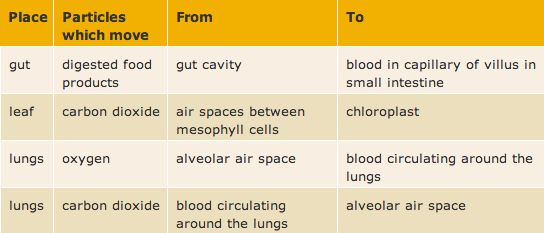
Diffusion in the body
- oxygen goes in lungs
- diffuses into bloodstream until respiration
- carbon dioxide diffuses from bloodstream to lungs
Diffusion of water molecules from a region of their higher concentration (dilute solution) to a region of their lower concentration (concentrated solution) through a semi-permeable membrane
W
Water molecules are small - are able to go through partially-permeable membrane
Wate
Water potential gradient exists between the two sides of the semi-permeable membrane
Root Hair Cells
water moves from soil through cell membrane and into root cells by osmosis
- moves from cell to cell by osmosis until it reaches the xylem
- if then carried up the plant by transpiration
In a concentrated solution
- animal cells shrivel up as water leaves them by osmosis
- plant cells also shrivel up (become flaccid)
- shrivel up and wilt
In a dilute solution
- animal cells burst as water enters them and they don't have a cell wall to support them
- plant cells become turgid (full of water)
DIffusion
Osmosis
Information
- Description
- IGCSE Biology (B1: Cells and the Characteristics of Life) Note on Movement in and out of Cells, created by ShreyaDas on 24/03/2014.
- Created by
- ShreyaDas · Mar 2014
- Updated
- Feb 19, 2016
- Views
- 69
- Tags
- Rating