
Notes
Chapter 14 - Bio
Content of the notes (10)
Page 1
The Central Dogma
One gene - one polypeptide // Beadle and Tatum
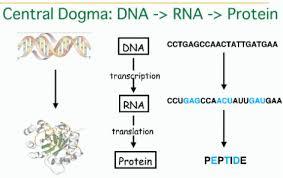
The Central Dogma - cells are governed by a cellular chain of command
The Flow of Genetic Information
Gene expression - the process by which DNA directs protein synthesis
DNA - TRANSCRIPTION - RNA - TRANSLATION - PROTEIN
----------------------> -------------------->
Basic Principles of Transcription
synthesis of RNA under the direction of DNA
produces messenger RNA (mRNA)
Page 2
Basic Principles of Translation
synthesis of a polypeptide, which occurs under the direction of mRNA
Ribosomes are the sites of translation
RNA
The bridge between DNA and protein synthesis
RNA has ribose sugar and the base uracil (U) rather than thymine (T)
usually single stranded
TEMPLATE DNA 5' - ACCTAGTTGC - 3'
Trascription RNA 3' - UGGAUGAACG - 5'
Page 3
Molecular Components of Transcription
RNA polymerase
Promoter
Terminator in bacteria
Transcription
Page 4
Transcription in Eukaryotes
Occurs in the nucleus
RNA processing produces the mature mRNA
mRNA goes to the cytoplasm for translation on ribosomes
RNA Processing
WHEN - modify pre mRNA before genetic messages are dispatched to the cytoplasm
WHERE - nucleus
Two types of modifications:
"Capping and Tailing" - both ends of the primary transcript are altered
"Splicing" - interior parts of the molecule are cut out and other parts are spliced together
Functions of Altercations of mRNA ends
facilitates the export of mRNA to the cytoplasm
protects mRNA from hydrolytic enzymes
helps ribosomes attach to the 5' end
Page 5
often translation isn't sufficient to make a functional protein
polypeptide chains are modified after translation or targeted to specific sites in the cell
Protein Folding
During synthesis, a polypeptide chain spontaneously coils and folds into its 3D shape
Post - Translational Modifications
Proteins may also require this before doing their jobs
Attach sugar, lipids, phosphate groups to certain amino acids
one or more amino acids are removed from the leading end of the polypeptide chain
a polypeptide chain is cleaved into multiple pieces
Multiple polypeptide assemple a protein that has quaternary structure
Page 6
Targeting Polypeptides to Specific Locations
Two populations of ribosomes are evident in cells: free ribosomes (in the cytosol) and bound ribosomes (attached to the ER)
Free ribosomes mostly synthesize proteins that function in the cytosol
Bound ribosomes make proteins of the endomembrane system and proteins that are secreted from the cell
Polypeptide synthesis always begins in the cytosol
synthesis finishes in the cytosol unless the polypeptide signals the ribosome to attach to the ER
Polypeptides destined for the ER or for secretion are marked by a signal peptide
A signal-recognition particle (SRP) binds to the signal peptide
Page 7
Making Multiple Polypeptides
In bacteria and eukaryotes multiple ribosomes translate an mRNA at the same time
Once a ribosome is far enough past the start codon, another ribosome can attach to the mRNA
Strings of ribosomes called polyribosomes (or polysomes) can be seen with an electron microscope
Page 8
Transcription in Prokaryotes
Absence of a nuclear membrane
mRNA transcription and translation are coupled
translation of mRNA can begin before transcription has finished
mRNA is translated as soon as it is made
no processing
Page 9
Mutations
mutations - changes in the genetic material of a cell or virus
small scale mutations - chemical changes in just one or a few nucleotide pairs of a gene
the change of a single nucleotide (point mutation) in a DNA template strand can lead to the production of an abnormal protein
Types of Small-Scale Mutations
Small scale mutations within a gene can be divided into two general categories
Nucleotide-pair substitutions. A nucleotide-pair substitution replaces one nucleotide and its partner with another pair of nucleotides
One or more nucleotide-pair insertations or deletions (frameshift mutations)
Page 10
Substitutaions
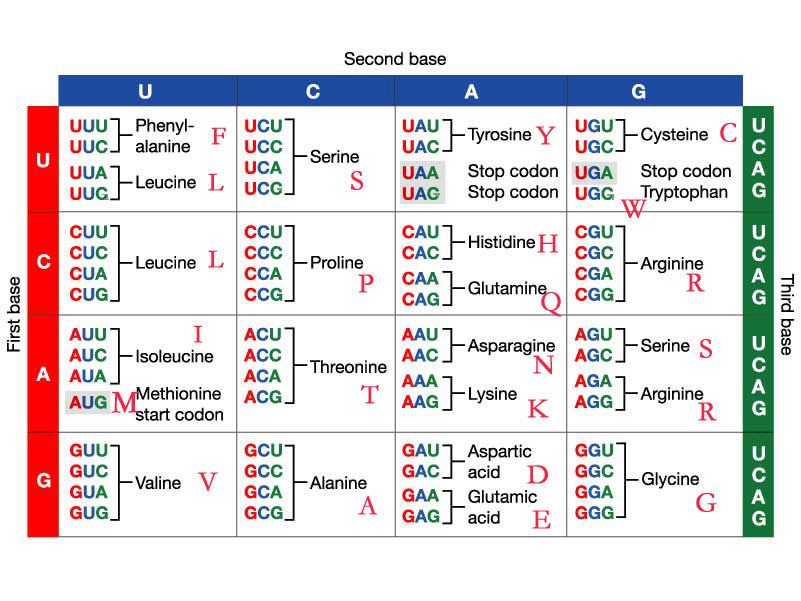
Silent mutations have no effect on the amino acid produced by a codon because of redundancy in the genetic code
Missense Mutations still code for an amino acid, but not the correct amino acid. Substitution mutations are usually missense mutations
Nonsense mutations change an amino acid codon into a stop codon, nearly always leading to a nonfunctional protein
Insertations and Deletions
inserations and deletions are additions or losses of nucleotide pairs in a gene
These mutations have a disastrous effect on the resulting protein more often than substitutions do
Insertion and deletion of nucleotides may alter the reading frame of the genetic message, producing a frameshift mutation
Information
- Description
- Biology (Chapter 14) Note on Chapter 14 - Bio, created by Brianna Niemeier on 10/11/2016.
- Created by
- Brianna Niemeier · Nov 2016
- Updated
- Nov 15, 2016
- Views
- 167
- Tags
- Rating