
Mass Spectrometry
Slides in this set (6)
-
- Mass spectrometers can be used to determine all the isotopes present in a sample of an element and to therefore identify elements.
- Calculating relative atomic mass
- The relative atomic mass quoted on the periodic table is a weighted average of all the isotopes of the element.
- For each isotope the mass spectrometer can measure a m/z (mass/charge ration) and an abundance.
- If asked to give a species from a mass spectrum then give charge and mass number.
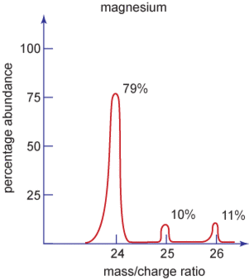
- Caption: Spectra for magnesium from mass spectrometer
-
- Sometimes two electrons may be removed from a particle forming a 2+ ion. ^24Mg^2+ with a 2+ charge would have an m/z of 12 (24/2).
- Use this equations to work out RAM:
- RAM = isotopic mass x %abundance/100
- For above example - RAM = [(78.7 x 24) + (100.13 x 25) + (11.17 x 26)]/100 = 24.3
- Or if relative abundance is used instead of percentage abundance:
- RAM = isotopic mass x relative abundance/total relative abundance
-
- Cl has two isotopes: Cl^35 (75%) and Cl^37 (25%).
- Br has two isotopes: Br^79 (50%) and Br^81 (50%).
- These lead to the following spectra caused by the diatomic molecules -->
-
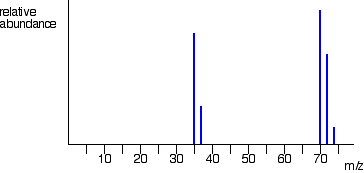
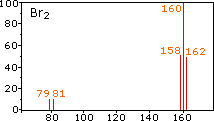
- Caption: The first two lines in each spectra show the masses of the two isotopes.
- Caption: The other lines are the combinations of these values added together: e.g. 79 + 79 = 158 The different column heights show the ratio of each combination.
-
Measuring the Mr of a molecule
- If a molecule is put through a mass spectrometer it will often break up and give a series of peaks caused by the fragments. The peak giving the largest m/z, however, will be due to the complete molecule and will be equal to the Mr of the molecule. This peak is called the parent or molecular ion.

-
- Mass spectrometers have been used:
- in planetary space probes so tat elements on other planets can be identified (they can have different compositions of isotopes)
- for drug testing in sports to identify chemicals in the blood and breakdown products from drugs in the body
- for quality control in the pharmaceutical industry and to identify molecules from sample with potential biological activity
- radioactive dating to determine the age of fossils and human remains
Information
- Description
- Chemistry (Atomic Structure and The Periodic Table) Slide Set on Mass Spectrometry, created by Kirsten Rowland on 03/01/2017.
- Created by
- Kirsten Rowland · Jan 2017
- Updated
- Jan 6, 2017
- Views
- 156
- Tags
- Rating