
Notes
Batteries and Fuel Cells
Content of the notes (4)
Page 1
Electrochemical cells are used as batteries
Batteries are types of electrochemical cells which provide the electricity we use to power things like watches and mobile phones. Some types of cell are rechargeable while others can only be used until they run out.
Non-rechargeable batteries are cheaper than rechargeable ones. But since you can just recharge and re-use rechargeable ones, they last longer and work out cheaper in the long run.
Page 2
Lithium batteries are rechargeable
Rechargeable batteries are found in lots of devices, such as mobile phones, laptops and cars.
EXAMPLE
Lithium cells are used in mobile phones and laptops. One type of lithium cell is made up of a lithium cobalt oxide electrode and a graphite electrode. The electrolyte is a lithium salt in an organic solvent. The half-equations are:
Li + e- <------> Li V = -3.04 V
Li+ + CoO2 + e- <------> Li+[CoO2]- V = +0.56 V
The Li+/Li half cell has the more negative value so goes in teh direction od oxidation (backwards). So the reactions which happen when the battery supplies power are:
At the negative electrode: Li ------> Li+ + e-
At the positive electrode: Li+ + CoO2 + e- ------> Li+[CoO2]-
The EMF of this type of cell is: +0.56 - (-3.04) = +3.60V
YOU COULD BE ASKED FOR THE EQUATIONS AT THE POSITIVE AND NEGATIVE ELECTRODES IN THE EXAM
To recharge these batteries, a current is supplied to force electrons to flow in the opposite direction around the circuit and reverse the reactions. The reactions that take place in non-rechargeable batteries are difficult or impossible to reverse in this way.
Page 3
Fuel Cells can generate electricity from hydrogen and oxygen
In most cells the chemicals that generate the electricity are contained in electrodes and the electrolyte that form the cell.
In a fuel cell the chemicals are stored separately outside the cell and are fed in when electricity is required. One example of this is the alkaline hydrogen-oxygen fuel cell, which can be used to power electric vehicles. Hydrogen and oxygen gases are fed into two separate platinum containing electrodes. The electrodes are separates by an anion-exchange membrane than allows anions (OH-) and water to pass through it, but not hydrogen and oxygen gas. The electrolyte is an aqueous alkaline (KOH) solution.
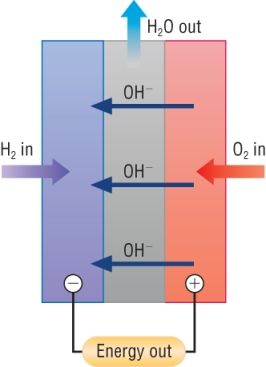
The electrons flow from the positive electrode through an external circuit to the negative electrode. The OH- ions pass through the anion-exchange membrane towards the positive electrode.
The overall effect is that H2 and O2 react to make water: 2H2 + O2 ------> 2H2O
Page 4
Fuel cells have some big advantages
The major advantage of using fuel cells in cars, rather than the internal combustion engine, is that fuel cells are more efficient - they convert more of their available energy into kinetic energy to get the car moving. Internal combustion engines waste a lot of their energy producing heat. Other benefits include:
The only waste product is water, so there are no toxic chemicals to dispose of and no CO2 emissions from the cell itself.
Fuel cells don't need to be recharged like batteries. As long as hydrogen and oxygen are supplied, the cell will continue to produce electricity.
The downside is that you need energy to produce a supply of hydrogen and oxygen. They can be produced from the electrolysis of water, i.e. by reusing the waste product from the fuel cell, but this requires electricity - and this electricity is usually generated by burning fossil fuels. So the whole process isn;t usually carbon neutral. Hydrogen is also highly flammable so it needs to be handled carefully when it's stored or transported.
Information
- Description
- A2 Chemistry (Electrode Potentials and Cells) Note on Batteries and Fuel Cells, created by Lucy Nove on 28/02/2017.
- Created by
- Lucy Nove · Feb 2017
- Updated
- Apr 6, 2018
- Views
- 11
- Rating