
OCR - A-Level - Chemistry - Oxidation of Alcohols
Slides in this set (4)
-
- Caption: (Potassium) Dichromate changes from orange to green.
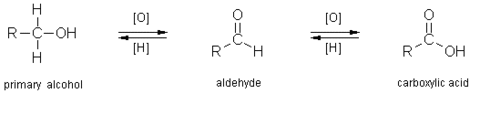
- Gently heat alcohols in the presence of an oxidising agent (such as potassium dichromate) and then distil immediately in acidic conditions.
- It forms an aldehyde and water.
- Heating further under reflux and using an excess of the oxidising agent. Reflux involves using equipment that boils and then condenses the alcohol.
- It forms a carboxylic acid and water.
-
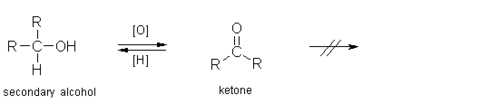
- Heat alcohol intensely under reflux and in the presence of an oxidising agent. Intense heating is necessary because secondary alcohols are more stable.
- It forms a ketone and water.
- Caption: (Potassium) Dichromate changes from orange to green.
-
- Even under the same conditions as the previous two, no reaction occurs. This is because there are already 3 bonds to carbon atoms, meaning it will not form anything else. This is the most stable.

- Caption: There will be no change to the dichromate because no reaction occurs.
-
- Under reflux:
- > If primary alcohol - end up as carboxylic acid, with aldehyde in between - orange to green dichromate.
- > If secondary alcohol - end up as ketone - orange to green dichromate.
- > If tertiary alcohol - no reaction, remains as alcohol - no change dichromate.
Information
- Description
- A level Chemistry Slide Set on OCR - A-Level - Chemistry - Oxidation of Alcohols, created by Josh Anderson on 13/03/2017.
- Created by
- Josh Anderson · Mar 2017
- Updated
- May 29, 2017
- Views
- 6
- Rating