
Atoms
Slides in this set (7)
-
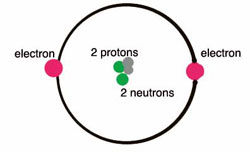
- Caption: This is a Helium Atom.
- Helium atoms consist of 2 protons, 2 electrons and 2 neutrons.
- Helium is a chemical element with the symbol He and atomic number 2.
- Helium is a colorless, tasteless and odorless gas.
- Helium is the second most common element in the Universe (after hydrogen), making up around 24% of its mass.
- Helium is part of a group of chemical elements called noble gases, the other five that occur naturally are neon, argon, krypton, xenon and radon. Under normal conditions they share similar properties, including being less likely to participate in chemical reactions due to their outer shell of electrons being full. Helium is the second least reactive element after neon.
- French and English astronomers Pierre Janssen and Norman Lockyer are jointly credited with discovering helium after spectral analysis of sunlight following a solar eclipse in 1868.
- The word helium comes from the Greek word meaning sun (helios). It was named by Lockyer and English chemist Edward Frankland.
-
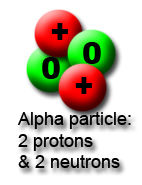
- Caption: This is an Alpha Particle.
- Alpha particle, positively charged particle, identical to the nucleus of the helium-4 atom, spontaneously emitted by some radioactive substances, consisting of two protons and two neutrons bound together, thus having a mass of four units and a positive charge of two. Discovered and named (1899) by Ernest Rutherford, alpha particles were used by him and coworkers in experiments to probe the structure of atoms in thin metallic foils. This work resulted in the first concept of the atom as a tiny planetary system with negatively charged particles (electrons) orbiting around a positively charged nucleus (1909–11). Later, Rutherford bombarded nitrogen with alpha particles, changing it to oxygen, in the first artificially produced nuclear transmutation (1919). Today, alpha particles are produced for use as projectiles in nuclear research by ionization—i.e., by stripping both electrons from helium atoms—and then accelerating the now positively charged particle to high energies.
-
What can radiation pass through?
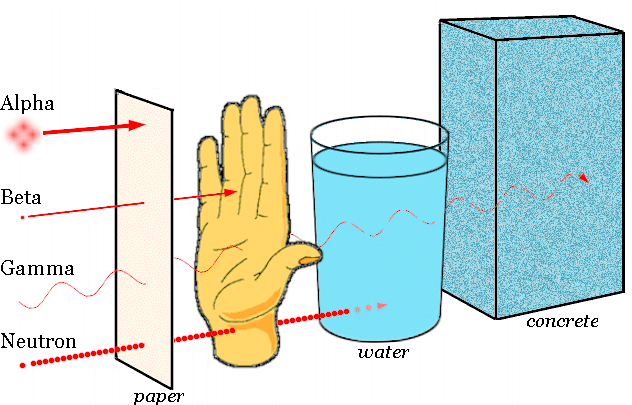
- Alpha radiation is the least penetrating. It can be stopped (or absorbed) by a human hand.
- Beta radiation can penetrate air and paper. It can be stopped by a thin sheet of aluminium.
- Gamma radiation is the most penetrating. Even small levels can penetrate air, paper or thin metal. Higher levels can only be stopped by many centimeters of lead or many meters of concrete..
- Caption: A diagram showing which radiation is the most penetrating.
-
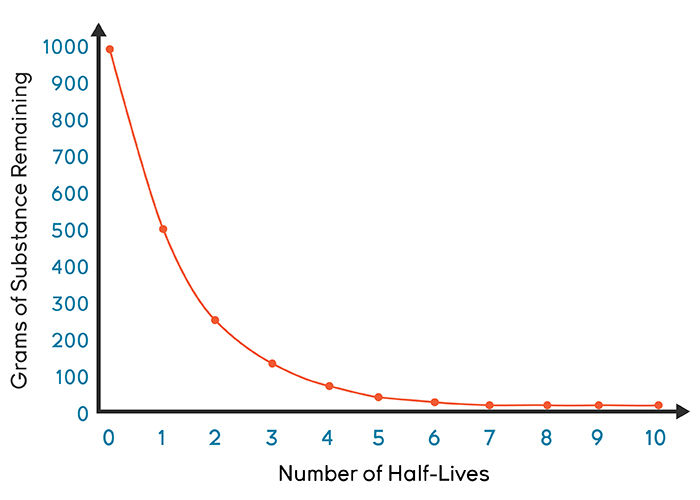
- Half-life, in radioactivity, the interval of time required for one-half of the atomic nuclei of a radioactive sample to decay (change spontaneously into other nuclear species by emitting particles and energy), or, equivalently, the time interval required for the number of disintegrations per second of a radioactive material to decrease by one-half.
- There are two definitions of half-life - but they mean essentially the same thing:the time it takes for the number of nuclei of the isotope in a sample to halve
- the time it takes for the count rate from a sample containing the isotope to fall to half its starting level
- Different radioactive isotopes have different half-lives. For example, the half-life of carbon-14 is 5,715 years, but the half-life of francium-223 is just 20 minutes.
- Caption: It is possible to find out the half-life of a radioactive substance from a graph of the count rate against time. The graph shows the decay curve for a radioactive substance.
-
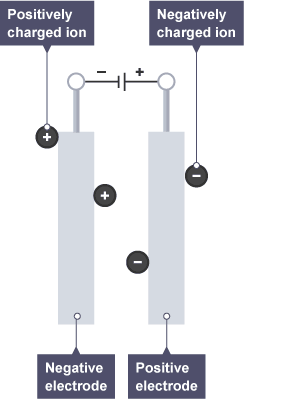
- Caption: This is an anode and a cathode.
- Alpha particles are positively charged, beta particles are negatively charged, and gamma radiation is electrically neutral. This means that alpha and beta radiation can be deflected by electric fields, but gamma radiation cannot.
- Remember that opposite charges attract. Beta particles are negatively charged so they will be attracted towards a positively charged plate. And positive alpha particles will be attracted towards a negatively charged plate. Because they consist of charged particles, alpha and beta radiation can also be deflected by magnetic fields. Just as with electric fields, gamma radiation is not deflected by magnetic fields.
- When alpha and beta particles move in magnetic fields they experience a deflecting force - provided their motion is not parallel to the field.
-
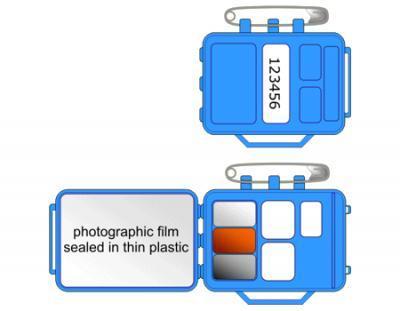
- Caption: The diagram shows a typical radiation badge when it is closed and what the inside looks like when it is opened.
- Photographic film goes darker when it absorbs radiation, just like it does when it absorbs visible light. The more radiation the film absorbs, the darker it is when it is developed.
- People who work with radiation wear film badges, which are checked regularly to monitor the levels of radiation absorbed.
- There is a lightproof packet of photographic film inside the badge. The more radiation this absorbs, the darker it becomes when it is developed.To get an accurate measure of the dose received, the badge contains different materials that the radiation must penetrate to reach the film. These materials may include aluminium, copper, lead-tin alloy and plastic. There is also an open area at the centre of the badge.
-

- Caption: This is a Geiger-Muller Tube
- The Geiger-Muller tube detects radiation. Each time it absorbs radiation, it transmits an electrical pulse to a counting machine. This makes a clicking sound or displays the count rate. The greater the frequency of clicks, or the higher the count rate, the more radiation the Geiger-Muller tube is absorbing.
- The GM tube is a hollow cylinder filled with a gas at low pressure. The tube has a thin window made of mica at one end. There is a central electrode inside the GM tube.
- When an alpha or beta or gamma radiation enters the tube it produces ions in the gas. The ions created in the gas enable the tube to conduct. A current is produced in the tube for a short time. The current produces a voltage pulse. Each voltage pulse corresponds to one ionising radiation entering the GM tube. The voltage pulse is amplified and counted.
Information
- Description
- GCSE Core Science Slide Set on Atoms, created by Aimee Mulholland on 28/04/2017.
- Created by
- Aimee Mulholland · Apr 2017
- Updated
- May 5, 2017
- Views
- 0
- Rating