
Quiz
Chapter 4
This quiz has a time limit, so it opens in the usual player.
Questions in this quiz (85)
1A type of learning in which an organism learns to respond with a conditioned response (CR) to a previously neutral stimulus (CS) that has been repeatedly presented along with an unconditioned stimulus (US). Also called Pavlovian conditioning
- Aoperant conditioning
- Bclassical conditioning
- Caversive conditioning
- Dconditioned compensatory response
2Form of learning, in which an animal learns that one stimulus predicts an upcoming important event, such as food delivery, is known as
- Aoperant conditioning
- Bclassical conditioning
3Pavlovian conditioning is also known as__________
- Aoperant conditioning
- Bclassical conditioning
4A CUE that has some biological significance and in the ABSENCE of prior training, NATURALLYevokes a response
- Aconditioned response
- Bconditioned stimulus
- Cunconditioned response
- Dunconditioned stimulus
5a reflexive response that occur unconditionally occurs for what kind of stimulus
- Aconditioned stimulus
- Bunconditioned stimulus
6In basic classical conditioning, learning occurs when a neutral stimulus is paired with a(an) _______. The neutral stimulus becomes a ___________ which can elicit a conditioned response.
- Aconditioned stimulus; unconditioned stimulus.
- Bunconditioned response; unconditioned stimulus.
- Cunconditioned stimulus; conditioned stimulus.
7The classical conditioning term for a reflexive response elicited by a stimulus in the absence of learning
- AUnconditioned stimulus
- BUnconditioned response
- CConditioned Stimulus
- DConditioned Response
8when an unconditioned stimulus (food) evoke natural response (salivation) it is called_____
- AUnconditioned stimulus
- BUnconditioned response
- CConditioned Stimulus
- DConditioned Response
9The classical conditioning term for an initially neutral stimulus that comes to elicit a conditioned response after being associated with an unconditioned stimulus
- AUnconditioned stimulus
- BUnconditioned response
- CConditioned Stimulus
- DConditioned Response
10Sara has always felt calm and relaxed when listening to classical music. Lately, she’s been lighting a candle just before she listens to classical music. Now she doesn’t even need the classical music to feel relaxed. She can just light a candle. What is the Conditioned stimulus
- Aclassical music
- Brelaxation
- Clit candle
11Sara has always felt calm and relaxed when listening to classical music. Lately, she’s been lighting a candle just before she listens to classical music. Now she doesn’t even need the classical music to feel relaxed. She can just light a candle. WHAT IS THE UNCONDITIONED STIMULUS
- Aclassical music
- Brelaxation
- Clit candle
12Sara has always felt calm and relaxed when listening to classical music. Lately, she’s been lighting a candle just before she listens to classical music. Now she doesn’t even need the classical music to feel relaxed. She can just light a candle. WHAT IS THE UNCONDITIONED RESPONSE?
- Aclassical music
- Brelaxation
- Clit candle
13The classical conditioning term for a response that is elicited by a conditioned stimulus; occurs after the conditioned stimulus is associated with an unconditioned stimulus
- AUnconditioned stimulus
- BUnconditioned response
- CConditioned Stimulus
- DConditioned Response
14The trained response to a conditioned stimulus in anticipation of the unconditioned stimulus that it predicts
- Aconditioned respone
- Bunconditioned response
- Cactivity dependent enhancement
- Dconditioned compensatory response
15conditioning in which the unconditioned stimulus (US) is a positive event (food delivery)
- Apositive reinforcement
- Bappetitive conditioning
- Caversive conditioning
- Dconditioned stimulus
16This type of conditioning consists of learning to predict something that SATISFIES a desire/ APPETITE
- Aclassical conditioning
- Boperant conditioning
- Caversive conditioning
- Dappetitive conditioning
17what are some appetitive unconditioned stimuli
- Ashock
- Bloud noise
- Csex
- Dfood
18Conditioning in which the unconditioned stimulus (US)is a NEGATIVE event e.g. shock, airpuff to eye
- Anegative reinforcement
- Bappetitive conditioning
- Caversive conditioning
- Dnegative punishment
19learning to avoid the consequences of an expected aversive event is what type of conditioning
- Aapetitive conditioning
- Baversive conditioning
- Cclassical conditioning
- Doperant conditioning
20shock and airpuff to eye is a form of what conditioning
- Aapetitive conditioning
- Baversive conditioning
- Cconditioned stimulus
- Dunconditioned stimulus
21Pavlovs study of dogs and food, and Domjan's study of quails and sex are examples of ___________conditioning. The experiment of measuring rats emotional response to tone and shock, as well as the fly odor shock experiment are examples of________ conditioning
- Aclassical; operant
- Boperant; classical
- Caversive; apetitive
- Dapetitive; aversive
22a CLASSICAL conditioning procedure in which the unconditioned stimulus (US) is a airpuff to the eyeand the conditioned (CR) and unconditioned responses (UR) are eyeblinks
- Alatent inhibition
- Bconditioned compensatory response
- Ctolerance
- Deyeblink conditioning
23what is another form of aversive conditioning that induces an anticipatory defensive response e.g. like chuck shutting his windows thinking it might rain
- Aclassical conditioning
- Boperant conditioning
- Ceyeblink conditioning
- Dlatent inhibition
24eyeblink conditioning is the most studied form of classical conditioning in mammals
- ATrue
- BFalse
25face slap was used as an unconditioned stimulus (US) in human eyeblink conditioning
- ATrue
- BFalse
26electromyography (EMG) detectors are used to measure what?
- Atheta-wave
- Bconditioned compensatory response
- Chomeostasis
- Deyeblink response
27In classical conditioning, a conditional response that OPPOSES, rather than BEING THE SAME as, the unconditional response (UR). It functions to reduce the strength of the unconditional response, as in drug tolerance.
- Ahomeostasis
- Baversion conditioning
- Cerror correction learning
- Dconditioned compensatory response
28 if the recreational drug has always been administered in the same room, the stimuli provided by that room may produce a _______________ ; then an overdose reaction may happen if the drug is administered in a different location where the conditioned stimuli are absent.
- Aextinction
- Bprediction error
- Cconditioned compensatory response
- Dlearning inhibition
29what type of response was demonstrated by Pavlov's dogs when they were injected with adrenaline on several occasions but the dog's heart rate increased less and less.
- Ahabituation
- Blearned inhibition
- Cclassical conditioning
- Dconditioned compensatory response
30various cues (the stand, the injection) that predicted the adrenaline injection triggered ______________ that lowered the dogs heart rate in anticipation.
- Aconditioned compensatory response
- Berror correction learning
- Ctolerance
- Dclassical conditioning
31a decrease in reaction to a drug so that larger doses are required to achieve the same effect
- Atolerance
- Bhomeostasis
- Cblocking
- Dextinction
32the TENDENCY of the body (including brain) to gravitate toward a STATE OF EQUILIBRIUM
- Aconditioned compensatory response
- Bhomeostasis
- Ctolerance
- Dblocking
33environmental cues (people, places etc) that accompany drug use can classically condition the user to expect to receive the drug.
- ATrue
- BFalse
34environmental cues that accompany drug use can classically condition the user to expect to receive the drug. what is the CONDITIONED STIMULUS
- Apeople/place
- Bcravings
- Cdrug
35environmental cues that accompany drug use can classically condition the user to expect to receive the drug. what is the UNCONDITIONED STIMULUS
- Apeople/ places
- Bcravings
- Cdrug
36environmental cues that accompany drug use can classically condition the user to expect to receive the drug. what is the CONDITIONED RESPONSE to these cues
- Apeople/ places
- Bcravings
- Cdrug
37the process of reducing a learned response to a stimulus by ceasing to pair that stimulus wit a reward or punishment
- Ablocking
- Btolerance
- Cextinction
- Dinterstimulus interval (ISI)
38When a previously acquired association becomes diminished through repeated presentation of the CS (jingle) in the absence of the US (ice cream) is known as__________
- Alatent inhibition
- Berror correction learning
- Ctolerance
- Dextinction
39When a previously acquired association becomes diminished through repeated presentation of the CS (jingle) in the absence of the US (ice cream) is known as__________
- Alatent inhibition
- Berror correction learning
- Ctolerance
- Dextinction
40extinction is not just unlearning, but rather a combination of unlearning and the learning of a new, opposing response to the CS
- ATrue
- BFalse
41learned responses are not just unexpressed, they are gone!
- ATrue
- BFalse
42a two-phase training paradigm in which prior training to ONE CUE BLOCKS later learning of a SECOND CUE when the two are paired together in a second phase of training
- Alatent inhibition
- Bhomeostatsis
- Cconditioned compensatory response
- Dblocking
43(BLOCKING) even if a cue does predict a US, it may not become associated with the US if its usefulness has been preempted (blocked) by a co-occurring cue that has a longer history of predicting the US
- ATrue
- BFalse
44what demonstrates that classical conditioning occurs only when a cue is both useful and a NONREDUNDANT predictor of the future
- Ablocking
- Bconditioned compensatory response
- Caversive conditiong
- Dlatent inhibition
45a mathematical specification of the conditions for learning that holds that, the degree to which an outcome is surprising modulates the amount of learning that takes placw
- Arescorla-wagner model
- Berror correction learning
- Cprediction error
- Ddelay conditioning
46learning through a process of trial and error, in which the errors on each trial lead to small changes in performance that seek to reduce error on the next trial e.g. tennis serve... is called____________
- Aprediction error
- Blatent inhibition
- Ctrace conditioning
- Derror-correction learning
47Positive prediction error means there is more unconditioned stimulus (US) than expected. Thus the CS--US association should increase proportional to the degree that the US is surprising. The LARGER the ERROR = the GREATER the LEARNING (because you want to learn to predict)
- Aerror correction learning
- Brescorla-wagner model
- Cblocking
48The LARGER the ERROR = the GREATER the LEARNING (because you want to learn to predict)--> rescorla-wagner model
- ATrue
- BFalse
49 the CS--US association should increase proportional to the degree that the US is surprising.- rescorla-wagner model
- ATrue
- BFalse
50According to the rescorla-wagner model, in order for the process of learning by errorcorrection requires which three assumptions
- AEach CS has an associative weight
- Bthe EXPECTATION of the US is based on the SUM OF ALL WEIGHTS for all the CS present
- Clearning is proportional to the timing
- Dlearning is proportional to the prediction error
- Ethe EXPECTATION of the CS is based on the SUM OF ALL WEIGHTS for all the US present
51Prediction error= expected US - actual US
- ATrue
- BFalse
52prediction error= actual US - expected US
- ATrue
- BFalse
53the actual US is defined as 100 if the US OCCURS and 0 if it does not
- ATrue
- BFalse
54the actual US is defined as 0 if the US OCCURS and10 0 if it does not
- ATrue
- BFalse
55a conditioning paradigm in which prior exposure to a CS RETARDS later learning of the CS-US association during acquisition training
- Aerror correction learning
- Bblocking
- Clatent inhibition
- Dprediction error
56there are 2 groups . GROUP 1 (control group) receives NO PRETRAINGING they just sit in phase 1 and wait for phase two. GROUP 2 does recieve pre exposure taining in phase one in which a tone CS is presented but with NO shock. In phase 2 both groups are trained to to associate a TONE (CS) with shock. RESULT pre-exposed group (group 2) learn to associate the tone and shock much SLOWLY than group 1. This is an example of
- Arescorla-wagner model
- Berror correction learing
- Clatent inhibition
- Ddelay conditioning
57a conditioning procedure in which there is NO TEMPORAL GAP between the end of the CS and the beginning of the US, and in which the CS co-terminates with the US. The tone CS continues throughout the trial and only ends once the US has occured
- Adelay conditioning
- Btrace condtioning
58a conditioning procedure in which there IS a TEMPORAL GAP between the end of the CS and the beginning of the US. Uses a shorter CS that terminates some time before the onset of the US
- Adelay conditioning
- Btrace conditioning
59name of the temporal gap between the onset of the CS and the onset of the US
- Adelay conditioning
- Btrace conditioning
- Cinterstimulus interval (ISI)
60In trace conditioning the animal need to maintain a memory trace
- ATrue
- BFalse
61a brain region lying below the cerebral cortex in the back of the head. it is responsible for COORDINATING complex VOLUNTARY MUSCULAR MOVEMENT, including classical conditioning of motor reflex responses
- Acerebeluum
- Bbrainstem
- Cparietal lobe
- Dtemporal lobe
62The cerebellum has two main regions. Lying along the top surface is the _________ . Beneath this lies a collection of cells called the ________________
- Acerebellar cortex, cerebellar deep nuclei
- Bcerebellar deep nuclei, cerebellar cortex
- Cpurkinje cells, interpositus nucleus
- Dinterpositus nucleus, purkinje cells
63a large, drop-shaped densely branching neurons
- Acerebellar deep nuclei
- Bpurkinje cell
- Cinterpositus cell
64The cerebellar cortex contains the Purkinje cells
- ATrue
- BFalse
65The cerebellar deep nuclei contains the Purkinje cells
- ATrue
- BFalse
66one of the cerebellar deep nuclei is called
- Apurkinje cell
- Binterpositus nucleus
- Chippocampus
- Dinferiro olive
67a nucleus of cells with CONNECTIONS TO the thalamus, cerebellum, and spinal cord
- APurkinje cell
- BInferior olive
- Cinterpositus nucleus
- Dhippocampu
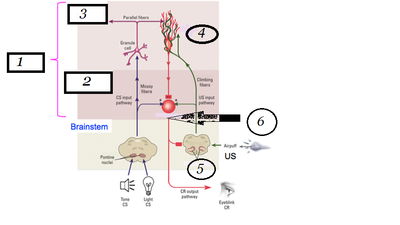
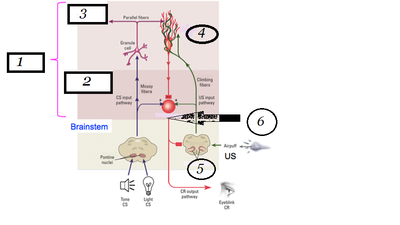
68an airpuff (US) to the eye activates neurons in the INFERIOR OLIVE which in turn activates the _________. The second branch of the inferior olive projects up to the ________ by means of climbing fibers. Each climbing fiber extends to and wraps around a ___________, these which has a very strong excitatory effect on it.
- Ainterpositus nucleus; Purkinje cell; cerebellar cortex
- Bcerebellar cortex; interpositus nucleus; Purkinje cell
- Cinterpositus nucleus; cerebellar cortex; Purkinje cell
- DPurkinje cell; interpositus nucleus; cerebellar cortex
69Identify 1
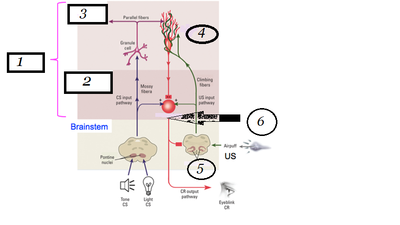
- Acerebellar cortex
- Bcerebellum
- Ccerebellar deep nuclei
70identify 2
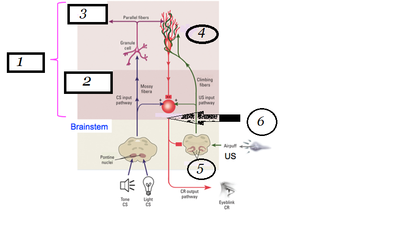
- Acerebellar cortex
- Bcerebellum
- Ccerebellar deep nuceli
71identify 3
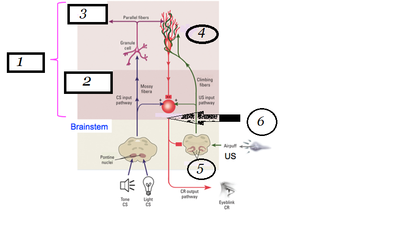
- Acerebellar cortex
- Bcerebellum
- Ccerebellar deep nuclei
72identify 4
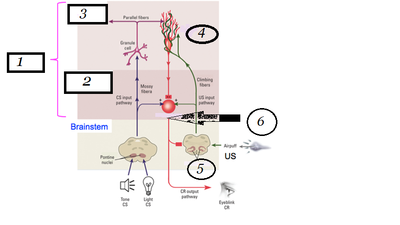
- APurkinje cell
- Binterpositus
- Cinferiror olive
73identify 5
- Apurkinje cell
- Binterpositus
- Cinferior olive
74identify 6
- Apurkinje cell
- Binterpositus
- Cinferior olive
75a string bean structure that lies, in humans, just inward from the ears
- Ainferior olive
- Bpurkinje cell
- Chippocapus
- Dinterpositus nucleus
76the hippocampus IS necessary for learning new conditioned responses
- ATrue
- BFalse
77hippocampus is very active during conditioning, especially in training
- ATrue
- BFalse
78an animal without a hippocampus should NOT exhibit CS modulation effects such as latent inhibition.
- ATrue
- BFalse
79removing the hippocampus eliminates the latent inhibition effect in classical conditioning of the rabbits eyeblink reflex
- ATrue
- BFalse
80The hippocampus plays a role in determining HOW SENSORY CUES are processed BEFORE they are used by the cerebellum to FORM LONG TERM MEMORY TRACES
- ATrue
- BFalse
81oscillating waves of synchronized electrical activity in the hippocampus are necessary for the storage of new info. These are called __________
- Abrain rhythms
- Bactivity dependent enhancement
- Ctheta wave
82oscillating waves of synchronized electrical activity in the hippocampus are necessary for the storage of new info. These are called __________
- Abrain rhythms
- Bactivity dependent enhancement
- Ctheta wave
83_________represents a "ready state" for learning
- Abrain wave
- Btheta wave
- Cactivity dependent enhancement
84when the hippocampus is in a theta state, waves of synchronized neural firing travel back and forth across the hippocampus about ___ times a SECOND!!
- A1
- B3
- C5
- D7
85paired training of a CS and US that produces an INCREASE in the GLUTAMATE VESICLES released from sensory to motor neurons
- Atrace conditioning
- Btheta wave
- Cactivity dependent enhancement
- Dinterstimulus interval (ISI)
Information
- Description
- classical conditioning
- Author
- melikewela
- Language
- English
- Views
- 33
- History
- Created on 13 Mar 2014 · updated on 7 Apr 2018
- Rating
- No ratings yet Rate this quiz