
Quiz
French Revolution Review Quiz I
This quiz has question types that open in the usual player.
Questions in this quiz (16)
1Identify all the causes of the French Revolution
- AIdeas from philosophers such as Rousseau and Locke influenced the French people
- BFrance was in financial crisis because of its unequal tax structure.
- CThe Nobility paid the majority of the taxes.
- DPoor weather conditions led to bad harvest.
- EOverproduction of crops and low food prices resulted in merchants failing to pay taxes.
- FBourgeoisie and the Sans culottes paid most of the taxes.
- GLouis XVI's war with the American colonies led to bankruptcy.
- HThe banks refused to loan France money
2Who said the following quote?
"What is the Third Estate? Everything.
What has it been up to now in the political order? Nothing.
What does it demand? To become something herein."- AMaximilien Robespierre
- BAbbe Emmanuel Joseph Sieyes
- CJean-Jacques Rousseau
- DJean-Paul Marat
- EGeorges Jacques Danton
3The voting procedure of the Estates General was that each estate met separately and each estate had cast [blank_start]one[blank_end] vote. This resulted in the Third Estate, which had the most representatives, being outvoted by the other two estates.
- Aone
4The political and social system that existed in France before the Revolution of 1789 was known as the [blank_start]Ancien Regime[blank_end] (two words) or Old Order.
- AAncien Regime
5The [blank_start]1st Estate[blank_end] consisted of the [blank_start]clergy[blank_end] and made up 1% of the population.
The [blank_start]2nd Estate[blank_end] consisted of the [blank_start]nobility[blank_end] and made up 2% of the population.
The [blank_start]3rd Estate[blank_end] consisted of [blank_start]Bourgeoisie, San Culottes, and Peasants[blank_end] and made up 97% of the population.- A1st Estate
- B2nd Estate
- C3rd Estate
- D2nd Estate
- E1st Estate
- F3rd Estate
- G3rd Estate
- H2nd Estate
- I1st Estate
- Jclergy
- Knobility
- LBourgeoisie, San Culottes, and Peasants
- Mnobility
- Nclergy
- OBourgeoisie, San Culottes, and Peasants
- PBourgeoisie, San Culottes, and Peasants
- Qclergy
- Rnobility
6The Third Estates were made up of:
[blank_start]Bourgeoisie[blank_end] were city-dwelling middle class made up of [blank_start]merchants[blank_end], manufacturers and professional people such as [blank_start]doctor[blank_end] and lawyers
[blank_start]sans-culottes[blank_end] were skilled laborers and [blank_start]artisans[blank_end]
[blank_start]Peasants[blank_end] who were ranked at the bottom of the Third Estate. They paid the heaviest taxes and rents as well as owed feudal dues and services- Adoctor
- Bsans-culottes
- Cartisans
- DPeasants
- ENobility
- FBourgeoisie
- Gmerchants
7[blank_start]Marie Antoinette[blank_end] (first and last name) was the Queen of France during the French Revolution. She was the daughter of [blank_start]Maria Theresa[blank_end] (first and last name) who was the Empress of Austria.
- AMarie Antoinette
- BMaria Theresa
8[blank_start]Estates General[blank_end] (two words): the representative body that existed in France during the Ancien Regime. It was drawn from all three Estates
- AEstates General
9Place the following events in their proper order
France supports the American Revolution
The Banks refuse to loan France any money
[blank_start]Estates General is called into session[blank_end]
The King refuses to change the voting procedure
[blank_start]The National Assembly is formed[blank_end]
The Third Estate is locked out of Versailles
[blank_start]Tennis Court Oath[blank_end]
[blank_start]Storming the Bastille[blank_end]
[blank_start]The Great Fear[blank_end]
National Assembly writes the Constitution of 1791
[blank_start]Legislative Assembly is formed[blank_end]- AEstates General is called into session
- BThe National Assembly is formed
- CTennis Court Oath
- DStorming the Bastille
- EThe Great Fear
- FLegislative Assembly is formed
10Identify the titles of the figures in the picture below.
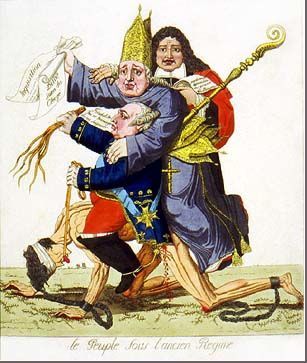
- AKing
- BNobility
- CClergy
- DCommoners
- EKing
- FClergy
- GNobility
- HCommoners
- IKing
- JClergy
- KNobility
- LCommoners
- MKing
- NClergy
- ONobility
- PCommoners
11Identify everything that involved the National Assembly
- AIt was formed by the 2nd Estate in reaction to the voting procedures of the Estates General.
- BIt wrote the Declaration Rights of Man
- CIt declared war on Austria
- DIt wrote the Constitution of 1791
- EIt came into power after the Legislative Assembly was dissolved.
- FIt ended feudalism in France.
- GIt created a Limited Constitutional Monarchy
12The [blank_start]Civil Constitution of the Clergy[blank_end] resulted in France taking control of the Catholic Church.
- ACivil Constitution of the Clergy
13On July 14, 1789, the need for weapons led to
- AThe calling of the Estates General
- BThe formation of the National Assembly
- CThe Woman’s March on Versailles
- DThe Storming of the Bastille
14Identify the event that is described in the quote below
““Sir, the flames are sweeping through Anjou and Maine. The Comte de Laurencin read out to us yesterday the terrible events suffered by Madame, his sister, at two chateaux (houses) in Dauphine: papers burnt, the chateaux pillaged (robbed) and roofs removed if they were not burnt. They were not even left with the means of gathering and securing their harvest..”- AThe Storming of the Bastille
- BThe Great Fear
- CThe Women's March on Versailles
- DThe September Massacre
15The excerpt below was part of the Constitution of 1791. What kind of government does the above passage describe?
2. The person of the King is inviolable and sacred; his only title is King of the French.
3. There is no authority in France superior to that of the law; the King reigns only thereby, and only in the name of the law may he exact obedience.
4. On his accession to the throne, or as soon as he has attained his majority, the King, in the presence of the legislative body, shall take oath to the nation to be faithful to the nation and to the law, to employ all the power delegated to him to maintain the Constitution decreed by the National Constituent Assembly in the years 1789, 1790, and 1791, and to have the laws executed.- AA Republic
- BA Dictatorship
- CA Limited Constitutional Monarchy
- DAn Absolute Monarchy
16Identify the document where the below excerpt appeared.
“His Majesty the Emperor [of Austria] and his Majesty the King of Prussia… jointly declare that they regard the present situation of his Majesty the king of France as a matter of common interest to all the sovereigns (rulers) of Europe. .”- AThe Brunswick Manifesto
- BThe Friends of the People
- CThe Declaration of Pillnitz
- DDanton's Address to the National Convention
Information
- Description
- Review activity for the lesson on the French Revolution
- Author
- K. Asher
- Language
- English
- Views
- 346
- Tags
- Rating
- 5.0 out of 5 · 1 rating Rate this quiz