
Determiners
Slides in this set (11)
-
- Content:
- 1. Definite article (the)
- 2. Indefinite article (a, an)
- 3. Zero article
- 4. Numbers in English (cardinal, ordinal)
- 5. Quantifiers (countable, uncountable, countable and uncountable)
- 6. Distributive determiners (all, both, half, either, neither, each, every)
- 7. Possessive adjectives (my, your, his, her, its, our, their)
- 8. Demonstratives (this, that, these, those)
- 9. Interrogative adjectives (which, what, whose)
- 10. Pre-determiners (such, what, rather, quite)
-
- The word 'the' is a definite article. Nouns are preceded by the definite article when the speaker believes that the listener already knows what he is referring to. The speaker may believe this for many different reasons, some of which are listed below.
- Use 'the' to refer to something which has already been mentioned.
- For example: I was walking past Benny's Bakery when I decided to go into the bakery to get some bread.
- Use 'the' when it is assumed that there just one of something in that place, even if it has not been mentioned before.
- For example: We went on a walk in the forest yesterday.
- Use 'the' in sentences or clauses where you define or identify a particular person or object.
- For example: The man who wrote this book is famous.
- Use 'the' to refer to people or objects that are unique.
- For example: Clouds drifted across the sky.
- Use 'the' before superlatives and ordinal numbers.
- For example: He is the most outstanding singer in the choir.
- This is the third time I have called you today.
- Use 'the' with adjectives, to refer to a whole group of people.
- For example: The elderly require special attention.
- Use 'the' with decades.
- For example: He was born in the seventies.
- Use 'the' with clauses introduced by 'only'.
- For example: You are the only person he will listen to.
-
- Use 'the' with names of geographical areas, rivers, mountain ranges, groups of islands, canals and oceans.
- For example: They are travelling in the Arctic.
- Use 'the' with countries that have plural names.
- For example: I have never been to the Philippines.
- Use 'the' with countries that include the words 'republic', 'kingdom', or 'states' in their names.
- For example: She is leaving the United States.
- Use 'the' with the names of famous buildings, works of art, museums or monuments.
- For example: We went to the Louvre and saw the Mona Lisa.
- Use 'the' with the names of families, but not with the names of individuals.
- For example: We are having dinner with the Smiths tonight.
-
- The two indefinite articles are 'a' and 'an'. For pronunciation reasons, depending on the first letter of the word following the article, one or the other article is used. Use 'a' when the next word starts with a consonant, or before words starting in 'u' and 'eu' when they sound like 'you'.
- For example: a car (starts with the consonant 'c')
- a university (starts in 'u' which is pronounced 'you
- Use 'an' when the next word starts with a vowel (a, e, i, o, u) or with a mute 'h'.
- For example: an ugly duck (starts with the vowel 'u')
- an honour (starts with a mute 'h')
- Use 'a' or 'an' to refer to something for the first time.
- For example: I have finally bought a new pair of headphones.
- Use 'a' or 'an' with names of jobs.
- For example: She wishes to be an accountant when she grows up.
- Use 'a' or 'an' with nationalities and religions in the singular.
- For example: Kate is a Catholic.
- Use 'a' or 'an' with the days of the week when not referring to any particular day.
- For example: I was born on a Thursday.
- Use 'a' or 'an' to refer to an example of something.
- For example: The elephant has a long trunk.
- Use 'a' or 'an' with singular nouns after the words 'what' and 'such'.
- For example: She is such an intelligent girl.
- Use 'a' or 'an' to meaning 'one', referring to a single object or person, or a single unit of measure.
- For example: The burglar took a diamond necklace and some valuable paintings.
-
- There are times when no article is needed before a noun. This is called the zero article. An article is not used when names of most people, cities, districts and countries are mentioned.
- For example: She is furthering her studies in Knightsbridge, London.
- An article is not used when talking about specific sports and games.
- For example: Alexis and Aaron always play table tennis together.
- An article is not used when referring to uncountable nouns and plural nouns in general.
- For example: We watch news for information.
- The cardinal numbers (one, two, three, etc.) are adjectives referring to quantity, and the ordinal numbers (first, second, third, etc.) refer to distribution.
- For example: Six hundred thousand people were left homeless after the earthquake.
- We use adjectives of quantity to show the amount or number of things. They are also known as quantifiers. These quantifiers are used with countable nouns.
- Several: Several people fainted from a lack of oxygen as the stadium was crowded.
- Many: There were many bargain-hunters at the sale.
- (A) few: Few people are here today due to the school examinations.
- Each: Each household is given a copy of the renovation guidelines.
- Every: Every pupil is expected to comply with the school rules.
- Both: Both Andrew and Andrea were disappointed with the results of the writing competition.
- Another: I am going to have another piece of cake.
- Either: Either Team A or Team B will qualify for the finals.
- Neither: Neither Ted nor I thought that Tim would win the competition.
- Fewer: There are fewer children enrolled in this school than in that school.
- None of: None of their drawings were selected for the art exhibition.
- A / the whole: I have read the whole manuscript.
-
- These quantifiers are used with uncountable nouns.
- Much: Because of the rain, were were not able to spend much time on the beach.
- (A) little: There was very little time to be lost.
- Less: I would like less sugar in my coffee.
- These quantifiers are used with both countable and uncountable nouns.
- A lot of: There are a lot of brownies left in the oven. (countable) There is not a lot of time left. (uncountable)
- Some: Some babies are crying in the baby room. (countable) Please add some oil into the pot. (uncountable)
- Any: I have not seen any of his movies. (countable) There was hardly any food left by the time we got there. (uncountable)
- All (the): All camels can go without water for a long period of time. (countable) All expenses for the trip have been paid for. (uncountable)
- Half of the: The children ate half of the cookies in the jar. (countable) You must finish half of the mango juice before it expires. (uncountable)
- No: There are no animals left in the wild. (countable) There is no water left in the flask. (uncountable)
- The other: In the other school, there are more male teachers. (countable) The other paint has dried up. (uncountable)
- Plenty of: There are plenty of eggs in the kitchen. (countable) The movie has plenty of action. (uncountable)
- Enough: There are enough board games to keep the children entertained. (countable) There is enough suspense in the book to make it a bestseller. (uncountable)
- More: More children were sick yesterday. (countable) I would like to see more soup in my bowl. (uncountable)
- Most (of the): The police solved most of the cases quickly. (countable) Most of the ice cream was eaten by Jerry. (uncountable)
-
- Distributive determiners refer to a group of people or things, and to individual members of the group. They show different ways of looking at the individuals within a group, and they express how something is distributed, shared or divided.
- Use 'each' and 'every' to talk about the members of a group as individuals.
- Use 'all' to talk about the whole group.
- Use 'half' to talk about a divided group.
- Use 'both', 'either' and 'neither' to talk about pairs of people or things.
- 'Each' is a way of seeing the members of a group as individuals, while every is a way of seeing group as a series of members. These distributives can only be used in countable nouns. They are normally used with singular nouns, and are placed before the noun. In many cases, they are interchangeable.
- For example: Each child received a present.
- Every child received a present.
- 'Each' can also be used with plural nouns and pronouns but must be followed by 'of'. Every cannot be used with plural nouns.
- For example: Each of the children received a present.
- 'Every' can express different points in a series, especially with time expressions. Each works in the same way, but is less common.
- For example: This magazine is published every week.
-
- 'All' can be used with uncountable nouns and plural countable nouns by itself. In this usage, it refers to the group as a concept rather than as individuals.
- For example: All cheese contains calcium.
- 'All' can be used with uncountable nouns and plural countable nouns preceded by 'the' or a possessive pronoun. In this case, the meaning is shifted towards referring to a concrete, physical group rather than the group as a concept. In these uses, the word 'of' can be added just after 'all' with no change in meaning.
- For example: All the people in the room were silent.
- I have invited all my friends to the party.
- 'All' can be used with plural pronouns preceded by 'of'.
- For example: All of us are going to the party.
- 'All' can be used with questions and exclamations with uncountable nouns preceded by 'this' or 'that'. In these uses, the word 'of' can be added just after 'all' with no change in meaning.
- For example: Who has left all this paper on my desk?
- 'All' can be used with questions and exclamations with countable nouns preceded by 'these' or 'those'. In these uses, the word 'of' can be added just after 'all' with no change in meaning.
- For example: Why are all these children crying?
-
- The distributive determiner 'half' is used to talk about a whole group divided in two. 'Half' can be used with measurements preceded by an indefinite article (a or an). In this case, it refers to a measurement.
- For example: He ran half a mile this morning.
- 'Half' can be used with nouns preceded by 'the', 'a', a demonstrative pronoun, or a possessive pronoun. In this case, the meaning refers to a concrete, physical division. The word 'of' can be added just after 'half' with no change in meaning.
- For example: I spent half that time on my project.
- 'Half' can be used with plural pronouns preceded by 'of'.
- For example: He scolded half of them but he let the rest off.
- 'Both' refers to the to the whole pair. 'Both' can be used with plural nouns on its own, or it can be followed by 'of', with or without an article. When followed by a plural pronoun, 'both' must be separated from the pronoun by 'of'. Both cannot be used with singular nouns, because it refer to two things.
- For example: Both the children were born in Italy.
- Both of us like skiing.
- 'Either' is positive and when used alone, refers to one of the two members of the pair. Because it refers to just one member of a pair, either must be used before a singular noun. It can also be used with a plural noun if followed by 'of'.
- For example: Either day is fine for me.
- I can eat either of the salads.
- 'Either' can also be used with 'or' in a construction that talks about each member of the pair in turn. The meaning remains the same, but in this case 'either' is not functioning as a distributive. It is functioning as a conjunction.
- For example: You can have either ice cream or chocolate cake.
- 'Neither' is negative and when used alone, refers to the whole pair. Because it refers to just one member of a pair, 'neither' must be used before a singular noun. It can also be used with a plural noun if followed by 'of'.
- For example: Neither parent came to meet the teacher.
- I think neither of these dresses fit me.
- 'Neither' can also be used with 'nor' in a construction that talks about each member of the pair in turn. The meaning remains the same, but in this case 'neither' is not functioning as a distributive. It is functioning as a conjunction.
- For example: Neither Brian nor his wife mentioned anything about moving house.
-
- Possessive adjectives indicate ownership. They are used before the things belonging to a person or an animal. Possessive adjectives are not pronouns, but rather determiners. They function as adjectives, so they appear before the noun they modify. They do not replace a noun as pronouns do.
- For example: Samantha will fix her bike tomorrow.
- There are three groups of possessive adjectives.
- First person: my, our
- Second person: your
- Third person: his, her, its, their
- For example: I hurt my wrist while playing basketball.
- We will discuss the project at your house.
- Marianne could hardly contain her excitement when she saw the puppy coming out of its cage.
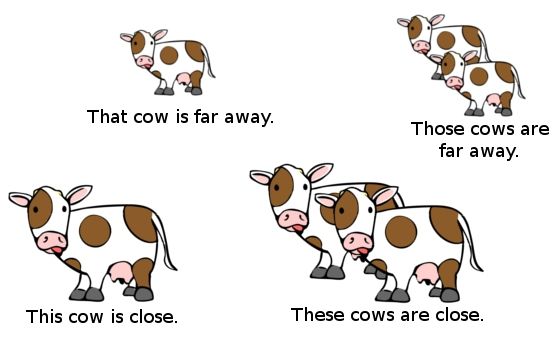
- Demonstratives show where an object, event, or person is in relation to the speaker. They can refer to to a physical or a psychological closeness or distance. When talking about events, the near demonstratives are often used to refer to the present while the far demonstratives often refer to the past.
- For example: This time I would not be late.
- We really surprised you that time.
- Demonstrative with singular nouns and uncountable nouns: this (near the speaker), that (far from the speaker)
- For example: This room is the Science laboratory. That room over there is the computer lab.
- Demonstrative with plural countable nouns: these (near the speaker), those (far from the speaker)
- For example: These dresses are as pretty as those dresses that we saw in the other shop.
- Demonstratives can be placed before the noun or the adjective that modifies noun.
- For example: This blue car needs to be washed next.
- Demonstratives can also appear before a number by itself when the noun is understood from the context.
- For example: I would like to try on that one.
- Demonstratives can be used by themselves when the noun they modify is understood from the context.
- For example: That has nothing to do with me.
-
- We use interrogative adjectives such as 'which', 'what' and 'whose' to ask questions about a particular noun. We put interrogative adjectives before a noun.
- For example: Which dressing table do you prefer?
- What is the title of this play?
- Whose idea is it to play in the kitchen?
- 'Which' is used with 'of' before a plural noun.
- For example: Which of the movies will be premiering first?
- Pre-determiners are normally placed before an indefinite article + adjective + noun to express an opinion about the noun they modify. 'Such' and 'what' are used to express surprise or other emotions.
- For example: You cannot imagine what an incredible meal I just ate.
- 'Rather' and 'quite' are commenting words, referring to the degree of a particular quality as expressed by the adjective that modifies the noun. They can express disappointment, pleasure, or other emotions depending on the adjective in question.
- For example: He had quite a bad accident.
Information
- Description
- Year 1 English Language Slide Set on Determiners, created by XIN YI LIM on 29/08/2017.
- Created by
- XIN YI LIM
- Views
- 1
- Tags
- Rating