
Articles, Determiners and Quantifiers
898 resources created by 757 users
This Articles, Determiners and Quantifiers page on GoConqr gathers community-made quizzes, mind maps, flashcards, flowcharts and notes, from a/an and the to some and any, much and many, and too and enough. It's built for school students practising everyday grammar and for teachers after ready-made material. There are over 800 resources here, including more than 130 quizzes and over 500 mind maps, mostly at secondary level. Pick a topic, try a quiz, then see what you remember.
Select topic
- Types of Determiners21
- Countable and Uncountable Nouns45
- Definite and Indefinite Articles105
- Indefinite Articles: A and An50
- Definite Article: The30
- Zero Article32
- Demonstratives: This, That, These and Those26
- Quantifiers195
- Some and Any64
- Much, Many and A Lot Of40
- How Much and How Many28
- Few, A Few, Little and A Little9
- All, Each, Every, Both, Either and Neither19
- Partitives and Measure Words6
- Too, Enough, So and Such22
Top Articles, Determiners and Quantifiers resources
-
Mind map Too much many very enough
-
Mind map The - Definite article Identifying nouns with the definite article
-
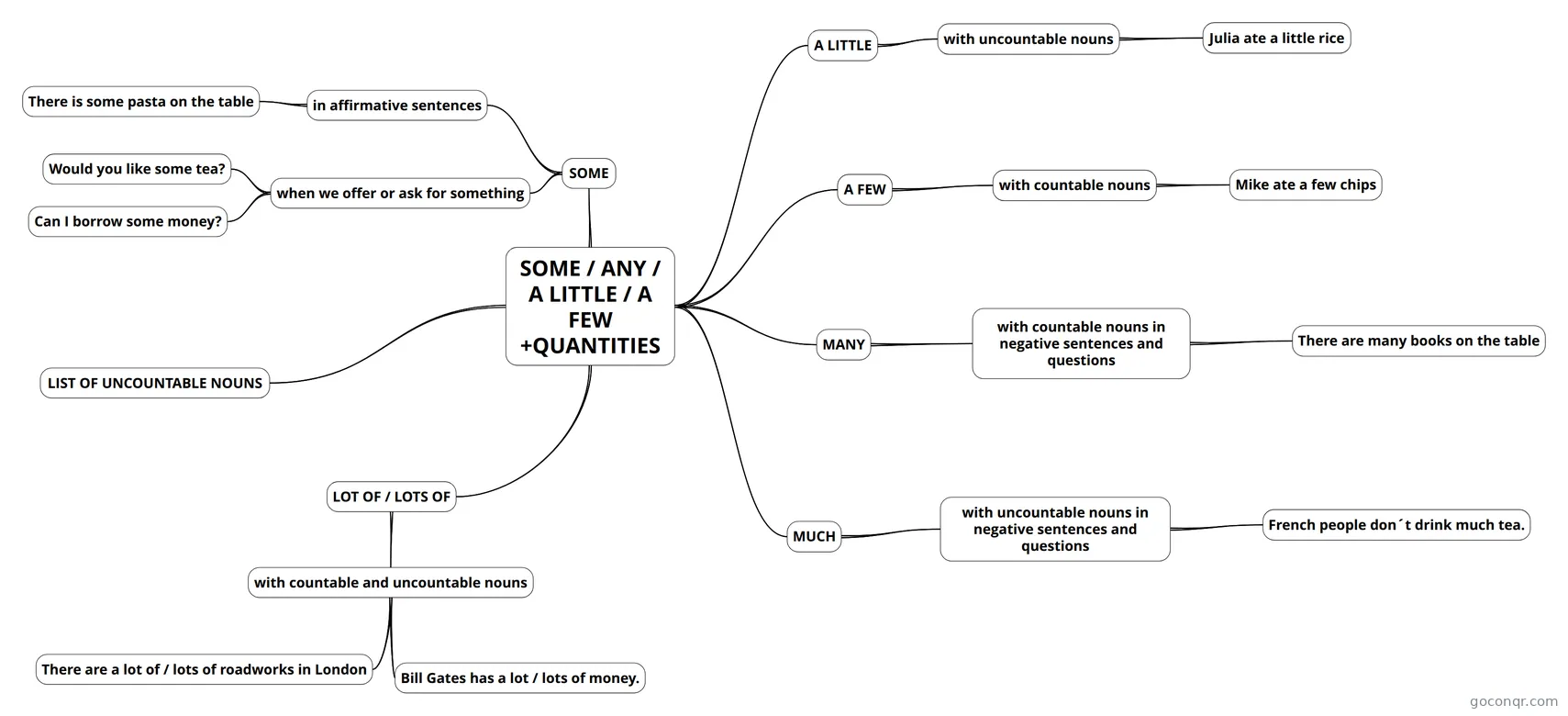 Mind map SOME / ANY / A LITTLE / A FEW +QUANTITIES
-
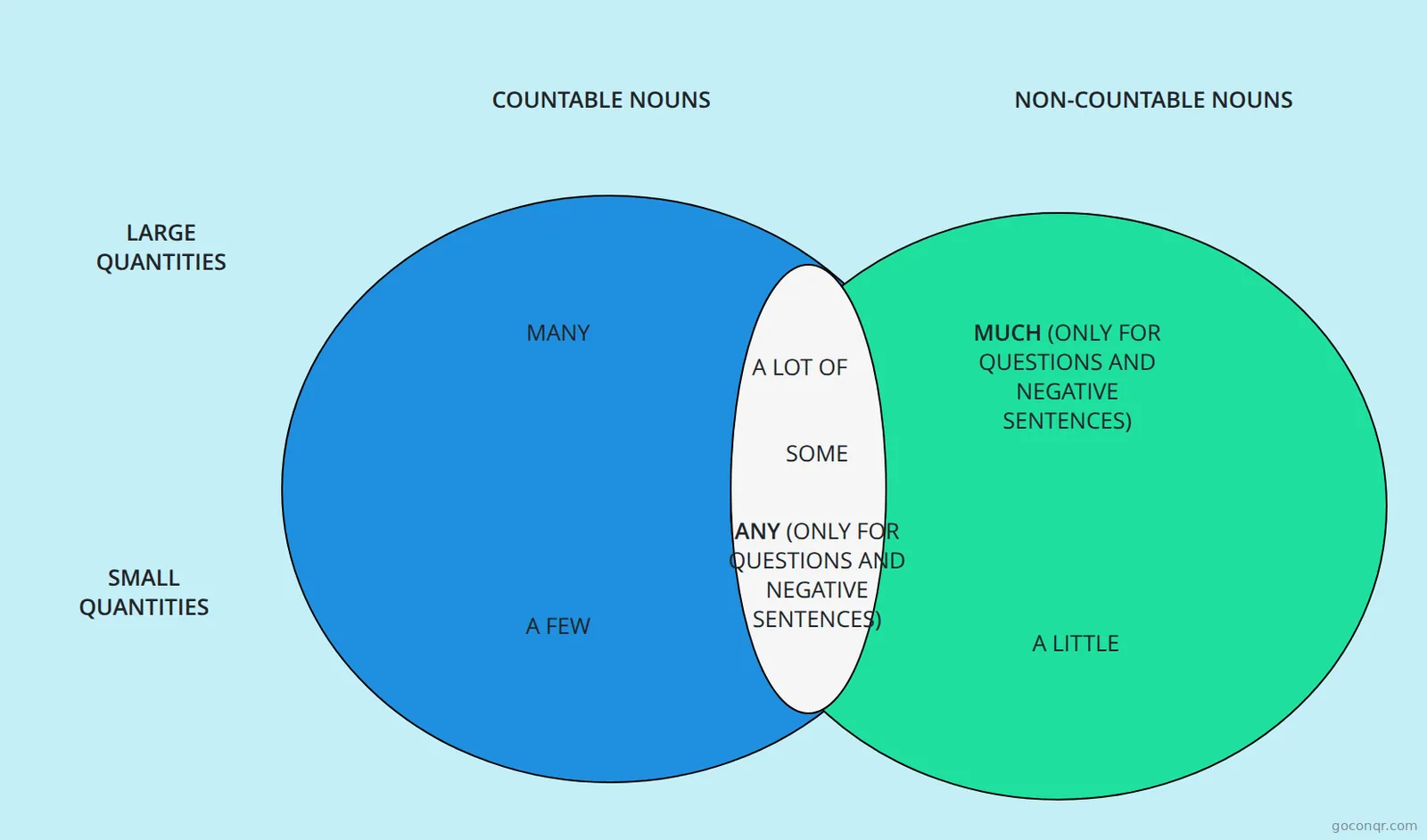 Flowchart Diagram for explaining quantifiers for Count and Non-count nouns This diagram can be used to explain the quantifiers for Count and Non=count nouns.
-
10 questionsPlaces to live What place is the hottest in the world?
-
16 questionsThisThatTheseThose Look at … birds up there in the tree.
-
9 questionsExcercise of quantifiers II Choose the correct option.
-
Mind map QUANTIFIERS
Quizzes
See all 159 quizzes-
10 questionsPlaces to live What place is the hottest in the world?
-
16 questionsThisThatTheseThose Look at … birds up there in the tree.
-
9 questionsExcercise of quantifiers II Choose the correct option.
-
8 questionsChoose the words in the box and fill in the blanks.
-
5 questionsUso de A y AN Pon en práctica lo aprendido
-
6 questionsSupermarket There isn’t any butter.
-
20 questionssome any there is there are...
-
5 questions10th grade. Unit 3. Articles in Set Expressions (Part 2)
Mind maps
See all 574 mind maps
Flashcards
See all 89 flashcards-
11 cardsST7 CL13 R&WPT1 What's this? (This/These) SS will guess the shadow. To answer they'll make sentences with This is... or These are... To assign turns ...
-
5 cardsa and an Uses of the Articles A and An
-
8 cardsMuch vs Many Practice Many, Much, a lot of
-
8 cardsSpanish: Definite and Indefinite Articles Indefinite Article Masculine, Singular
-
8 cardsAdverbs of Quantity ABVERBS OF QUANTITY Revise: Countables Nouns and Uncountables Nouns
-
20 cardsUntitled 1) The fish was delicious, but I found a little / a few bones.
-
21 cardsArticles With singular countable nouns when we talk about things in general.
-
10 cardsPC2 QUANTIFIERS
Flowcharts
See all 46 flowchartsNotes
See all 15 notes-
Quantifiers (video)
-
9. Final Review 1. Use 'a/an' for singular countable nouns - I eat a banana every day - I really want a dog this Christmas - I want to buy an apple for lunch2. Don't use 'a/an' or 'the' for plural countable nouns and u...
-
5. When to use 'the' 1. When talking about one particular thing i.e. when the speaker knows which particular thing they have in mind.e.g.I'm going to the doctor tomorrow morning. - the speaker is going to their usual doctor - not any...
-
7. When not to use 'a/an' or 'the' 1. When we are talking about people or things in general: - I'm afraid of dogs - Doctors are paid more than teachers - Do you often listen to classical music? - I go to school (i.e. the speaker is ...
-
Unit 1 "All in the Family" Lesson 3 All in the family : Sleepless Nights Warm up: 1. What's the best age to have children?2. How does your life change when you have your first baby, do you think?3. Do you ever look after children for friends or someone ...
-
4. Review Countable A countable noun can be singular or plural I eat a banana every day I like bananas Examples when to use a/an Ann was singing a song It was an accident Can I have a 10 Euro note? Uncountable An uncountable no...
-
2. a/an Countable A countable noun can be singular or plural For example: I eat a banana every day I like bananas Examples when to use a/an Ann was singing a song It was an accident Can I have a 10 Euro note? Uncountable An u...
-
LET'S HELP THEM - Criado a partir de um Mapa Mental LET"S HELP THEM Little jobs for young people Which do you like better,cats or dogs?
Slides
See all 15 slidesTopics in Articles, Determiners and Quantifiers
More English language topics
About Articles, Determiners and Quantifiers
GoConqr OriginalWhat this unit covers
The page is about the small words that sit in front of nouns. It has three main threads: articles, demonstratives and other determiners, and quantifiers. Resources come as mind maps, quizzes, flashcards, flowcharts, slides and notes, all made by GoConqr users.
Articles
Start with the mind map Articles (A-An-The). It shows that a goes before a consonant sound and an before a vowel sound, and that the is used when something is named for the second time or when there is only one of it. The mind map The - Definite article adds shared information, visual context and general knowledge. Then test yourself with the quiz Uso de A y AN, which asks you to pick a or an for words such as elephant and university. For the zero article, look at the flowcharts on when to use no article.
Determiners and quantifiers
- THIS/THAT-THESE/THOSE separates things near us from things far away.
- SOME / ANY / A LITTLE / A FEW +QUANTITIES covers some in affirmative sentences and offers, such as Would you like some tea?
- The flowchart Diagram for explaining quantifiers for Count and Non-count nouns sorts many, much, a few, a little and a lot of.
- too / enough too much / too many deals with too and enough with nouns and adjectives.
How to study with maps and quizzes
- Read a mind map or flowchart on one point.
- Take a quiz on the same point, such as the Supermarket quiz on some, any, a little and a lot of.
- Go back to the map for anything you got wrong.
- Use flashcards such as Much vs Many for quick repeat practice.
Teachers can use the slide sets, notes and quizzes as ready-made starters or short checks.
Where it sits
This unit belongs to the strand Grammar: Words and Sentences in English language. Most resources are pitched at secondary level. Choose one topic, open a quiz, and build your own maps and flashcards as you go.
Frequently asked questions
Where should I start on this page?
Begin with the mind map Articles (A-An-The) if a, an and the are new to you, or the quantifiers flowchart if much and many confuse you. Then take a quiz on the same point, such as Uso de A y AN or Supermarket, to see what stuck.
What do the mind maps cover?
There are over 500 mind maps. They cover definite and indefinite articles, the zero article, this and that, these and those, some and any, little and few, too and enough, and all and the whole. Many include short example sentences you can copy into your own notes.
Are the resources free to use?
Yes. Every resource listed here is free to open, study and take, with no account needed. A free account also saves your quiz scores and lets you make your own quizzes, mind maps, flashcards and notes.
Who made these resources?
They were made by GoConqr users, not by GoConqr itself. Over 600 contributors have added material, so the style and depth vary. Some resources include Spanish or Portuguese wording, so check the title and a few lines before you commit.
Which levels are the resources aimed at?
Most of them, about 93 per cent, are at secondary level, so they suit school students working on everyday grammar. A small share is aimed at other levels. Teachers can pick through the quizzes, flashcards and slide sets for classroom practice.
What if the exact topic I need is missing?
Try a nearby title first. Some and any, for example, appear in maps, quizzes, flowcharts and slides under different names. If you still cannot find it, make your own mind map, quiz or flashcards, using a free account to keep them.