
Flashcards
ATP, DNA, RNA
Cards in this deck (14)
- 1what is DNA?Deoxyribonucleic acid, carries the genetic code of an organism. Replication of DNA for cell division , provides code for protein synthesis
- 2What is RNA?Ribonucleic acid, synthesises proteins
- 3What is ATP?Adenosine Triphosphate is the universal energy currency of living organisms, can diffuse.
Adenine joined to a ribose base and 3 phosphate groups - 4What are the 3 components of a nucleotide?- phosphate group
- pentose sugar
- organic nitrogenous base - 5ATP hydrolysisATP + water -> ADP + pi, 30.6kJmol energy is released
- 6What is a pyrimidine?single ring structure, Cytosine, Thymine (DNA) and Uracil (RNA)
- 7What is a purine?double ring structure, Adenine, Guanine
- 8Structure of DNA2 strands of nucleotides which are antiparallell , that form a double helix, with a sugar-phosphate backbone. A and T pair - 2H bonds
C and G pair - 3H bonds - 9What are the types of RNA?messenger RNA - formed in nucleus by transcription of a stand of DNA, carries code for polypeptide chain that will be formed in translation stage of protein synthesis
ribosomal RNA - combines with protein to form ribosomes
transfer RNA - transports amino acids to the ribosome for translation, has an anticodon and amino attachment site - 10Semi-conservative method for DNA replication- one double-stranded molecules of DNA unwinds, hydrogen bonds are broken by DNA helicase
- DNA polymerase catalyses the addition of free DNA nucleotides to form new complementary strands, using both original strands as templates
- hydrogen bonds form between each complementary DNA strand, causing the molecule to twist into a double helix.
- 2 molecules of DNA are identical to each other and the original strand of DNA - 11Meselson and Stahls proof of semi-conservative DNA replication- cultivated bacteria in a flask in a nutrient medium which source of N was N-15
-Bacteria took up N-15 and used it in nitrogenous bases of nucleotides
-sample of bacteria lysed & centifuged, DNA settled at a low point in tube.
- Then put same bacteria in N-14 culture, lysed and centifuged, DNA settled at a mid point on tube
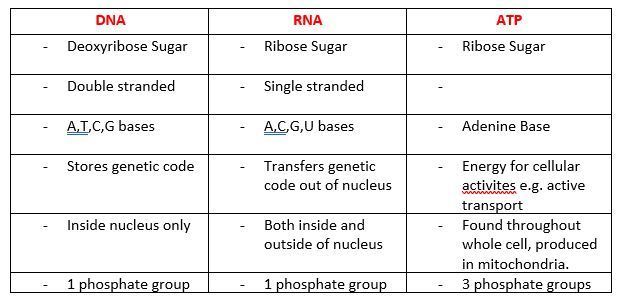
- Then in N-14 again, centifuged and there is a midpoint and higher point - 12DNA vs. RNA vs. ATP sugar type strand bases function location no. P groups
- 13Advantages of ATP vs. Glucose- ATP requires 1 reaction, glucose many to release energy
- ATP requires only 1 enzyme, glucose many
- ATP contains a smaller amount of energy so can be released when and where is needed, glucose has a lot which could be released all at once
- ATP is universal - 14Process of DNA replication- during interphase
- DNA unzips with DNA helicase
- Free nucleotide aligns next to their complimentary base pair
- DNA polymerase catalysed formation of phosphodiester bond --> forming a new strand
1st leading strand 3' -> 5'
2nd lagging strand in sections, joined by DNA ligase