
Flashcards
Lecture Nine - Enzyme Inhibition/Regulation of Enzyme Activity
Cards in this deck (18)
- 1Concepts to understand• Four types of enzyme inhibition
• For each how Km and v max are affected by the inhibition
- Allosteric regulation, both inhibition, and activation
-Example of Phosphofructokinase
-Upstream reaction is often controlled by downstream products that modulate enzyme activity
• Covalent modification
-Multi-enzyme complexes - 2Enzyme terminology ____: The molecule on which an enzyme acts. Catalytic center or Active site: The specific site where the substrate binds to an enzyme. Transition state: Intermediate state formed by enzyme and substrate Enzyme-substrate complex: is formed in the transition state ___ ___: An energy barrier that reacting molecules must overcome to form products. ___: Molecules or ions that are essential for the catalytic activity, includes metals or small organic moleculesSubstrate
Activation energy
Cofactors - 3Km = measure of E-S affinity km = __ at Vmax/2 Reaction reaches maximum rate at lower [S] when Km is ___ Two ways to change Vmax : 1) K2 2) [E][S]
smaller - 4Enzyme Regulation In health: • Enzymes must be tightly ___ to do the work only where and when needed and not to cause damage. In disease: • Enzymes can be drugs (e.g., digestive enzymes) • Enzymes can be targeted by drugs, for example by regulating their activity. *Many drugs are enzyme ____.regulated
inhibitors - 5Enzyme inhibition -Inhibition is one of the fastest regulation mechanisms -An inhibitor can bind to an enzyme to __ down the reaction rate V. The binding can be: A) reversible (reversible inhibition). Weak non-covalent bonds are formed and easily broken. B) irreversible (irreversible inhibition). Often covalent bonds are formed. Non-covalent bonds can form as well. The enzyme often becomes ___.slow
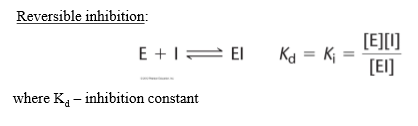
dysfunctional - 6Reversible inhibition: There are three major inhibition mechanisms that demonstrate different enzyme kinetics: 1. Competitive inhibition (la. classical and lb. non-classical) 2. Non-competitive inhibition 3. Uncompetitive inhibition
- 71. Competitive inhibition What happens to Vmax? Km? 2. Non-competitive inhibition Vmax? km? 3.Uncompetitive inhibition Vmax? km?1. Vmax unchanged
Km increases
2. Vmax decreases
Km unchanged
3. Both Vmax & Km decreased - 8Competitive Inhibition a) Classical competitive inhibition -Inhibitor resembles substrate -inhibitor ___ the ES time and therefore, also __ affinity **This is why Km ___reduces
reduces
increases (higher Km = lower affinity)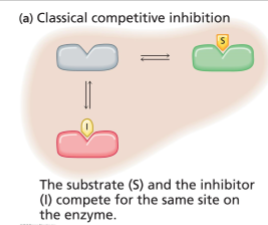
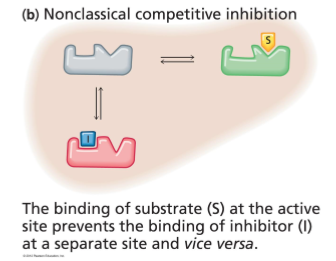
- 9Competitive Inhibition b) Non-classical competitive -Inhibitor does __ have to resemble the substrate -Allosteric inhibition -They are still competing in a similar way as in the case of classical inhibition (Km still increases & Vmax remains unchanged).NOT
- 10Uncompetitive inhibition Inhibitor can only bind if the substrate is ___ to the enzyme S become ___ regulator for I Vmax ___ & Km ___ so the slope remains the samebound
allosteric
decreases
decreases (affinity increases)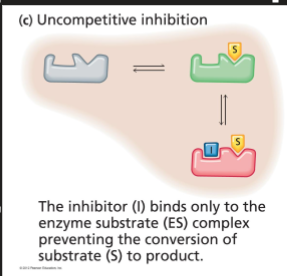
- 11Noncompetitive inhibition -Inhibitor does not have to resemble substrate -Inhibitor binds __ of S-binding -Allosteric inhibition -Vmax ___ -Km ___independently
decreases
remains the same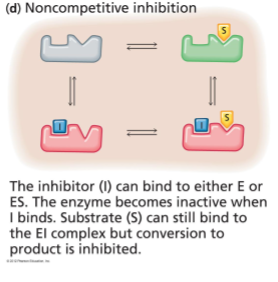
- 12Mixed InhibitionEnzyme affinity to ES and E is not the same, Km is affected as well
- 13Enzymes cannot only be inhibited allosterically but also ____ Example: Phosphofructokinaseactivated
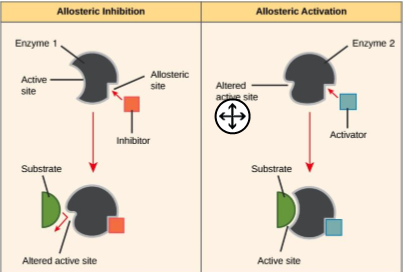
- 14Example: Phosphofructokinase & feedback loop • When ATP levels drop low, [ADP] and, especially, [AMP] increases -Glycolysis needs to produce more ATP • AMP and ADP allosterically activate _____ Phosphofructokinase-1 is a tetramer, 4 identical subunits -Active site is physically ___from regulatory sitephosphofructokinase
separated - 15If glycolysis stops at the 10th stage, phosphoenolpyruvate (PEP) will accumulate. PEP is allosteric ___ for Phosphofructokinase (PFK). PEP binding to a subunit of PFK, switches it to T-conformation. PEP inhibition is an example of a negative feedback loop: Up-stream reaction is regulated by ___-stream productinhibitor
down - 16Phosphofructokinase tetramer may behave in a ___way, similar to hemoglobin. R-conformation of one subunit forces other units to switch from T to R. Kinetics may be quite complex. R - Relaxed, ___-affinity T — Tense, ___-affinitycooperative
high
low - 17Enzyme kinetics for a simplified case: - Substrate and activator only bind enzyme in the __ state - Inhibitor only binds enzyme in the ___ state - There is a fast interconversion between R and Trelaxed (R)
tense (T) - 18Regulation by covalent modification One enzyme can regulate another using (de)phosphorylation Usually ___ than allosteric regulation -It is reversibleslower