
Flashcards
GCSE AQA Biology - Unit 2
Cards in this deck (74)
- 1What is the purpose of Mitochondria?To release energy through Respiration
- 2What is the purpose of Ribosomes?Protein synthesis takes place in the Ribosomes
- 3What is the cell wall in plants made of?Cellulose
- 4Chloroplasts are the site of ________________.Photosynthesis
- 5What is the stored in a Plant's Vacuole?Cell Sap
- 6TRUE OR FALSE: The Genetic info in Bacteria is held in the NucleusFALSE
The genetic information is like spaghetti, all tangled up! - 7What is a Plasmid?A small circular strand of DNA in a Bacterial cell
- 8How do Bacterial cells move?Flagella/Flagellum - Whip like structures, which extend outside bacterial cell.
- 9What is Mitosis used for?Growth
Repair
Asexual Reproduction - 10How many chromosomes do we have in a body cell?46
(23 pairs) - 11What are Genes?Genes are sections of the chromosomes that code for a particular characteristic by providing a code for a combination of amino acids that make up a specific protein.
- 12What are Gametes?Sex cells
They contain half the genetic information that every other cell contains. - 13What happens in Mitosis?The cells replicates its chromosomes and its organelles. Then the cell splits, leaving two identical DAUGHTER cells.
- 14What does Meiosis produce?4 haploid non-identical gametes
- 15What is so special about Stem Cells?Stem Cells have the ability to become a different type of cell!!!
- 16What is the word equation for Aerobic Respiration?Glucose + Oxygen --> Carbon Dioxide + Water [+ Energy]
- 17What is the word equation for Anaerobic Respiration?Glucose --> Lactic Acid [+ Energy]
- 18What is the energy produced by Respiration used for?Energy from respiration is used in reactions that produce different molecules.
To build larger molecules from smaller ones, this process is called Anabolism. - 19Fill in the missing gaps: Anabolism in Plants leads to the formation of ________. This is a storage _______________, made up of __________ sub-units.Starch
Carbohydrate
Glucose - 20What is the Human equivalent of Starch?Glycogen
- 21In plants, what do Anabolic Reactions convert nitrates, sugars and other nutrients into?Amino Acids
The Amino Acids are then joined in specific sequences to make proteins - 22Where is Glycogen stored?In the Liver and Muscle Cells
- 23What is the energy molecule used by cells called?ATP
- 24How many ATP Molecules are produced per Glucose molecule in Aerobic Respiration, compared to in Anaerobic Respiration?Aerobic Respiration-
38 ATP Molecules per Glucose Molecule
Anaerobic Respiration-
2 ATP Molecules per Glucose Molecule - 25What happens when Lactic Acid Builds up in Muscles?It causes Muscle Fatigue and Cramp
- 26The Oxygen needed to oxidize the Lactic Acid formed after anaerobic respiration into Carbon Dioxide and Water is called what?The Oxygen Debt
- 27What are the products of Anaerobic Respiration in Plants and Microorganisms like yeast?Ethanol + Carbon Dioxide
- 28What are different forms/variations of a gene called?Alleles
- 29What are the two types of allele?Dominant and Recessive
- 30What is it called, when a characteristic is controlled by just one pair of alleles?Monohybrid inheritance
- 31DEFINE: GenotypeThe combination of alleles that an individual has for a particular gene.
- 32DEFINE: HomozygousAn individual who carries two copies of the SAME allele for a particular gene.
e.g. BB or bb - 33DEFINE: HeterozygousAn individual who carries two DIFFERENT alleles for a particular gene.
e.g. Bb - 34DEFINE: PhenotypeThe expression of the genotype (the characteristic shown).
e.g. The HOMOZYGOUS RECESSIVE GENOTYPE of 'bb' would have a PHENOTYPE of blue eyes. - 35Who was Gregor Mendel?The father of modern genetics, he proposed the idea of separately inherited factors.
- 36Why are fossils so rare?1. Many early forms of life were soft-bodied and did not leave traces behind.
2. Fossils have been destroyed by geological activity (weathering and erosion). - 37Name 4 reasons why a new species might arise. (3 of these reasons are Higher-tier)1. A result of isolation
2. Genetic Variation
3. Natural Selection
4. Speciation - The populations become so different that successful interbreeding is no longer possible - 38During fertilisation, the female and male gametes fuse to produce a _______.Zygote
- 39Which combination of chromosomes determine that someone is: A Man? A Woman?Man - XY
Woman - XX - 40Amylase: Where is it produced? What does it digest? What does it produce?Produced in the salivary glands, pancreas and small intestine.
Digests starch.
Produces sugars in the mouth and small intestine. - 41Protease: Where is it produced? What does it digest? What does it produce?It is produced in the stomach, pancreas and small intestine.
Digests proteins.
Produces amino acids in the stomach and small intestine. - 42Lipase: Where is it produced? What does it digest? What does it produce?It is produced in the pancreas and small intestine.
Digests lipids (fats and oils).
Produces fatty acids and glycerol in the small intestine. - 43Where is Bile produced?In the Liver
- 44Where is Bile stored?In your Gall Bladder
- 45Where is Bile released into?Into the Small Intestine
- 46What does Bile do?Bile neutralises the acid that is added to food in your stomach.
- 47Which two types of enzyme are found in biological detergents?Protease
Lipase - 48Give two methods of sampling the distribution of daisies in a field.Random Sampling with Quadrats
Sampling Along a Transect - 49List three factors that may affect the rate of photosynthesis...Temperature
CO2 Concentration
Light Intensity - 50What is the word equation for Photosynthesis?Carbon Dioxide + Water --> Glucose + Oxygen
- 51Name 5 or more different types of cell.Root Hair Cells
Ovum (egg cell) + Sperm cells
Xylem
White Blood Cells
Palisade cells
Red Blood cells
Nerve Cells - 52What is the spreading of the particles of a gas or a substance in solution known as?Diffusion
- 53What is a tissue?A group of cells that have a similar structure and function.
- 54What is an Organ?Organs are made of tissues. One organ may contain several tissues.
- 55_________ cell --> _________ tissue --> Leaf (organ) -> Plant (organism)Pallisade
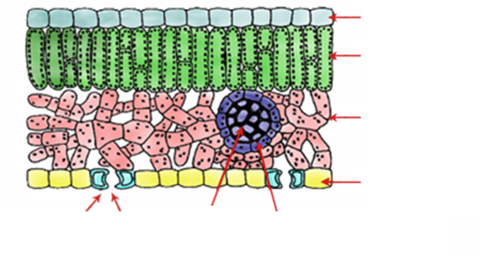
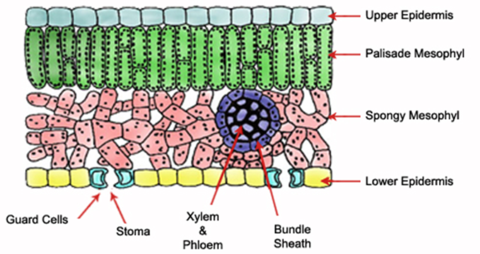
- 56Give some examples of Plant Tissues:- epidermal tissues, that cover the plant.
- mesophyll, where photosynthesis takes place.
- xylem and phloem that transport substances around the plant. - 57—
- 58Fill in the missing words: The stomach also produces ___________________ in which stomach enzymes work best.Hydrochloric acid
- 59The glucose produced by plants in photosynthesis may be changed into... (And stored where?)Insoluble starch, and stored in the stem leaves or roots.
- 60What do plants need, in addition to glucose, to make proteins?Nitrate ions, which are absorbed from the soil.
- 61Describe root-hair cells...Tiny hair-like entensions that increase surface area of the cell for absorption.
- 62Describe an ovum (egg cell)...Large cell that can carry food reserves for the developing embryo.
- 63Describe a Xylem cell...Long, thin, hollow cell used to transport water through the stem and root.
- 64Describe a white blood cell...Can change shape in order to engulf and destroy invading microorganisms.
- 65Describe a sperm cell...Has a tail, which allows it to move.
- 66Describe a palisade cell...Packed with chloroplasts for photosynthesis.
- 67Describe a white blood cell...No nucleus, so packed full of haemoglobin to absorb oxygen.
- 68Describe a nerve cell...Long slender axons that can carry nerve impulses.
- 69What are protein molecules made from?Long chains of amino acids.
- 70What do proteins act as?- Structural components of tissues such as muscles.
- Hormones.
- Anitbodies.
- Catalysts - 71What are enzymes?Biological catalysts made from proteins, they increase the rate of chemical reactions.
- 72How do digestive enzymes work?1- They pass out of the cells into the digestive system.
2- They come into contact with food molecules.
3- They catalyse the breakdown of large food molecules into smaller molecules. - 73Give some examples + uses of enzymes in industry...- Protease, to 'pre-digest' protein in some baby foods.
- Carbohydrases, to convert starch into sugar syrup.
- Isomerase, to convert glucose syrup into fructose syrup, which is sweeter. - 74What is the energy released during respiration used for?- To build larger molecules from smaller ones.
- To allow muscles to contract (in animals).
- To maintain a steady body temperature in colder surroundings.
- To build up amino acids from sugars, nitrates and other nutrients, which then combine to form proteins.
Information
- Description
- The Day of the Biologist - The Biologists embark on their greatest adventure in this special. In the 21st century, something terrible is awakening in Biondon's National Gallery; in 1562, a murderous plot is afoot in Elizabethan Biongland; and somewhere in space an ancient battle reaches its devastating conclusion. All of reality is at stake as the Biologist's own dangerous past comes back to haunt him.
- Created by
- James Jolliffe
- Views
- 3,956
- Tags
- Rating