
Flashcards
IB Biology Topic 4 Genetics (SL)
Cards in this deck (39)
- 14.1.1 State what eukaryotic chromosomes are made ofDNA and protein:
DNA wrapped around histone proteins
This forms the basic structure of a nucleosome, which is packaged together to form chromatin
Prokaryotic is not wrapped around histone proteins and is thus considered to be naked - 24.1.2 Define GeneGene:
A heritable factor that controls a specific characteristic, consisting of a length of DNA occupying a particular position on a chromosome (locus) - 34.1.2 Define AlleleAllele:
One specific form of a gene, differing from other alleles by one or a few bases only and occupying the same locus as other alleles of the gene - 44.1.2 Define genomeGenome:
The whole of the genetic information of an organism. - 54.1.3 Define gene mutationGene mutation:
A change in the nucleotide sequence of a section of DNA coding for a particular feature. - 64.1.4 What is a base substitution mutation?A base substitution mutation is the change of a single base in a sequence of DNA, resulting in a change to a single mRNA codon during transcription
- 74.1.4 What are the causes of Sickle Cell Anaemia?A base substitution mutation
In the case of sickle cell anaemia, the 6th codon for the beta chain of haemoglobin is changed from GAG to GTG (on the non-coding strand)
This causes a change in the mRNA codon (GAG to GUG), resulting in a single amino acid change of glutamic acid to valine (Glu to Val)
• DNA: GAG to GTG (non-coding strand) • mRNA: GAG to GUG • Amino Acid: Glu to Val
The amino acid change alters the structure of haemoglobin, causing it to form fibrous, insoluble strands. This causes the red blood cell to adopt a sickle shape - 84.1.4 What are the consequences of Sickle Cell Anaemia?The insoluble haemoglobin cannot effectively carry oxygen, causing individual to feel constantly tired
The sickle cells may accumulate in the capillaries and form clots, blocking blood supply to vital organs and causing a myriad of health problems
Also causes anaemia (low RBC count), as the sickle cells are destroyed more rapidly than normal red blood cells
Sickle cell anaemia occurs in individuals who have two copies of the codominant 'sickle cell' allele (i.e. homozygotes)
Heterozygous individuals have increased resistance to malaria due to the presence of a single 'sickle cell' allele (heterozygous advantage) - 94.2.4 What is non-disjunction in meiosis?Non-disjunction refers to the chromosomes failing to separate correctly, resulting in gametes with one extra, or one missing, chromosome (aneuploidy)
- 104.2.4 Why would chromosomes fail to separate in meiosis?The failure of the chromosomes to separate may either occur via:
Failure of homologues to separate during Anaphase I (resulting in four affected daughter cells)
Failure of sister chromatids to separate during Anaphase II (resulting in two affected daughter cells) - 114.2.4 What is the cause of Down Syndrome?Individuals with Down syndrome have three copies of chromosome 21 (trisomy 21)
One of the parental gametes had two copies of chromosome 21 as a result of non-disjunction
The other parental gamete was normal and had a single copy of chromosome 21
When the two gametes fused during fertilisation, the resulting zygote had three copies of chromosome 21, leading to Down syndrome - 124.2.5 State how chromosomes are arranged during karyotypingThe chromosomes are arranged into homologous pairs and displayed according to their structural characteristics
- 134.2.5 Outline what karyotyping involvesHarvesting cells (usually from foetus or white blood cells of adults)
Chemically inducing cell division, then halting it during mitosis when chromosomes are condensed and thus visible----------> The stage during which mitosis is halted will determine whether chromosomes appear with sister chromatids
Staining and photographing chromosomes, before arranging them according to structure - 142.4.6 What is pre-natal karyotyping used for?Determine the gender of an unborn child (via identification of sex chromosomes)
Test for chromosomal abnormalities (e.g. aneuploidies resulting from non-disjunction) - 152.4.6 Through which two processes are pre-natal cells collected for karyotyping?Amniocentesis:
A needle is inserted through the abdominal wall, into the amniotic cavity in the uterus, and a sample of amniotic fluid containing foetal cells is taken
It can be done at ~ 16th week of pregnancy, with a slight chance of miscarriage (~0.5%)
Chorionic Villus Sampling
A tube is inserted through the cervix and a tiny sample of the chorionic villi (contains foetal cells) from the placenta is taken
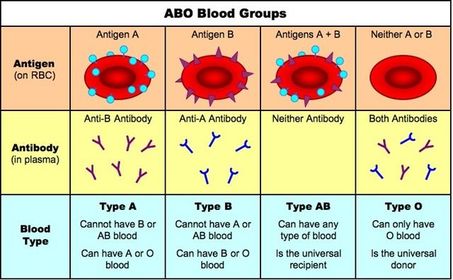
It can be done at ~ 11th week of pregnancy, with a slight risk of inducing miscarriage (~1%) - 164.3.4 Describe ABO blood groups as an example of codominance and multiple allelesWhen assigning alleles for codominance, the convention is to use a common letter to represent dominant and recessive and use superscripts to represent the different codominant alleles
I stands for immunoglobulin (antigenic protein on blood cells)
A and B stand for the codominant variants
The ABO gene has three alleles: IA, IB and i
IA and IB are codominant, wherease i is recessive (no antigenic protein is produced)
Codominance means that both IA and IB alleles will be expressed within a given phenotype - 174.3.4 Desribe donor and recipient characteristcs of each blood type
- 184.3.5 What is special about the 23rd pair of chromosomes in humans?The 23rd pair of chromosomes are the only heterosomes (or sex chromosomes) and determine gender
Females are XX - they possess two X chromosomes
Males are XY - they posses one X chromosome and a much shorter Y chromosome - 194.3.5 What does the Y-chromosome contain and what does this mean?The Y chromosome contains the genes for developing male sex characteristic - hence the father is always responsible for determining gender
If the male sperm contains the X chromosome the growing embryo will develop into a girl
If the male sperm contains a Y chromosome the growing embryo will develop into a boy
In all cases the female egg will contain an X chromosome (as the mother is XX) - 203.4.5 What do the different sizes in X and Y-chromosomes prohibit?Because the X and Y chromosomes are of a different size, they cannot undergo crossing over / recombination during meiosis
This ensures that the gene responsible for gender always remains on the Y chromosome, meaning that there is always ~ 50% chance of a boy or girl - 214.3.7 Define sex linkageSex linkage refers to when a gene controlling a characteristic is found on a sex chromosome (and so we associate the trait with a predominant gender)
Sex-linked conditions are usually X-linked, as very few genes exist on the shorter Y chromosome - 223.4.7 Describe the inheritance colour blindness and haemophilia as examples of sex linkageColour blindness and haemophilia are both examples of X-linked recessive conditions
The gene loci for these conditions are found on the non-homologous region of the X chromosome (they are not present of the Y chromosome)
As males only have one allele for this gene they cannot be a carrier for the condition
This means they have a higher frequency of being recessive and expressing the trait
Males will always inherit an X-linked recessive condition from their mother
Females will only inherit an X-linked recessive condition if they receive a recessive allele from both parents - 234.4.1 Outline the use of the polymerase chain reaction (PCR)PCR is a way of producing large quantites of a specific target sequence of DNA
It is useful when only a small amount of DNA is avaliable for testing
E.g. crime scene samples of blood, semen, tissue, hair, etc. - 244.4.1 What does PCR involve?PCR occurs in a thermal cycler and involves a repeat procedure of 3 steps:
1. Denaturation: DNA sample is heated to separate it into two strands
2. Annealing: DNA primers attach to opposite ends of the target sequence
3. Elongation: A heat-tolerant DNA polymerase (Taq) copies the strands - 254.4.1 How many identical copies of the DNA sequence does one cycle of PCR yield?Two.
A standard reaction of 30 cycles would yield 1,073,741,826 copies of DNA (2^30) - 264.4.2 What is the use of gel electrophoresis?Gel electrophoresis is a technique which is used to separate fragments of DNA according to size
- 274.4.2 Outline the process of gel electrophoresis?Samples of fragmented DNA are placed in the wells of an agarose gel
The gel is placed in a buffering solution and an electrical current is passed across the gel
DNA, being negatively charged (due to phosphate), moves to the positive terminus (anode)
Smaller fragments are less impeded by the gel matrix and move faster through the gel
The fragments are thus separated according to size
Size can be calculated (in kilobases) by comparing against a known industry standard - 284.4.4 What are two applications of DNA profiling?Paternity testing (comparing DNA of offspring against potential fathers)
Forensic investigations (identifying suspects or victims based on crime-scene DNA) - 294.4.4 Describe the application of DNA profiling to determine paternity and aid forensic investigationA DNA sample is collected (blood, saliva, semen, etc.) and amplified using PCR
Satellite DNA (non-coding) is cut with specific restriction enzymes to generate fragments
Individuals will have unique fragment lengths due to the variable length of their short tandem repeats (STR)
The fragments are separated with gel electrophoresis (smaller fragments move quicker through the gel)
The DNA profile can then be analysed according to need - 304.4.5 Outline three outcomes of sequencing the complete human genomeMapping: We now know the number, location and basic sequence of human genes
Screening: This has allowed for the production of specific gene probes to detect sufferers and carriers of genetic disease conditions
Medicine: With the discovery of new proteins and their functions, we can develop improved treatments (pharmacogenetics and rational drug design)
Ancestry: It will give us improved insight into the origins, evolution and historical migratory patterns of humans - 314.4.8 Outline a basic technique used for gene transfer involving plasmids, a host cell (bacterium, yeast or other cell), restriction enzymes (endonucleases) and DNA ligaseDNA Extraction
A plasmid is removed from a bacterial cell (plasmids are small, circular DNA molecules that can exist and replicate autonomously)
A gene of interest is removed from an organism's genome using a restriction endonuclease which cut at specific sequences of DNA
The gene of interest and plasmid are both amplified using PCR technology
2.Digestion and Ligation
The plasmid is cut with the same restriction enzyme that was used to excise the gene of interest
Cutting with certain restriction enzymes may generate short sequence overhangs ("sticky ends") that allow the the two DNA constructs to fit together
The gene of interest and plasmid are spliced together by DNA ligase creating a recombinant plasmid
3.Transfection and Expression
The recombinant plasmid is inserted into the desired host cells (this is called transfection for eukaryotic cells and transformation for prokaryotic cells)
The transgenic cells will hopefully produce the desired trait encoded by the gene of interest (expression)
The product may need to subsequently be isolated from the host and purified - 324.4.9 State two examples of current uses of genetically modified crops1. Engineering crops to extend shelf life of fresh produce
Tomatoes (Flavr Savr) have been engineered to have an extended keeping quality by switching off the gene for ripening and thus delaying the natural process of softening of fruit
2. Engineering of crops to provide protection from insects
Maize crops (Bt corn) have been engineered to be toxic to the corn borer by introducing a toxin gene from a bacterium (Bacillus thuringiensis) - 334.4.9 State two examples of current uses of genetically modified animals?1. Engineering animals to enhance production
Sheep produce more wool when engineered with the gene for the enzyme responsible for the production of cysteine - the main amino acid in the keratin protein of wool
2. Engineering animals to produce desired products
Sheep engineered to produce human alpha-1-antitrypsin in their milk can be used to help treat individuals suffering from hereditary emphysema - 344.4.10 What are the potential benefits of using gm-crops like Bt Corn?Allows for the introduction of a characteristic that wasn't present within the gene pool (selective breeding could not have produced desired phenotype)
Results in increased productivity of food production (requires less land for comparable yield)
Less use of chemical pesticides, reducing the economic cost of farming
Can now grow in regions that, previously, may not have been viable (reduces need for deforestation) - 354.4.10 What are the potential harmful effects of a gm-crop such as Bt Corn?Could have currently unknown harmful effects (e.g. toxin may cause allergic reactions in a percentage of the population)
Accidental release of transgenic organism into the environment may result in competition with native plant species
Possibility of cross pollination (if gene crosses the species barrier and is introduced to weeds, may have a hard time controlling weed growth)
Reduces genetic variation / biodiversity (corn borer may play a crucial role in local ecosystem) - 364.4.11 Define cloneA clone is a group of genetically identical organisms or a group of cells derived from a single parent cell
- 374.4.12 Outline a technique for cloning using differentiated animal cellsSomatic Cell Nuclear Transfer (SCNT) is a method of reproductive cloning using differentiated animal cells
A female animal (e.g. sheep) is treated with hormones (such as FSH) to stimulate the development of eggs
The nucleus from an egg cell is removed (enucleated), thereby removing the genetic information from the cell
The egg cell is fused with the nucleus from a somatic (body) cell of another sheep, making the egg cell diploid
An electric shock is delivered to stimulate the egg to divide, and once this process has begun the egg is implanted into the uterus of a surrogate
The developing embryo will have the same genetic material as the sheep that contributed the diploid nucleus, and thus be a clone - 384.4.13 What are the ethical arguments for therapeutic cloning?May be used to cure serious diseases or disabilities with cell therapy (replacing bad cells with good ones)
Stem cell research may pave the way for future discoveries and beneficial technologies that would not have occurred if their use had been banned
Stem cells can be taken from embryos that have stopped developing and would have died anyway (e.g. abortions)
Cells are taken at a stage when the embryo has no nervous system and can arguably feel no pain - 394.4.13 What are the ethical arguments against therapeutic cloning?Involves the creation and destruction of human embryos (at what point do we afford the right to live?)
Embryonic stem cells are capable of continued division and may develop into cancerous cells and cause tumors
More embryos are generally produced than are needed, so excess embryos are killed
With additional cost and effort, alternative technologies may fulfil similar roles (e.g. nuclear reprogramming of differentiated cell lines)
Information
- Description
- IB Biology Flashcards on IB Biology Topic 4 Genetics (SL), created by R S on 05/04/2015.
- Created by
- R S
- Views
- 1,063
- Tags
- Rating