
Flashcards
EXCHANGE AND TRANSPORT BIOL2

Cards in this deck (86)
- 1Give some examples of things that need to be exchanged between an organism and its environment.Respiratory gases
Nutrients
Excretory products
Heat - 2What are the two ways this exchange can take place?Passively or actively
- 3Give an example of each type of exchangePassive - diffusion, osmosis
Active - active transport - 4In terms of a surface area to volume ratio, what must it be for exchange to be effective and efficient?The surface area of an organism must be larger compared to its volume (ie large sa:vol ratio)
- 5Some organisms have a sa:vol ratio that is too large to ensure an efficient gas exchange rate (some cells too far away). What are the two features organisms may have evolved to overcome this problem?- Flat shape so that no cell is ever far from the surface (e.g flatworm)
- Specialised exchange surfaces with large areas to increase the sa:vol ratio (lungs and gills etc) - 6What are some of the features of a specialised exchange surface?- large sa:vol
- thin
- partially permeable
- movement of internal medium
- movement of external medium - 7How can the relationship between these factors be expressed? (equation)
- 8Why are gas exchange surfaces often located inside an organism?They are thin so easily damaged
- 9What does this mean to organism needs?Means of moving the external medium over the surface (means of ventilating the lungs in mammals)
- 10What is the problem with all terrestrial organisms (live on land)?Water easily evaporates from the surface of their bodies and they become dehydrated
- 11What does this mean they need to do?Conserve water
- 12However what features of an efficient gas exchange surface contradict with this?Thin + permeable surface
- 13What two features do terrestrial organisms exhibit to reduce water loss?- Waterproof coverings (in insects this is a rigid outer skeleton covered with a waxy cuticle)
- Small s.a:vol ratio (minimise area over which water is lost) - 14This means that insects cannot use their body surface to diffuse gases in the same way as ______ ______ _________Single celled organisms
- 15Instead they have developed an internal network of tubes called _______Tracheae
- 16Why are the tracheae supported by strengthened rings?To stop them collapsing
- 17What do the tracheae divide into?Smaller tubes called tracheoles
- 18In which ways to respiratory gases move in and out of the tracheal system?- Along a diffusion gradient
- Ventilation - 19Explain how gases move through the tracheal system along a diffusion gradientWhen cells respire they use O2 - O2 conc at end of tracheoles falls - O2 diffuses from atmosphere (high conc) to tracheoles (low conc)
(diffusion gradient in opposite direction for CO2) - 20Diffusion in air is much quicker than in water. What does this mean?Respiratory gases are exchanged quickly by this method
- 21How does ventilation further speed up the exchange of respiratory gases?Movement of muscles in insects can create mass movements of air in and out of the tracheae
- 22Through which structures do gases enter and leave the tracheae?Spiracles
- 23The spiracles are open and closed by valves. What is allowed to happen when the spiracles are open?Water is allowed to diffuse
- 24So why do insects keep their spiracles closed most of the time?To prevent water loss
- 25What is a limitation of the tracheal gas exchange system?Relies on diffusion - efficient diffusion requires a short diffusion pathway - this limits the size an insect can attain
- 26Fish have a ____________ and ___ _____ outer coveringWaterproof and gas tight
- 27Being relatively large they have a _____ sa:vol ratioSmall
- 28This means their body surface is not adequate to supply & remove their respiratory gases. What is the name of the specialised internal gas exchange surface inside fish?The gills
- 29What are gills made up of?Gill filaments
- 30The gill filaments are stacked up in a pile. What structures are at right angles to the gill filaments?Gill lamellae
- 31What do gill lamellae increase?The surface area of the gills
- 32The position and arrangement of the gill filaments & lamellae mean that water flow over them and blood flow within them are in opposite directions. What name is given to this principle?Contercurrent flow
- 33What does the countercurrent exchange principle allow for?Maximum possible gas exchange
- 34Why is there a fairly constant rate of diffusion across the entire length of the gill lamellae?
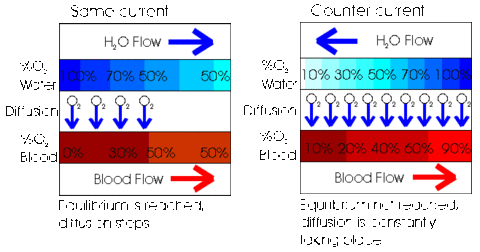
- 35In plants, why is there a reduced need for gas exchange with the external air?Plants respire and photosynthesise - the product of one is the reactant of the other
- 36In which 2 ways is gas exchange in plants similar to gas exchange in insects?- No living cell is far from external air
- Diffusion takes place in gas phase (more rapid than if it were in water) - 37In addition, plants have a very _____ surface area compared to the volume of living tissueLarge
- 38This means no specialised gas exchange system is needed. Where does most of the gas exchange in the plant happen?The leaves
- 39What are the three adaptations of the leaf that make it suitable for rapid diffusion?- Thin and flat (large sa:vol)
- Many small pores (stomata)
- Many interconnecting air spaces (throughout the mesophyll) - 40Each stomata is surrounded by a pair of what?Guard cells
- 41What can these cells do?Open and close the stomatal pore and therefore control the rate of gaseous exchange
- 42Why is this important?Terrestrial organisms lose water by evaporation - plants have to balance conflicting needs of gas exchange and control of water loss
- 43How do they use the stomata to do this?By completely or partially closing stomata at times when water loss would be excessive
- 44________ is adequate for transport over short distancesDiffusion
- 45Mammals however have a very small s.a:vol ratio and therefore require a mass __________ _______Transport system
- 46Whether or not there is a specialised transport medium and/or a pump depends on what two factors?- The surface area to volume ratio
- How active the organism is - 47How many features of a mass transport system are there?5
- 48One feature is that there needs to be a suitable medium in which to carry materials. What is this medium in mammals?Blood
- 49Why is this medium usually a liquid based on water?Because water readily dissolves substances and can be moved around easily
- 50Another feature is that there is a closed system of what that contain the transport medium?Tubular vessels
- 51Why do the vessels form a branching network?To distribute the medium to all parts of the body
- 52Moving the transport within vessels requires a _______ difference between one part of the system and anotherPressure
- 53In which two main ways is this achieved?- Animals - muscular contractions
- Plants - passive natural physical processes e.g evaporation of water - 54Give an example of another feature of transport systems that maintains mass flow movement in one direction?Valves
- 55What is the final feature?A means of controlling the flow of the transport medium to suit the changing needs of different parts of the organism
- 56Mammals have a _______ circulatory systemDouble
- 57What does this refer to?The fact that blood passes twice through the heart for each complete circuit of the body
- 58Why is this necessary? (in terms of pressure)Because when blood is passed through the lungs, pressure is reduced
If blood was to be passed round the body straight from the lungs it would do so very slowly
So instead blood is returned to the heart to boost its pressure before being circulated to the rest of the tissues - 59For what two reasons is it necessary that substances are delivered to the rest of the body quickly?- Mammals have a high body temp
- Mammals have a high rate of metabolism - 60What are the three types of vessels that make up the circulatory system of a mammal?Arteries
Veins
Capillaries - 61The transport system is used to move substances longer distances. What process is the final part of the journey into the cells?Diffusion
- 62Why is the final exchange from capillaries into cells rapid?- Large surface area
- Short distances
- Steep diffusion gradient - 63Arteries, arterioles (smaller arteries) and veins all have the same basic layered structure. What is this structure?Tough outer layer
Muscle layer
Elastic layer
Thin inner lining
Lumen - 64What is the function of the tough outer layer?To resist pressure changes from both within and outside
- 65What is the function of the muscle layer?It can contract so that it controls the flow of blood
- 66What is the function of the elastic layer?Maintain blood pressure by stretching and springing back
- 67Why is the thin inner lining (endothelium) smooth?To prevent friction
To allow diffusion - 68What is the lumen?The central cavity in which the blood flows
- 69Out of arteries, arterioles, capillaries and veins, which has the thickest muscle layer?Arterioles
- 70Why is this necessary?Arterioles control the blood flow between arteries and capillaries - thick muscle layer required to constrict lumen and restrict blood flow
- 71However arterioles have a thinner elastic layer than arteries. Why is this?Because blood pressure is lower in the arterioles. In arteries it is important that the blood pressure is high so it reaches the extremities of the body - the elastic wall is stretched at each beat of the heart creating smooth pressure surges
- 72In which vessels are valves present throughout?Veins
- 73Explain why there are valves in veins but no valves in arteries (except leaving the heart)Veins - valves ensure blood doesn't flow backward which it might do because the pressure is so low. Veins are compressed when body muscles contract, increasing the pressure. Valves direct blood towards the heart
Arteries - Blood under constant high pressure- doesn't tend to flow backwards - 74Why is the muscle, elastic and overall thickness of the walls in veins relatively thin?Pressure is too low to create any risk of bursting or to create a recoil action
- 75Give some features of capillary structure that make it suited to its function of exchanging metabolic materials between the blood and the tissuesThin
Numerous, highly branched
Narrow diameter + permeate tissues
Narrow lumen
Spaces between lining (endothelium) cells - 76Why are the spaces between the endothelium lining cells useful?They allow white blood cells to escape in order to deal with infection
- 77What name is given to the liquid which bathes the tissues?Tissue fluid
- 78Tissue fluid is formed of blood plasma. Why is blood plasma forced out the capillary wall at the arteriole end of capillaries?Due to a high pressure
- 79Tissue fluid is formed by ultrafiltration rather than diffusion. Explain whyLarger molecules such as proteins and cells are too large to fit through the permeable capillary walls
- 80Give some examples of ways by which materials are now exchanged between the tissue fluid and the tissuesLipid diffusion - lipid soluble substances and gases
Osmosis - water
Facilitated diffusion - ions
Active transport - glucose and amino acids - 81Why does tissue fluid return by diffusion at the venous end of the capillary bed?Since the pressure of the blood is much lower because it has lost most of its plasma
- 82Solutes (salts, carbon dioxide etc) enter the blood by diffusion ____ their concentration gradientDown
- 83Why has a water potential gradient been set up between the tissue fluid and the blood?The blood has lost much of its water but regained soluble proteins so its water potential is low
So water moves into the capillary down its water potential gradient - 84Not all the fluid that left returns. Where does this excess tissue fluid drain to?Lymph vessels in the capillary beds
- 85Lymph vessels have ____ wallsThin
- 86So tissue fluid can easily _______ inside, forming lymphDiffuse
Information
- Description
- includes mammals, fish and insects. little bit on plants but most on separate flashcards
- Created by
- ashiana121
- Views
- 91
- Tags
- Rating