
Flashcards
Lecture 4- Lipids
Cards in this deck (35)
- 1Are lipids polar?No they are non-polar
- 2Are lipids soluble in water?No they are insoluble
- 3Are lipids soluble in non-polar solvents?Yes
- 4Are lipids polymers?No
- 5Structure of a triglyceride moleculeGlycerol forms the backbone and 3 fatty acid side chains are attached to the glycerol backbone
- 6What reaction occurs in the formation of triglycerides?Dehydration synthesis (condensation reaction)
- 7Which enzyme catalyses the hydrolysis of triglycerides?Lipase
- 8The possible products formed in the digestion of a triglycerideGlycerol, Diglyceride, Monoglyceride and Fatty acids
- 9What are the features of a saturated fatty acid?Saturated with single C-C bonds. Solid at room temperature (closely packed)
- 10What are the features of unsaturated fatty acids?Unsaturated with numbers of C=C bonds. Liquid at room temperature (loosely packed)
- 11What are the two isomers that unsaturated fatty acids exist as ?cis- and trans- isomers
- 12What is the difference between cis- and trans- isomers?Cis- isomers: bend at the double bond and are naturally occurring
Trans- isomers: straight at the double bond and are normally manmade - 13—This is a cis- fatty acid
- 14—Trans- fatty acid
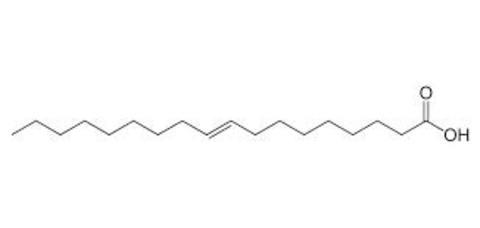
- 15What are fatty acids called when not part of a triglyceride?Free fatty acids
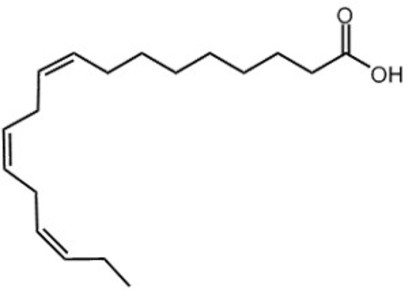
- 16—Omega 3 fatty acid

- 17—Omega 6 fatty acid

- 18Steroids are lipids. What is the building block for other steroids?
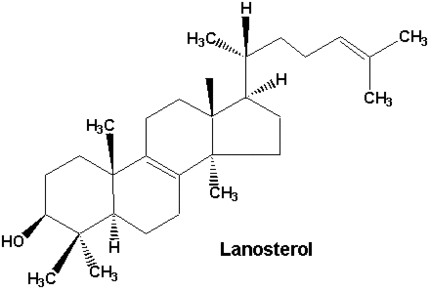
- 19How is lanosterol formed?The cyclization of squalene
- 20Name some common steroidsCholesterol, oestrogen, progesterone, testosterone corticosteroids (produced in the adrenal cortex)
- 21The structure of phospholipidsThe phosphate head (polar, hydrophilic, soluble in water), Fatty acid tails (non-soluble in water, non-polar and hydrophobic), glycerol backbone
- 22GlycolipidsLipid attached to an oligosaccharide
- 23LipoproteinsSoluble complexes that transport lipids and are usually synthesised in the liver
- 24Structure of lipoproteinsSpherical particles with central hydrophobic core: triglycerides, esterified cholesterol, small amounts of other lipids and fat soluble vitamins.
External hydrophilic layer: phospholipids, cholesterol, apoproteins (stabilise the structure and regulate enzymatic activity at the lipoprotein) - 25Functions of white adipose tissueCushions internal organs, acts as a shock absorber, gives insulation, protects internal organs from temperature swings
- 26Effects of having excess adipose tissueAtheroma, atherosclerosis, thrombosis, exerts undue pressure on organs, sequestration (accumulation) of lipophillic substances
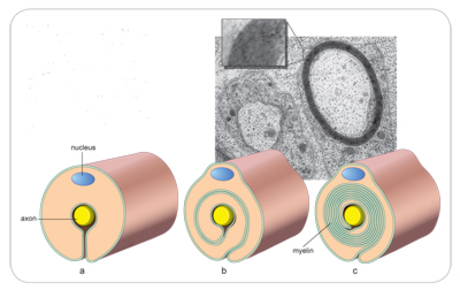
- 27What is myelin?It is an insulating material, made from phospholipids, surrounds nerve cells
- 28What cells produce myelin peripherally (nerves outside the brain and spinal cord)?Schwann cells
- 29What cells produce myelin centrally (nerves in the brain and spinal chord)?Oligodendrocytes
- 30Which vitamins are fat soluble?ADEK
- 31What is the function of apoproteins?They provide structural stability and regulate enzyme activity in lipoproteins
- 32What effect does myelin have on nerve cells?Increases the speed at which nerve impulses are transmitted along the nerve
- 33How can lipids prevent moisture loss?They prevent the evaporation of water
- 34—Oligodendrocyte
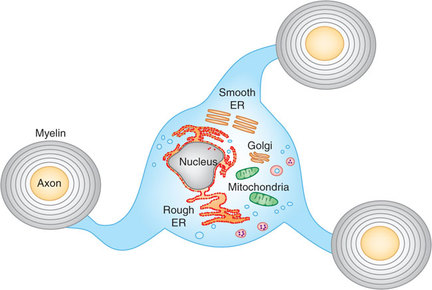
- 35—Schwann cell
Information
- Description
- Biology- Semester 1 (Lecture 4- Lipids ) Flashcards on Lecture 4- Lipids , created by emma_moran on 21/12/2013.
- Created by
- emma_moran
- Views
- 71
- Tags
- Rating