
Flashcards
Fluid Mosaic Model & Membrane Structure
Cards in this deck (9)
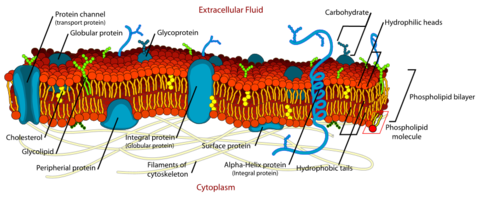
- 1Fluid Mosaic ModelThis theory was put forward in 1972 by Singer and Nicholsen. It is like a fluid as the components can move and it is like a mosaic due to the random arrangement of proteins
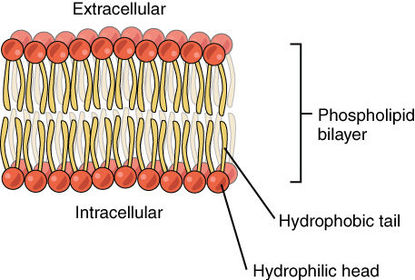
- 2Phospholipid ComponentThere is the polar hydrophilic phosphate head, and the hydrophobic fatty acid tails. Cells are surrounded by a watery liquid and the inside of a cell is filled with cytoplasm so they arrange themselves as a:
- 3—Phospholipid Bilayer! This is because the polar heads are attracted to water and the fatty acid tails in the centre repel water!
- 4Protein ComponentThese are globular proteins. They can either be:
Extrinsic or Intrinsic.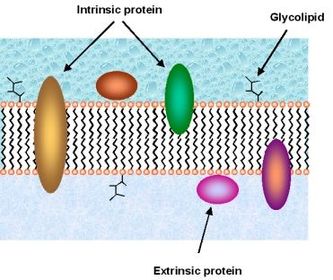
- 5ExtrinsicThey are only made up of hydrophilic amino acids so it cannot sit in the hydrophobic part of the bilayer
- 6Intrinsic ProteinThese are made up of hydrophobic and hydrophilic amino acids/R chains so they span the whole bilayer. The coiling of the protein makes a hydrophilic channel so charged molecules can pass through
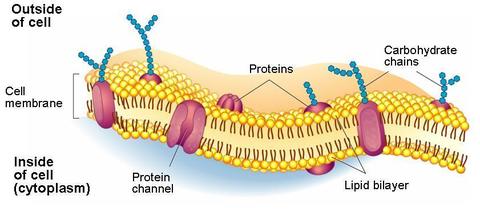
- 7Carbohydrate ComponentThese are attached to proteins or the membrane as a chain and are either glycoproteins or glycolipids (the term glycocalyx is a group term)
- 8Roles of CarbohydratesThey act as:
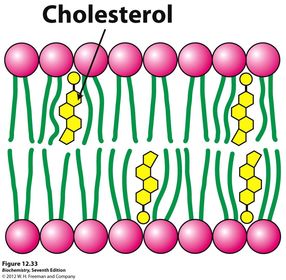
Antigens, receptors for specific hormones (adrenaline), A B O blood grouping, receptors for specific neurotransmitters and cell to cell interactions - 9CholesterolRegulates fluidity and stability
Information
- Description
- A-Level Biology (Membranes and Membrane Transport) Flashcards on Fluid Mosaic Model & Membrane Structure, created by Fauzia Ali on 26/02/2016.
- Created by
- Fauzia Ali
- Views
- 95
- Rating