
Flashcards
1.4 Enzymes
Cards in this deck (28)
- 1How do you test for protein?1. Add a few drops of biuret solution to the test tube.
2. Blue -> purple/lilac (contains protein) - 2How do you test for starch?1. Add a few drops of iodine dissolved in potassium iodide to test tube
2. Yellow/brown -> blue/black (starch present) - 3How do you test for lipids?1. Add 2cm cubed of ethanol and shake
2. Pour the liquid into a test tube of water (2cm cubed)
3. Clear liquid -> cloudy white emulsion (lipid present) - 4How do you test for reducing sugar?1. Add a few drops of benedict's reagent.
2. Place test tube in a water bath and heat for approx. 3 mins.
3. Blue -> red (lots present)
Blue -> green (not much present) - 5How do you test for non-reducing sugar?1. Take new sample in new test tube.
2. Add 1cm cubed HCl and heat for 3min
3. Add sodium hydrogencarbonate in small amounts (upto 1 spatula)
4. Add benedicts and reheat
5. Blue -> red (lots present)
Blue -> green (not much present) - 6What is an enzyme made of and what can you say about its structure?Made of amino acids and it has a tertiary structure (Active site)
- 7Is the active site of an enzyme and the substrate the same shape?No - they are complimentary
- 82 main theories which describe how enzymes act?•Lock and key theory
•Induced fit theory - 9After an enzyme-substrate complex is formed, what happens to the enzyme and substrate?•Enzyme = can go react with other molecules to form more complexes
•Substrate = converted into product - 10What is the lock and key theory?Only one specific shape of an enzyme will match the substrate as they are complimentary
- 11What is the induced fit theory?Substrate and enzyme don't have to be complimentary initially - can have minor differences. Active site changes shape to mould itself around the substrate to form an enzyme-substrate complex
- 12What 4 things affect the rate of enzyme reaction?•Temperature
•pH
•Concentration of substrate OR enzyme
•Inhibitors - 13How does an increasing temperature affect the rate of reaction of enzymes?•Rate of reaction increases as the temperature increases upto optimum temperature
•Temperature increase gives substrate molecules more kinetic energy which means they move faster, resulting in a higher collision rate
•This means more enzyme-substrate complexes are formed per second - 14How does optimum temperature affect the rate of reaction for enzymes?At the optimum temperature, the rate of reaction is at its highest with the quickest rate of enzyme-substrate complexes being formed
- 15How does a temperature above optimum temperature affect the rate of reaction for enzymes?•Very high temps break the hydrogen bonds holding the tertiary structure
•This causes the enzyme to denature and so enzyme-substrate complexes can no longer form as the active site has changed shape - 16How does a low pH affect the rate of reaction of enzymes?Some enzymes will denature at a very low pH (acidic)
- 17How does optimum pH affect the rate of reaction of enzymes?At an optimum pH the enzyme is working at the maximum rate of reaction with the max rate of enzyme-substrate complexes being formed
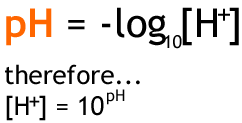
- 18What is the pH of a solution a measure of?Hydrogen ion concentration
- 19How do you calculate the pH of a solution?
- 20How does enzyme concentration affect enzyme activity?
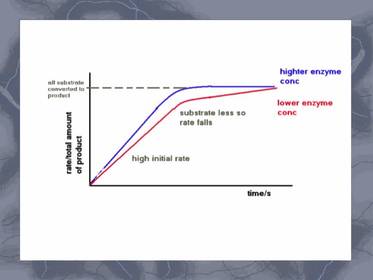
- 21Why does increasing the substrate concentration increase the rate of reaction?Increasing the concentration means more collisions are possible so enzyme-substrate complexes are produced at a rapid rate
- 22What would happen to the rate of reaction if the substrate concentration was increased after the maximum rate of reaction had been achieved?Would stay the same because all the active sites of every enzyme are already occupied and so no more enzyme-substrate complexes can form at a greater rate
- 23How could the rate of reaction be increased beyond the maximum rate of reaction?Increase enzyme concentration
- 24What is an inhibitor and what are the 2 types?•A substance that slows down or stops enzyme action
•Competitive and non-competitive - 25Describe the task of competitive inhibitors? (3)•Have a similar shape to substrate
•Bind to active site's specific tertiary structure
•Substrate is prevented from binding to the enzymes active site
•Therefore less or no enzyme substrate complexes are formed - 26Describe the task of non-competitive inhibitors? (3)•Have a different shape to substrate
•Bind to enzyme away from active site which changes tertiary shape of enzyme's active site
•Means substrate cannot bind and so prevents enzyme-substrate complexes being formed - 27How do inhibitors affect the rate of enzyme reaction?
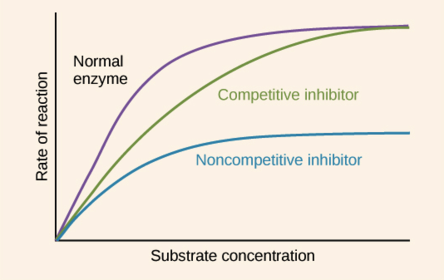
- 28How do you measure the rate of change at any point on a graph?Measure the gradient of the chosen point by drawing a tangent and calculating the gradient by doing y/x
Information
- Description
- AS level AS Biology (Unit 1 - Biological Molecules) Flashcards on 1.4 Enzymes, created by Tania Parvaiz on 01/03/2017.
- Created by
- Tania Parvaiz
- Views
- 39
- Rating