
Choreography and Dance Composition
53 resources created by 47 users
This Choreography and Dance Composition page on GoConqr gathers community-made mind maps, flashcards, quizzes and slides, from choreographic devices and motif development to profiles of choreographers such as Christopher Bruce and Jerome Robbins. It's built for school students revising GCSE Dance or A-level Dance, and for teachers after ready-made material. There are over 40 resources here, including more than 30 mind maps and more than 5 flashcard decks, made by over 40 contributors. Pick a mind map, try a quiz, then make your own.
Top Choreography and Dance Composition resources
Quizzes
Mind maps
See all 42 mind mapsFlashcards
Notes
-
Untitled How does Wayne McGregor describe/define choreography? Wayne says choreography is the process of physical thinking in the mind and as well as in the body. A distributive/collaborative cognitive process. How do you desc...
-
Untitled Week 1 - Concept development Focus: Developing the concept and base ideas of the composition Strengths: Strong idea and premise to build on for the choreography Weakness: Only had a few ideas to pick on so ...
Slides
Topics in Choreography and Dance Composition
More Performing arts (theatre, dance) topics
About Choreography and Dance Composition
GoConqr OriginalWhat this page covers
The resources sit in the Choreography, Dance Works and Dance Production strand of Performing arts (theatre, dance). Most are mind maps, and they fall into three groups: the tools of composition, the people behind the dances, and the role of the choreographer.
Start with the tools
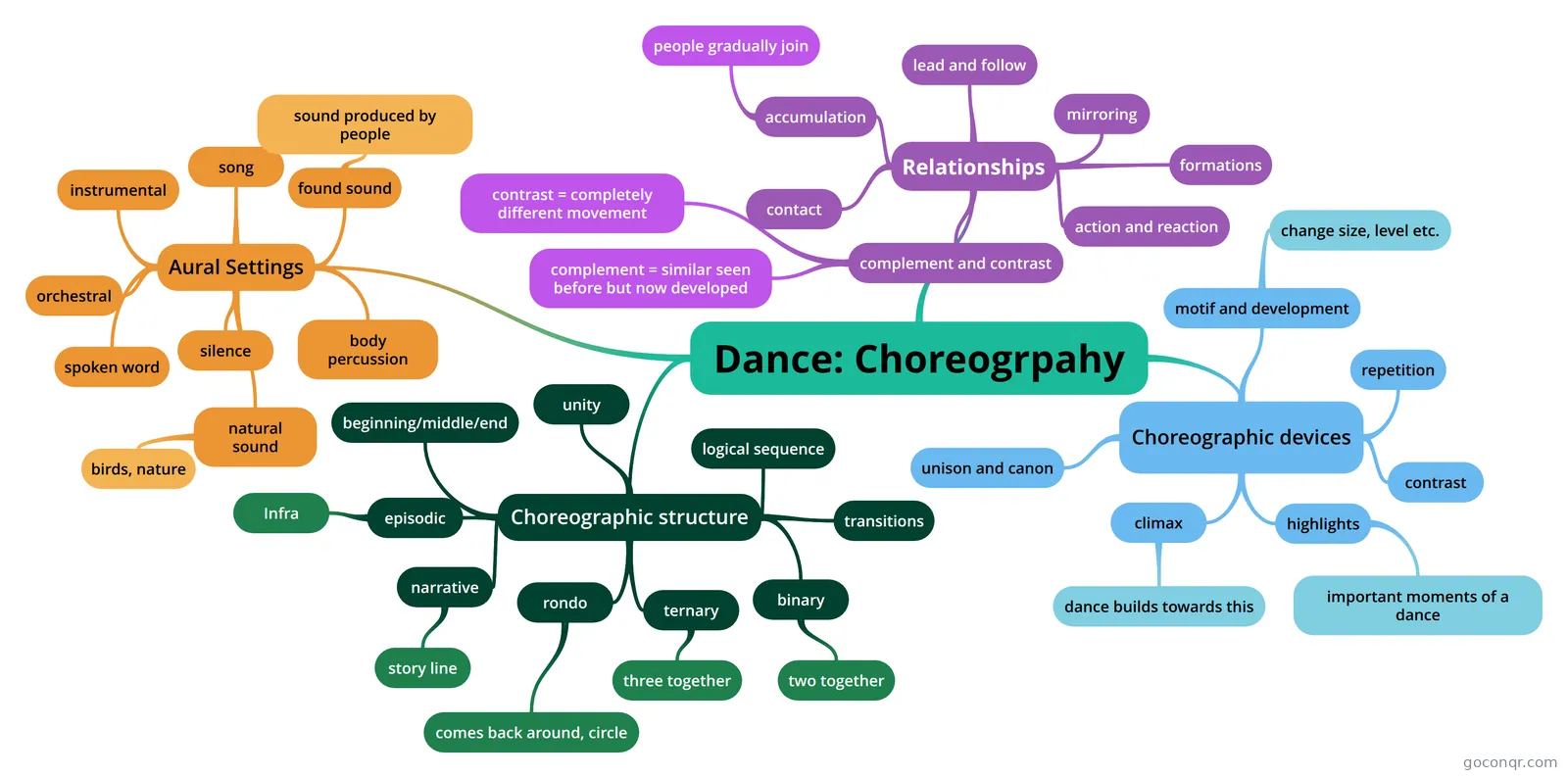
Begin with the mind map Manipulating a Motif. It covers repetition, retrograde (performing a movement in reverse) and inversion (flipping a movement upside down or horizontally). Then open Dance: Choreogrpahy, which lists relationships such as lead and follow, mirroring, action and reaction, accumulation, and complement and contrast. Follow with Motif Development and Choreographic devices.
The Choreographic Devices Flashcards deck is a quick way to fix the terms in your head. It includes augmentation, embellishment, fragmentation, instrumentation, accumulation and theme and variation.
Meet the choreographers
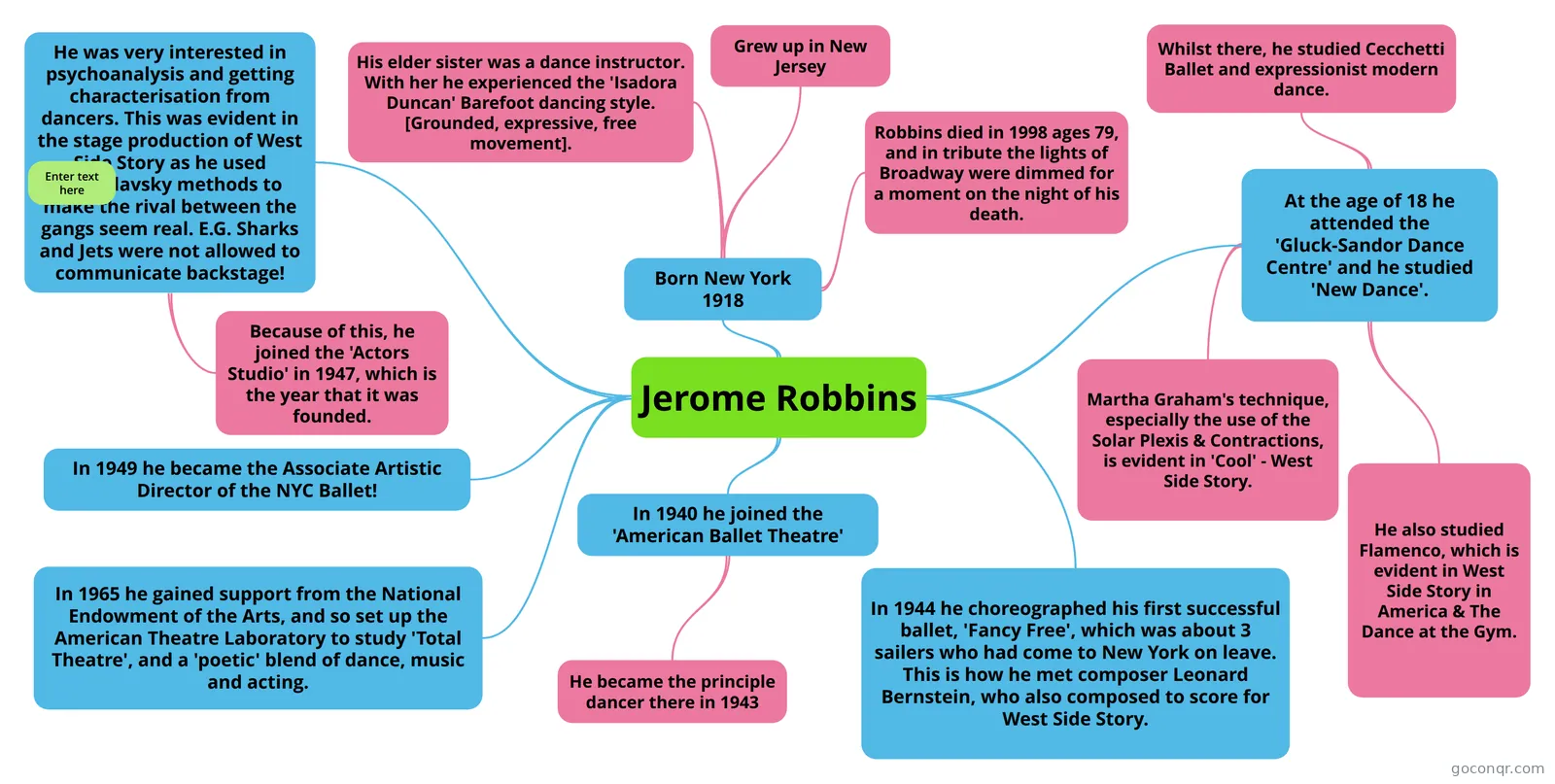
Several maps are profiles. Jerome Robbins begins with his birth in New York in 1918 and his early experience of barefoot dancing. Christopher Bruce traces his training at the Rambert school. Glen Tetley follows his move from medical school into dance. There are also maps on Siobhan Davies, Sidi Larbi and Sue Healey. The Shadows map looks at a work by Christopher Bruce for Phoenix Dance Theatre. The Key People in Dance flashcards cover Martha Graham, Marie Rambert, Norman Morrice and Merce Cunningham.
The choreographer's role and making your own work
Several maps cover the roles, responsibilities and skills of a choreographer. Others help you plan, such as Theme Brainstorming, Choreography Ideas and Choreographic Exploration. Teachers may like the slides on solo choreography, which set tasks based on Peter Pan, a poem and a sculpture.
Putting maps and quizzes together
- Read a map on a topic, such as devices.
- Test yourself with Choreographic Principles.
- Try A Level dance test when you want exam-style practice.
- Go back to the maps for anything you missed.
Choose a map that matches what you are working on today and see where it takes you.
Frequently asked questions
Where should I start on this page?
Start with the Manipulating a Motif mind map, then open Dance: Choreogrpahy for relationships and devices. After that, use the Choreographic Devices Flashcards to learn the terms. Once the ideas feel familiar, try the Choreographic Principles quiz to see what has stuck.
Which exams do these resources suit?
The listed resources mention GCSE Dance and A-level Dance, and most of the material is aimed at secondary students. Teachers can also use the maps, flashcards and slides as ready-made starting points for lessons on choreography and composition.
What do the mind maps cover?
They cover choreographic devices, motif development, the roles and skills of a choreographer, and profiles of choreographers including Jerome Robbins, Christopher Bruce, Glen Tetley, Siobhan Davies and Sidi Larbi. Others help with theme brainstorming and planning ideas for your own piece.
Are there quizzes for this unit?
Yes. Choreographic Principles checks your grasp of core ideas, and A Level dance test gives you a longer check. Use them after reading the maps, then return to any topic where you lost marks.
Are the resources free, and who made them?
Every resource here is free to open, study and take, with no account needed. They were made by GoConqr users, not by GoConqr itself. A free account lets you save quiz scores and create your own quizzes, mind maps, flashcards and notes.
What if I can't find a topic I need?
Try the related maps first, as many choreographers and devices appear in more than one. If a topic is still missing, you can build your own mind map or flashcards on it and use them alongside the resources listed here.