
Food Science Fundamentals
183 resources created by 160 users
This Food Science Fundamentals page on GoConqr gathers community-made mind maps, flashcards, quizzes and notes, from browning reactions and starch gelatinisation to emulsions, food additives and preservation. It's built for school students revising a topic, university students and professional candidates filling gaps, and teachers after ready-made material. There are over 180 resources here, including more than 15 quizzes, over 110 mind maps and more than 40 flashcard decks, written by more than 150 contributors. Pick a map, test yourself with a quiz, then make your own set.
Select topic
- Food Composition and Water10
- Carbohydrates, Starch and Sugar18
- Fats and Oils6
- Proteins and Eggs8
- Functional Properties of Food and Ingredients19
- Food Structure and Rheology7
- Food Flavor, Taste and Aroma7
- Food Additives and Color17
- Chemical Reactions in Food15
- Baking Science23
- Food Processing8
- Food Spoilage, Preservation and Safety15
Top Food Science Fundamentals resources
-
 Mind map Food Tech - functions of food
-
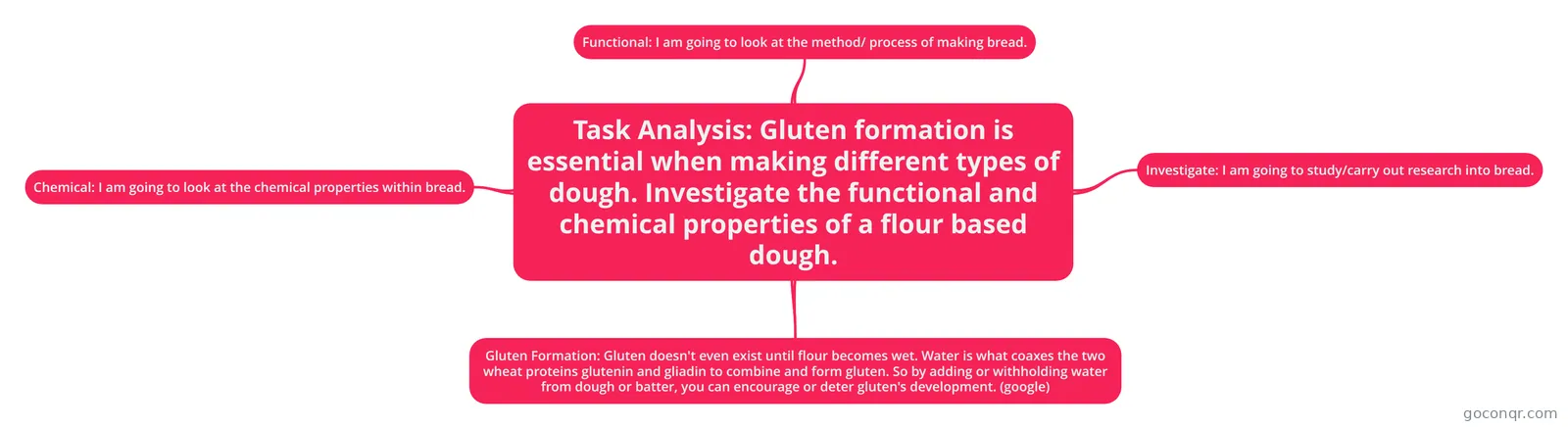 Mind map Task Analysis: Gluten formation is essential when making different types of dough. Investigate the functional and chemical properties of a flour based dough. Task Analysis for task 1 (science of bread)
-
 Mind map Acids and Alkalis
-
64 cardsFood Chem Exam 2 What is the relationship between wavelength and energy?
-
37 cardsExam 1 Why is butter cut into pea sized chucks for crust?
-
41 cardsExperimental Food Science FINAL EXAM
-
49 cardsFood Technology Keywords - AQA
-
23 cardsCarbohydrates What is photosynthesis?
Quizzes
See all 16 quizzesMind maps
See all 112 mind maps
Flashcards
See all 46 flashcards-
64 cardsFood Chem Exam 2 What is the relationship between wavelength and energy?
-
37 cardsExam 1 Why is butter cut into pea sized chucks for crust?
-
41 cardsExperimental Food Science FINAL EXAM
-
49 cardsFood Technology Keywords - AQA
-
23 cardsCarbohydrates What is photosynthesis?
-
9 cardsFunctional and chemical properties of food: Key definitions Flashcards on Key definitions , created by Beth Charnell on 22/04/2017.
-
5 cardsmock revision FUNCTION OF INGREDIENTS IN BREAD MAKING Yeast: Raising agent: Is a living micro organism. When it’s the ide...
Topics in Food Science Fundamentals
More Food industry and safety topics
About Food Science Fundamentals
GoConqr OriginalWhat the unit covers
This unit sits in the Food Science and Nutrition strand of Food industry and safety. Most of it is about how ingredients behave. The mind map Food Tech - functions of food runs through solutions, suspensions, gels, gelatinisation, smart starches and emulsions. Browning reactions separates the Maillard reaction from caramelisation, and Acids and Alkalis explains the pH scale and why it affects taste and microorganism growth.
Where to start
Begin with the broad maps, then narrow down.
- Open Food Science and Technology or Functional Properties for the overall picture.
- Move to Carbohydrates, Properties of Starch and Gelatinisation of starch.
- Continue with Fats, Emulsions, Enzymes and The effect of heat on protein.
- Finish with Food Additives, Food preservation methods and Food Spoilage and Preservation.
Using maps, flashcards and quizzes together
Read a map first and say each branch aloud without looking. Then use a flashcard deck on the same topic, such as Functional properties or Food Technology Keywords - AQA, to fix the key terms. Finish with a quiz, for example Food Science Quiz, and note which answers slipped. Go back to the matching map for those gaps.
Who it suits
The resources lean towards secondary and university study. Some mention GCSE Food Technology and GCSE Food Preparation and Nutrition, while others read like university course exam prep. Teachers can pick maps and decks to set as starter or revision tasks.
Next step
Choose one topic you find hardest, open its map and try a quiz straight afterwards. If you want something tailored, build your own map or deck from what you have learned.
Frequently asked questions
Which resource should I open first?
Start with a broad mind map such as Food Science and Technology or Functional Properties. They give you the overall picture. Then move to narrower maps on starch, fats, proteins and additives, and check yourself with a quiz afterwards.
What do the mind maps cover?
They cover the functions of ingredients, including gels, suspensions and emulsions, plus browning reactions, acids and alkalis, carbohydrates, starch properties, enzymes, fats, sugar, additives, pigments and food preservation. There is also a map on the history of food science.
Are the resources free to use?
Yes. Every resource on this page is free to open, study and take, with no account needed. They were made by GoConqr users rather than by GoConqr itself, so it is worth comparing a few on the same topic.
Which levels and exams do they suit?
Most are secondary or university level. Some resources mention GCSE Food Technology and GCSE Food Preparation and Nutrition, and others look like university food science exam revision. Teachers can use them as ready-made material.
Can I save my quiz scores or make my own?
A free account saves your quiz scores and lets you make your own quizzes, mind maps, flashcards and notes. This is handy if you want to turn a map you have studied into a deck of your own.
What if my topic is missing?
Try the flashcard decks and notes too, as a topic can appear in a different format. If it is still absent, make your own map or deck on it, using the listed resources as a model.