
Modern and 20th-Century Drama
155 resources created by 121 users
This Modern and 20th-Century Drama page on GoConqr gathers community-made mind maps, quizzes, flashcards, notes and slides, from A Doll's House and All My Sons to A Taste of Honey, The History Boys and Waiting for Godot. It's built for school students revising set texts and for teachers after ready-made material. There are over 700 resources here, including more than 600 mind maps, over 80 flashcards and more than 10 quizzes. Pick a play, try a quiz to find your gaps, then revise from the maps.
Top Modern and 20th-Century Drama resources


Quizzes
-
10 questionsA Taste of Honey - Quiz In what city is A Taste of Honey set?
-
18 questionsThe glass menagerie The action of the play takes place in the
-
5 questionsEducating Rita Quiz What does the door to Frank Study Represent
-
25 questionsWho's Afraid of Virginia Wolf What kind of animal does George compare Martha's father to?
Mind maps
See all 122 mind maps
Flashcards
See all 18 flashcards-
9 cardsAll my sons character quotes
-
7 cardsDNA, by Dennis Kelly - Themes Analysis of some of the major themes within Dennis Kelly's harrowing drama, DNA. Issues such as bullying, f...
-
16 cardsA DOLLS HOUSE QUOTES Dr Rank's view of his own death (1)
-
16 cardsA Taste of Honey - Quotes Helen: Children owe their parents these little attentions. Jo: I don't owe you a thing.
-
10 cardsA DOLLS HOUSE CONTEXT AND CRITICS Sally Ledger's view of Dr Rank
-
4 cardsAll my Sons characters key scenes
-
20 cardsDoll's House Flashcards When was the book written, and by who?
-
6 cardsAll my sons - Return of the past What does the play express?
Flowcharts
Notes
-
Rossetti and A doll's house context The Tarantella- Italian folk dance, represents passionate self expression, originates from 'tarantisim': a disease/ form of hysteria that formed in Italy 15th-17th century. For these reasons it can be considered an em...
-
Monologue/ Dialogue Monologue/ Dialogue - J dominates the conversation throughout the whole play, barely lets P get in a word edgeways- The begnnning especially seems more like an interview than a conversation - J asks a lot of questions...
-
Key Quotes for The Rivals "Men are all barbarians"Mrs Malaprop "I should regard every mirthful moment in your absence as a treason to constancy" Faulkland "The fortune is saddled with a wife"Sir Anthony
-
A Dollshouse Act 3 Gender Quotes Nora to Helmer: "Everything you do is quote right, Torvald"Nora to Helmer: "Don't look at me like that, Torvald"Helmer to Nora: "Do you know, when I am out at a party with you like this, why I speak to you so little, ...
-
Billy Elliot Essay http://www.nzqa.govt.nz/nqfdocs/ncea-resource/exams/2012/90850-exm-2012.pdf https://docs.google.com/a/wegc.school.nz/viewer?a=v&pid=gmail&attid=0.2&thid=141910af62c3c4b1&mt=app... New Page
-
Metatheatre Meta-theatreAlbee's use of meta-theatre is demonstrated primarily through Jerry's monologues, however, throughout the play it seems that Jerry is completely aware that what he's doing is an act.Why?- Force the audienc...
-
Lights, Sound and Music Within the Zoo Story there is a conspicuous lack lighting, sound and music directions. The result of this in tandem with a very bare set forces the audience to focus only on the two characters and what they are saying...
-
All my sons- the backyard The importance of setting in All my Sons is important because the characters are re- acting what should of happened to Keller Everyone within the household and the neighbours pay a key role with this informal pr...
Slides
More Literature topics
About Modern and 20th-Century Drama
GoConqr OriginalWhat this unit covers
The resources follow the plays students meet at GCSE and A-level. You will find Ibsen's A Doll's House, Arthur Miller's All My Sons, Tennessee Williams's Cat on a Hot Tin Roof and The Glass Menagerie, Shelagh Delaney's A Taste of Honey, Willy Russell's Educating Rita, Alan Bennett's The History Boys and Dennis Kelly's DNA. There is also Samuel Beckett and the absurdist tradition.
Where to start
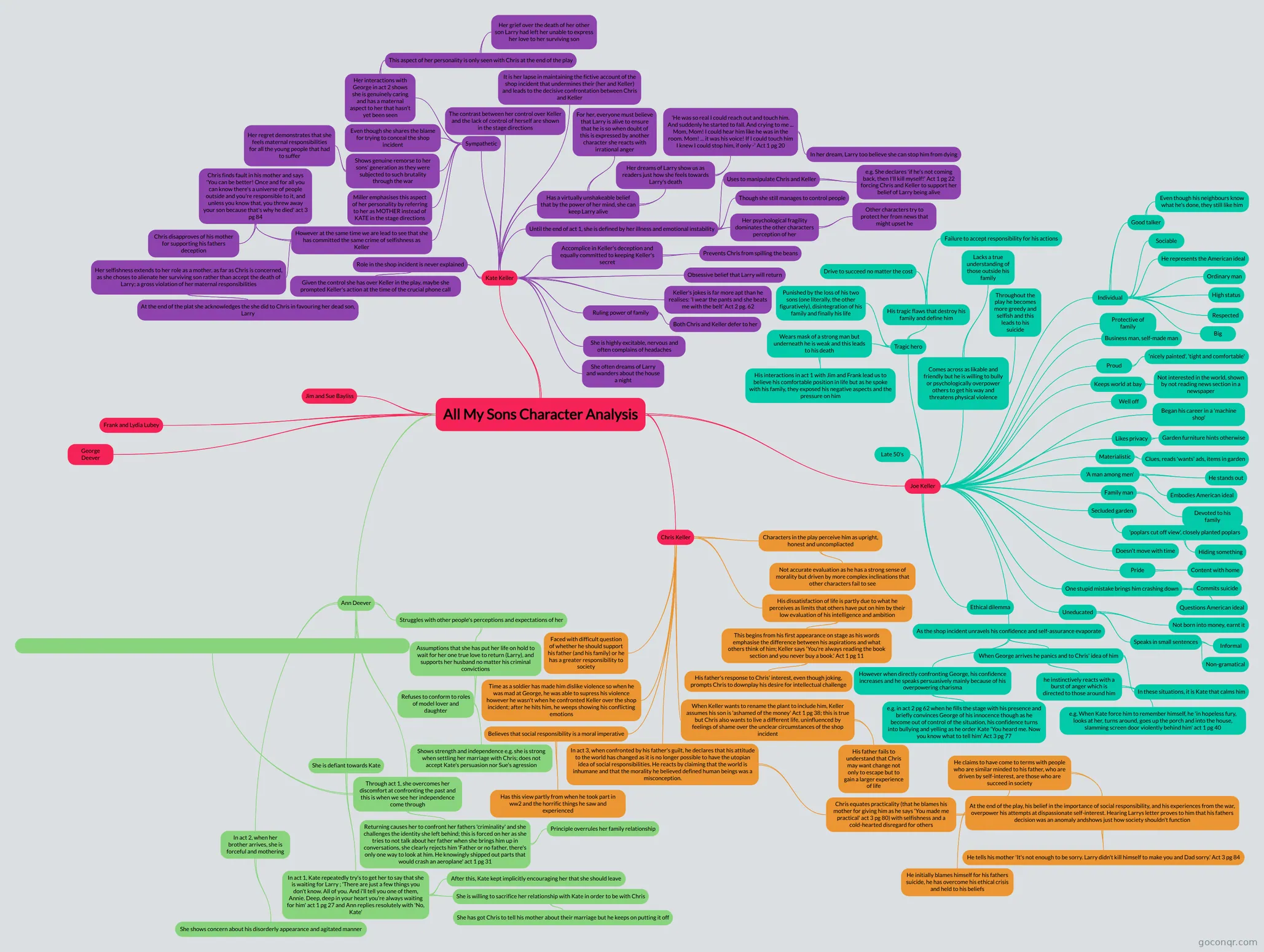
Begin with a mind map for your set play. The All My Sons Character Analysis map starts with Joe Keller, a self-made businessman, and picks out clues such as the garden furniture. The Cat on a Hot Tin Roof map groups themes such as gender, truth and lies, greed and death, and links Brick's crutch to his emasculation. Both show how a good map ties a quotation to an idea.
Moving from maps to quotes
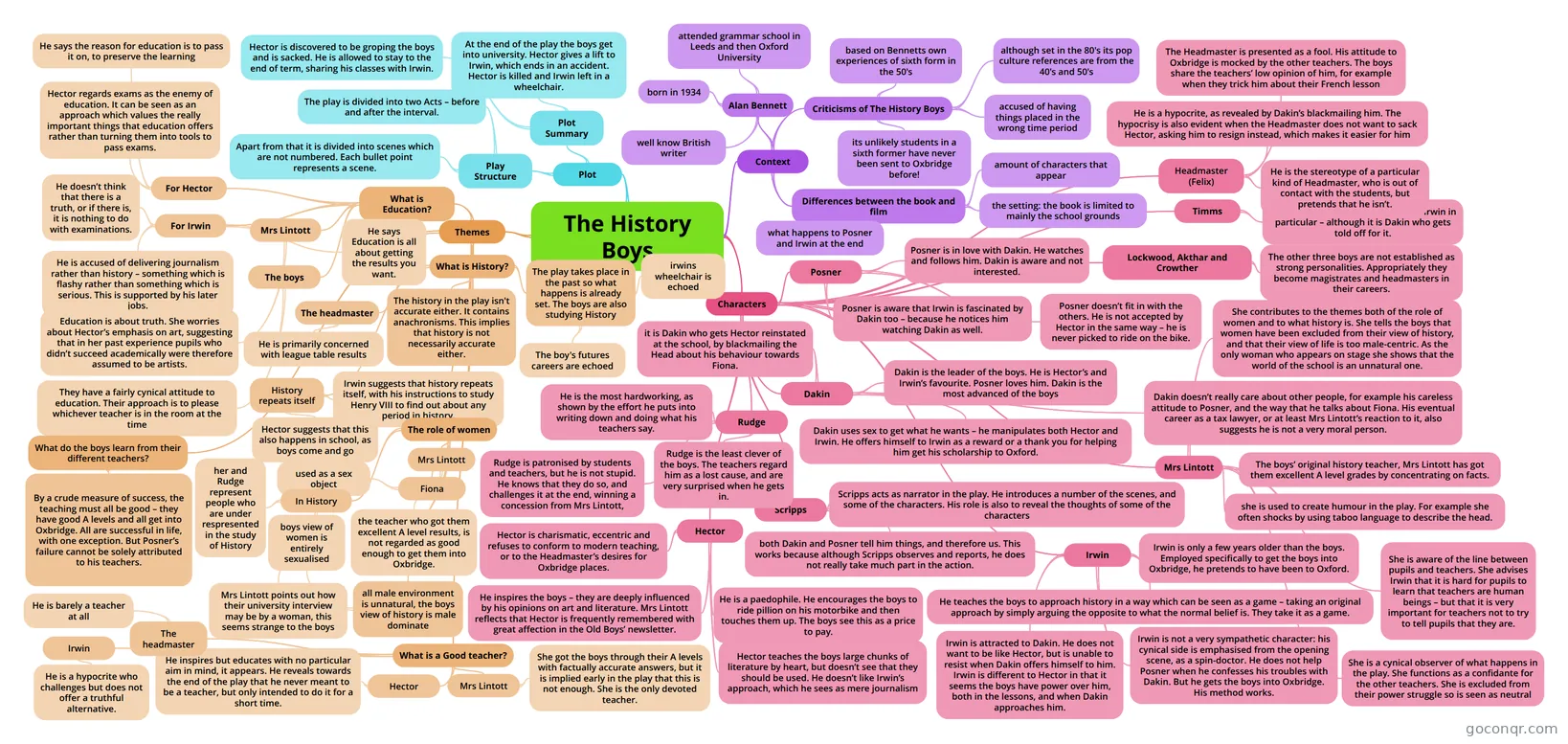
Once you know the characters and themes, move to flashcards and notes. There are quote decks for A Taste of Honey, A Doll's House and The History Boys, plus character cards for Nora, Helmer and Krogstad. Context matters too, so look at the cards on Ibsen and the role of women in Norwegian society, and the notes on Marxist and Feminist readings of A Doll's House.
Testing yourself
Quizzes are the quickest way to find gaps. The A Taste of Honey quiz asks where the play is set and which branch of the armed forces Jimmie and Peter served in. There are also quizzes on Educating Rita, The Glass Menagerie and Who's Afraid of Virginia Woolf. Take one, note what you missed, then go back to the matching map or card deck. Repeat until the details come easily.
Where it fits
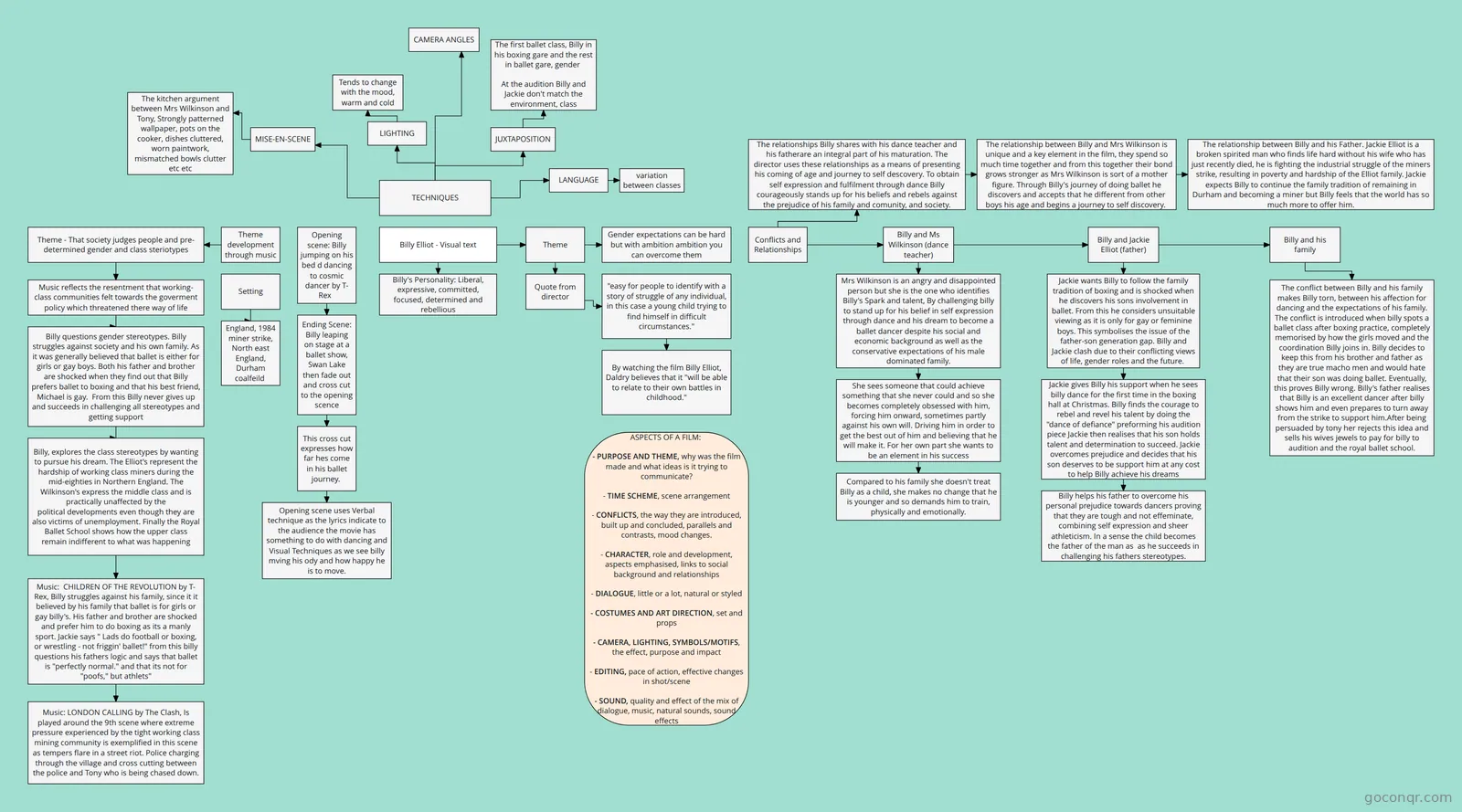
This unit sits in the Drama strand of Literature. It suits students working towards GCSE English Literature, A-level English Literature, GCSE Drama or A-level Drama and Theatre. Teachers can pick out maps, slides or flowcharts, such as Billy Elliot - Visual Text, to share with a class.
Choose one play, open its map and see how far you get before the quiz.
Frequently asked questions
Which resource should I start with?
Start with a mind map for the play you are studying. The All My Sons Character Analysis map and the Cat on a Hot Tin Roof map are good examples, because they set out characters, themes and key quotations in one view. Then try a quiz on the same play.
Which plays are covered?
The page lists resources on A Doll's House, All My Sons, A Taste of Honey, Educating Rita, The History Boys, DNA, Waiting for Godot, Top Girls, Pygmalion, Billy Elliot and Who's Afraid of Virginia Woolf, among others. Mind maps are the biggest group, with flashcards, notes, slides and quizzes alongside.
Are there quizzes I can take?
Yes. There are more than 10 quizzes, including ones on A Taste of Honey, Educating Rita, The Glass Menagerie, A Doll's House and Who's Afraid of Virginia Woolf. DNA has quizzes split by character, such as Leah and Richard. They work well after you have read a map.
Which exams do these resources suit?
The listed resources mention GCSE English Literature, A-level English Literature, GCSE Drama, A-level Drama, A-level Drama and Theatre and Leaving Certificate English. Most are written for school level, so they suit school students revising set texts, and teachers can use them for ready-made material.
Are the resources free, and who made them?
Every resource listed here is free to open, study and take, with no account needed. They were made by GoConqr users, not by GoConqr itself. A free account lets you save quiz scores and build your own quizzes, maps, flashcards and notes.
What if my play is not listed?
Look at the broader resources, such as the notes on metatheatre, the Symbolism flashcards and the map on the characteristics of absurdist theatre. They apply across several plays. You can also make your own mind map or flashcards for your text.