
Indian Classical Music
17 resources created by 15 users
This Indian Classical Music page on GoConqr gathers community-made quizzes, mind maps, flashcards and notes, with a strong focus on Rag Desh, its three recorded versions, tala and the sections of a raga. It's built for school students revising GCSE Music and for teachers after ready-made material. There are over 60 resources here, including more than 30 mind maps, over 20 flashcards decks and 5 quizzes. Pick a version of Rag Desh, try a quiz to find your gaps, then make your own revision aids.
Top Indian Classical Music resources
-
25 questionsRag Desh Definitions In Indian traditional music, what is a pattern of notes called that are similar to a scale?
-
8 questionsRag Desh Set of notes combined to create a particular mood
-
26 cardsRag Desh What is the tala in Indian music?
-
Mind map Indian Music and 'Rag Desh'
-
17 cardsMUSIC RAG DESH Rag Desh is what type of Indian music? How is it normally played?
-
24 cardsRag Desh Key words
-
23 cardsRag Desh Versions 1, 2 and 3 as well as some key vocab
-
10 cardsrag desh version 1 (anoushka shankar) key features of indian classic music (3)
Quizzes
Mind maps
Flashcards
See all 10 flashcards-
26 cardsRag Desh What is the tala in Indian music?
-
17 cardsMUSIC RAG DESH Rag Desh is what type of Indian music? How is it normally played?
-
24 cardsRag Desh Key words
-
23 cardsRag Desh Versions 1, 2 and 3 as well as some key vocab
-
10 cardsrag desh version 1 (anoushka shankar) key features of indian classic music (3)
-
22 cardsRag Desh What is the structure of Rag Desh V1?
-
10 cardsSTEVE & BENJY: 'Rag Desh' Edexcel GCSE Music flashcards for Rag Desh (Steve & Benjy)
-
9 cardsC.L. TANWAR: 'Rag Desh' Edexcel GCSE Music flashcards for Rag Desh (Tanwar)
Notes
-
GCSE Music Revision 3 Rag Desh Sections of a full raga performance- Alap, Jor (Jhor), Jhalla, GatFeatures of the Alap = very slow, free time, unmetred (no regular pulse), soft dynamics, explores the notes of the rag, the  ...
-
Rag Desh Rag DeshFor Music GCSE Edexcel you are required to know three different versions of the piece 'Rag Desh'. The RagThe Rag can be one of three things: the mood, the scale or the title. There are many hundreds of di...
More Music topics
About Indian Classical Music
GoConqr OriginalWhat the resources cover
Most of this unit is built around Rag Desh, the set work for GCSE Music. The notes explain that a rag can mean a mood, a scale or a title. They also set out the sections of a full performance: alap, jor, jhalla and gat. The alap is described as very slow, in free time, with no regular pulse and soft dynamics, exploring the notes of the rag.
Where to start
- Read the note called Rag Desh for the three versions and what the rag is.
- Open the note GCSE Music Revision 3 for the sections of a raga performance.
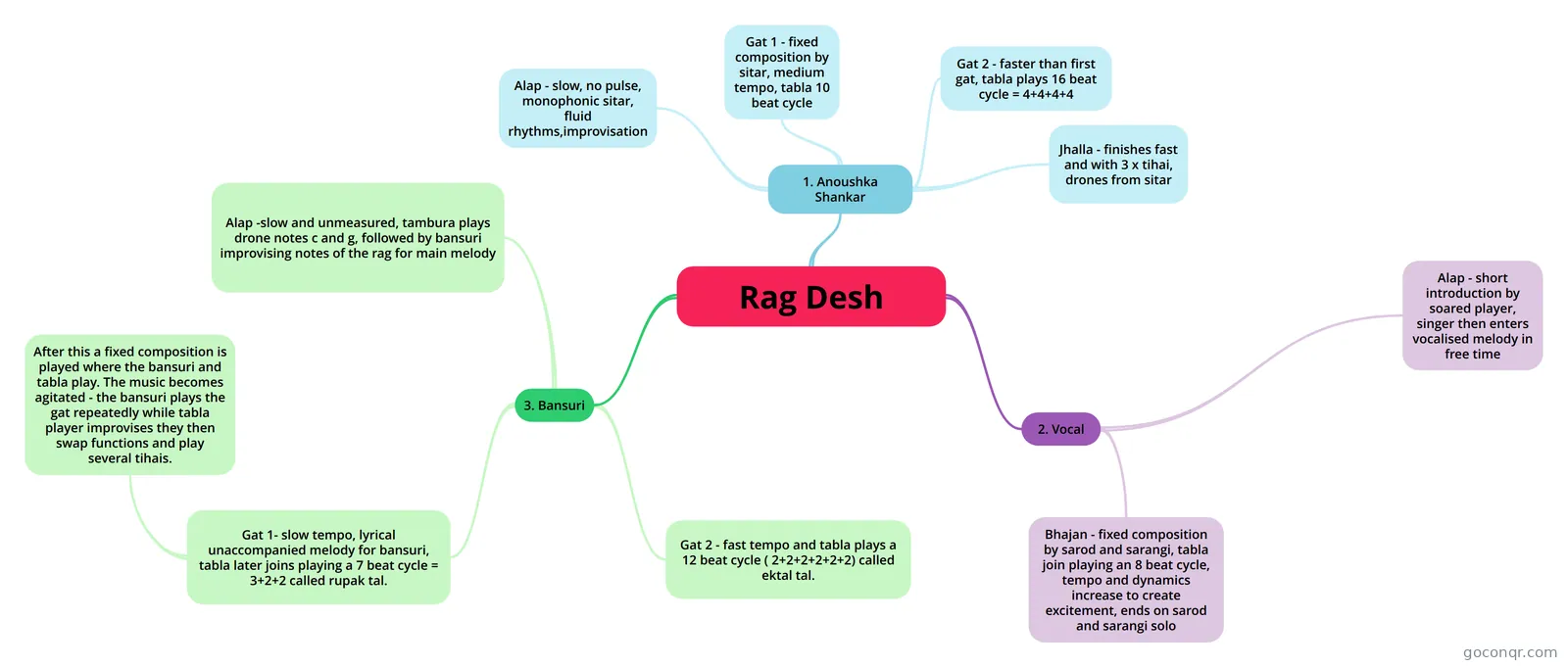
- Look at the mind map called Rag Desh, which branches into Version 1, Version 2 and Version 3, with instrumentation, rhythm and structure.
- Move on to the version-specific maps, such as those on Anoushka Shankar, Chiranji Lal Tanwar, and Steve Gorn and Benjy Wertheimer.
Using quizzes and maps together
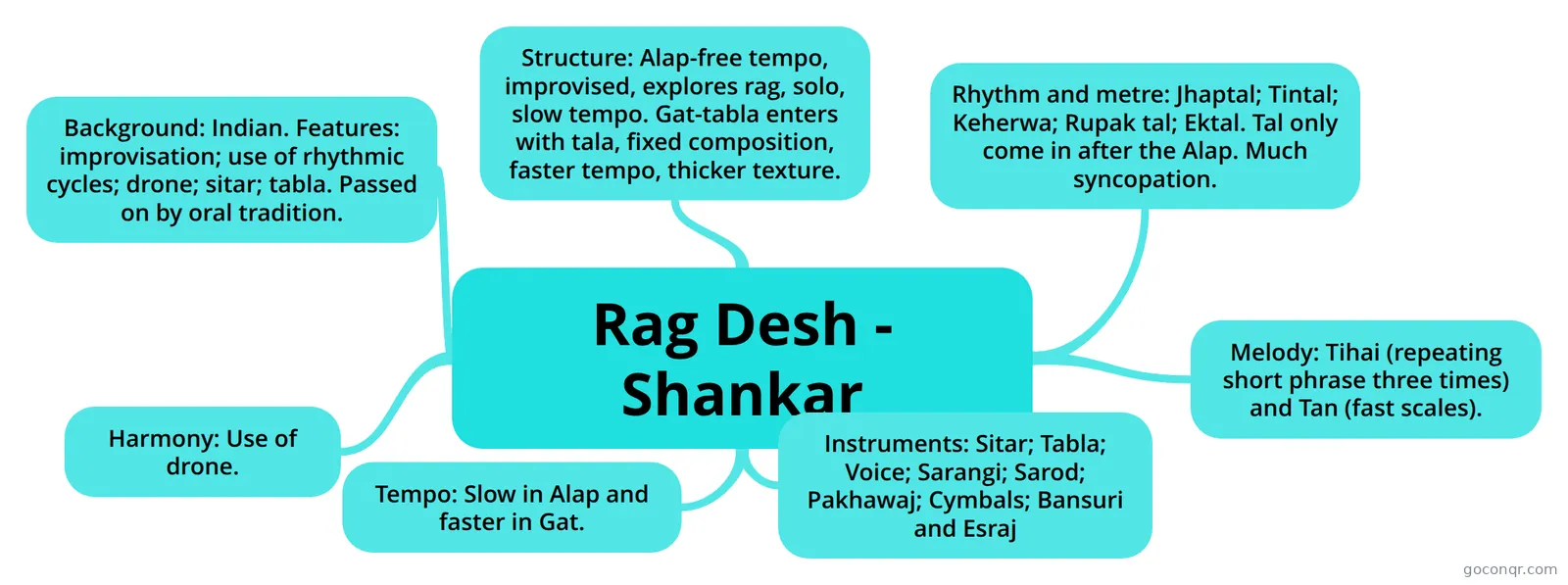
Begin with the quiz Rag Desh Definitions. It asks what a pattern of notes like a scale is called, what a cycle of beats is called and what the first beat of a tal is called. Check what you missed, then look for it on a mind map. The map on Rag Desh covers the sitar, meend (pitch bend), the tabla and the two tals, Jhaptal with 10 beats and Tintal with 16.
The second quiz, Rag Desh, tests the same ideas as the opening section, the second section and the mood of a rag. After that, use the flashcard decks to drill terms such as sam, matras, bols, gat and jhalla. There is also a deck on Rag Desh Terminology and a deck covering all versions.
Where it fits
This unit sits in the World Music strand of Music. Beyond Rag Desh, you will find broader items such as the note on the concept of Tala, a mind map called Indian Raga and the quiz Forms of Music. Teachers can use the version decks and maps as ready-made starters for lessons or revision.
When you have worked through a few, try making your own mind map of one version and test yourself with a quiz.
Frequently asked questions
Which resource should I open first?
Start with the note called Rag Desh, which explains the three versions you need to know and what a rag is. Then read GCSE Music Revision 3 for the sections of a full raga performance. Once those make sense, the Rag Desh mind map gives you a quick visual summary.
What do the quizzes test?
Rag Desh Definitions asks about terms such as the pattern of notes similar to a scale, the cycle of beats and the first beat of a tal. The quiz Rag Desh covers mood and the sections of a raga. There are also quizzes on Indian Classical Music and Forms of Music.
What do the mind maps cover?
Many maps cover Rag Desh by version, including Anoushka Shankar, Chiranji Lal Tanwar, and Steve Gorn and Benjy Wertheimer. They show instruments like the sitar and tabla, tala, structure and the alap. Others give wider views, such as Indian Raga and Indian Music.
Are the resources free to use?
Yes. Every resource listed here is free to open, study and take, with no account needed. They were made by GoConqr users, not by GoConqr itself. A free account also saves your quiz scores and lets you make your own quizzes, mind maps, flashcards and notes.
Which exam do these resources suit?
The resources that name an exam mention GCSE Music, and most of the page is aimed at school students. The Rag Desh material follows the three versions set for that course. Teachers can also use the maps and flashcards as ready-made classroom material.
What if I cannot find what I need?
Look at the flashcard decks and mind maps for each version, since many cover the same ideas in different ways. If a topic is still missing, you can build your own mind map or flashcards from the notes on the page and test yourself with a quiz.