
Test
MO25 Drug action and Dose-Response
Este test tiene tipos de pregunta que se abren en el reproductor de siempre.
Preguntas del test (10)
1What matters when considering affinity?
- AThe association rate constant
- BThe disassociation rate constant
- CBoth
2The [blank_start]Law of Mass Action[blank_end] for drug receptor interaction is the same principle as a chemical reaction in [blank_start]equilibrium[blank_end]. Assuming Drug and Receptor interact in a [blank_start]reversible[blank_end] manner:
• Kon is proportional to the concentration of [blank_start]D and R[blank_end]
• Koff is proportional to the concentration of [blank_start]DR[blank_end]- Aequilibrium
- Breversible
- CLaw of Mass Action
- DD and R
- EDR
3The dissociation binding constant (Kd) is measured experimentally and is = Koff/Kon.
- AVerdadero
- BFalso
4The lower the Kd, the [blank_start]higher[blank_end] the affinity.
- Ahigher
- Blower
5Agonists are drugs that interact with and activate receptors, producing a signal. Agonists have both [blank_start]affinity[blank_end] and some [blank_start]efficacy[blank_end]
There are different types of agonists: 'full’ agonists which activate the receptor to the [blank_start]highest response/signal level[blank_end] (full efficacy) and partial agonists which can only activate the receptor to a [blank_start]lower[blank_end] extent.- Aaffinity
- Befficacy
- Chighest response/signal level
- Dlower
6A dose-response curve for an agonist reveals the efficacy and potency. Label them:
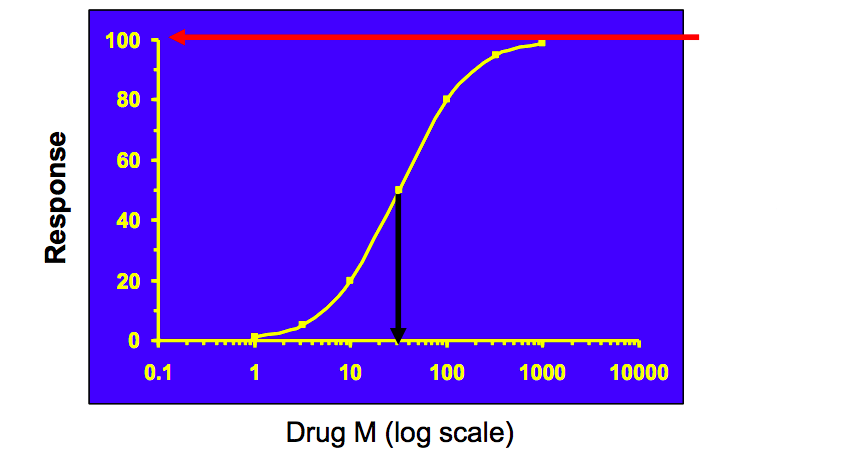
- Apotency
- Befficacy
7Potency is the drug [blank_start]concentration[blank_end] required to produce a specified [blank_start]response[blank_end]. It is often expressed as EC50 – concentration of drug required to produce [blank_start]half[blank_end] the maximum response.
- Aconcentration
- Bresponse
- Chalf
8 Antagonists are drugs that prevent an [blank_start]agonist[blank_end] from binding to a receptor and thus [blank_start]prevent[blank_end] its effects. Antagonists have [blank_start]affinity[blank_end] for the receptor but do not by themselves have any [blank_start]efficacy[blank_end]. Antagonists often are [blank_start]larger[blank_end] and make different interactions and [blank_start]more[blank_end] interactions with the receptor than an agonist.
- Aagonist
- Bprevent
- Caffinity
- Defficacy
- Elarger
- Fmore
9An antagonist moves an agonist’s dose response curve to the left.
- AVerdadero
- BFalso
10An inverse agonist is a drug that binds to a receptor and produces a pharmacological response that is [blank_start]opposite[blank_end] to that of an agonist. An inverse
agonist [blank_start]reduces[blank_end] the activity mediated by a receptor. This works because a lot of receptors have [blank_start]intrinsic[blank_end] or constitutive activity.- Aopposite
- Breduces
- Cintrinsic
Información
- Descripción
- (Molecules) PHCY211 Test sobre MO25 Drug action and Dose-Response, creado por Mer Scott el 14/04/2018.
- Autor
- Mer Scott
- Idioma
- English
- Visitas
- 7
- Etiquetas
- Valoración
- Aún sin valoraciones Valora este test