
Fichas
Chapter 12
Fichas del conjunto (38)
- 1Piaget’s Theory: The Concrete Operational StageChildren's thoughts become more logical, flexible,and organized
- 2Stages of Piaget’s Theory1. Conservation
2.Classification
3.Seriation
4.Spatial reasoning - 31.Conversation: Decentrationfocusing on several aspects of a problem and relating them rather than centering on just one
- 41. Conversation:Reversibilitythe capacity to think through a series of steps and then mentally reverse direction, returning to the starting point
- 52. Classificationpass class inclusion problem - more aware of classification hierarchies and can focus on relations between general category
- 6At age ten Joey spent hours sorting and reporting his baseball cards, grouping them first by league and team, then by playing position and batting average -separate players into a variety of classes and subclassesClassification
- 73. Seriationthe ability to order items along quantitive dimension such as length or weight
- 8Transitive inferenceability to seriate mentally
- 9Spatial reasoningCognitive maps: mental
representations of spaces
-their mental representations of spaces such as a classroom - 10Impact of culture and schooling-Experience of attending school promotes mastery of Piagetian
tasks.
-Certain informal, nonschool experiences can also foster
operational thought - 11Neo-Piagetian theoriesOperational thinking represents expansion of informationprocessing
capacity.
Central conceptual structures enable children to think effectively
in wide range of situations.
Neo-Piagetian approaches account for unevenness in cognitive
development. - 12Information-Processingexamines separate aspects of thinking
- 13Attention Executive Functionimproves, supporting gains in
planning, strategic thinking, and
self-monitoring.
improves, supporting gains in
planning, strategic thinking, and
self-monitoring. -ADHD - 14Working-memory capacitybenefits from increased efficiency of
thinking.
is often deficient in children with
persistent learning difficulties in
reading and math.
can be increased through direct
training - 15Memory StrategiesRehearsal
Organization
Elaboration - 16Rehearsalrepeating information to yourself
early grade school - 17Organizationgrouping related items together
soon after rehearsal - 18Elaborationcreating a relationship or shared meaning between two or more pieces of info that are not members of the same category
end of middle childhood - 19Children with ADHDUnable to stay focused on task requiring mental effort for more
than a few minutes
Often ignore social rules and lash out when frustrated
Highly heritable, but also related to environmental factors
Stimulant medication reduces symptoms in 70% of children, but
drugs have risks.
Best approach is medication combined with interventions that
model and reinforce appropriate behavior. - 20Traditional classroomsA classroom in which the teacher is the sole authority for knowledge,rules and decision making and students are relatively passive learners who are elevated in relation to a uniform set of standards for their grade
- 21Constructivist Classroomencourages students to construct their own knowledge
- children are viewed as active agents who reflect on and coordinate their own thoughts, rather then absorbing others. - 22Social-constructivistchildren participate in a wide range of challenging activities with teachers and peers, with whom they jointly construct understandings. As children appropriate (take for themselves) the knowledge and strategies generated through working together, they become competent, contributing members of their classroom community and advance in cognitive and social development.
- 23Reciprocal teachinga teacher and two-four students form a group and take turns leading dialogues on the content of a text passage. Within the dialogues, group members apply four cognitive strategies: questioning, summarizing, clarifying, and predicting
- 24Communities of learnerswhere teachers guide the overall process of learning but no other distinction is made between adult and child contributors: All participate in joint endeavors and have authority to define and resolve problems.
- 25Teacher–student interaction Self-fulfilling prophesieschildren may adopt teachers' positive or negative views and start to live up to them
- 26Grouping practicesHomogenous
Multigrade classrooms
Cooperative learning - 27Cooperative learningsmall groups of classmates work toward common goals- by considering one another's ideas, appropriately challenging one another, providing sufficient explanations to correct misunderstandings, and resolving differences of opinion on the basis of reasons and evidence.
- 28Magnet schoolsoffer usual curriculum plus
specific area of interest, such as performing arts. - 29Metalinguistic awarenessability to think about language as a system
- 30Vocabulary Development-increases fourfold
Reading contributes enormously to vocabulary growth. - 31pragmaticsthe communicative side of language
-Children can adapt to needs of listeners in challenging communicative
situations
Narratives advance - 32Children can become bilingual bylearning two languages at once.
learning a first language, then a second. - 33code switchingproducing
an utterance in one language containing “guest” words from the other. - 34Children’s Intelligence TestsStanford-Binet Intelligence Scales
Wechsler Intelligence Scale for Children-IV - 35Stanford-Binet Intelligence Scales, Fifth EditionMeasures five intellectual factors: general knowledge, quantitative
reasoning, visual-spatial processing, working memory, basic
information processing.
Age 2 to adulthood - 36Wechsler Intelligence Scale for Children-IVAges 6 to 16
Wechsler Preschool and Primary Scale of Intelligence–Revised (for
younger children)
Measures four broad intellectual factors: verbal reasoning, perceptual
(or visual-spatial) reasoning, working memory, processing speed. - 37predictors of IQInhibition, selective attention, and
sustained attention
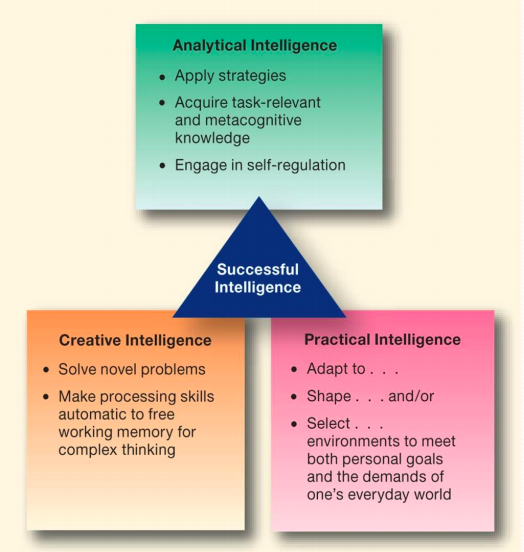
Processing speed - 38Sternberg’s Triarchic Theory of Successful Intelligence
Información
- Descripción
- Psychology Fichas sobre Chapter 12, creado por Marilyn Garcia el 10/12/2017.
- Creado por
- Marilyn Garcia
- Visitas
- 0
- Valoración