
Fichas
Learning and Memory
Fichas del conjunto (74)
- 1What is stimulus-response learning?Learning to perform a particular response/behaviour to a particular stimulus
- 2What is perceptual learning?Learning to identify and discriminate types of stimuli
- 3What is motor learning?Learning how to modify your motor responses
- 4What is classical conditioning?Pavlov
Before conditioning:
UCS = UCR
NS = NR
During conditioning:
UCS + NS = UCR
After conditioning:
UCS = UCR
CS = CR
(The neutral stimulus turns into a conditional stimulus) - 5Does classical conditioning last forever?- Extinction: repeated presentation of the CS without the UCS leads to a decrease in the CR
- Spontaneous recovery: after a rest, a seemingly extinguished response may return, but often not as strongly
- Generalisation: a CR to a stimulus similar but not identical to the trained CS - 6Why is classical conditioning helpful?- Many of the stimuli that cause a reflexive involuntary UR are aversive
- Pinel and Treit 1978 - when rats touched object they receive a aversive stimulus = immediately bury the object - 7What is conditioned taste aversion?The development of an aversion to the taste of foodstuff following the experience of feeling ill after consuming it
- 8What is operant conditioning?Learning to modify voluntary behaviours - learning based on the consequences of behaviour
- 9What is Thorndike's law of effect?Behaviour that is followed by pleasant consequences is likely to be repeated, and behaviour that is followed by unpleasant consequences is likely to be stopped
- 10Skinner- Operant conditioning is control of behaviour through its consequences
- The nature of the consequence determines whether the behaviour is repeated - 11What is reinforcement and punishment?Reinforcement: used to maintain or increase a desired behaviour
Punishment: used to reduce or eliminate a undesired behaviour - 12What is positive reinforcement?Increasing behaviour by adding a reward
- 13What is negative reinforcement?Increasing behaviour by removing an unpleasant stimulus
- 14What is positive punishment?Decreasing behaviour by adding a punishing stimulus
- 15What is negative punishment?Decreasing behaviour by removing a pleasant stimulus
- 16+ reinforcement in the Skinner box- Rats would initially run round the box
- Would hit the response lever by accident
- Produce food
- Rat then hits response lever over and over again - 17- reinforcement in Skinner box- Grid in base is electrified and gave an unpleasant electrical current
- Rats would eventually hit the lever
- Hitting the lever would turn it off - 18+ punishment in Skinner box- To reduce the occurrence of behaviour, hitting the lever would produce an electric shock from the grid
- 19- punishment in Skinner box- Hitting the lever causes the food to drop out of the cup i.e. the reward would be removed
- 20What is the radial arm maze?- Bait would be placed at the end of one arm of the maze
- Rat would wander round randomly for first few days
- After a few times they would go straight to the bait
- Seemed to use features of the room - 21What is continuous reinforcement?Reinforcement/punishment is given every time the behaviour occurs
- 22What is partial reinforcement?Reinforcement/punishment only occurs some of the time when the behaviour occurs
- 23What is fixed-interval reinforcement?Reinforcement only occurs after fixed period of time, regardless of the number of responses
- 24What is variable-interval reinforcement?Reinforcement occurs after randomly varying periods of time
- 25What is fixed-ratio reinforcement?Reinforcement occurs after a set number of responses
- 26What is variable-ratio reinforcement?Reinforcement occurs after a random number of responses
- 27What are primary reinforcers?Things that directly satisfy a need or reflexively drive a response e.g. food
- 28What are secondary reinforcers?Things that have no intrinsic value but become valued through association with a primary reinforce e.g. money
- 29Neural mechanisms of conditioning - what is the Hebb rule?- Neurons that fire together wire together
- Tone and puff of air activate neurons that connect via synapses to the motor neuron that initiates the blink
- Connections that are active stimutaneously strengthen - 30What is the operant conditioning model?1. Stimulus e.g. sight of lever
2. Neural circuit that detects a particular stimulus
(Reinforcement system strengthens connection)
3. Neural circuit that controls a particular behaviour --> behaviour e.g. lever press
4. Reinforcing stimulus e.g. food
5. Reinforcement system
Loops from 3 --> 5 - 31What happens in the transcortical pathway?- Direct connections from one cortical region to another
- Stimuli are processes by a sensory area
- Information transmitted to motor regions in frontal cortex
- Typically involved in initial learning stages of learning complex activities - 32What happens in the basal ganglia?- Controls voluntary motor movements
- Procedural learning
- Caudate nucleus and putamen receive sensory info and info about planned and in-progress movements
- Transmit info to the globus pallidus
- Transmits to frontal and premotor cortices - 33What is the "reward" circuit?- Part of the mesolimbic system
- Tend to be involved in evaluating rewards and particular unexpected or surprising rewards
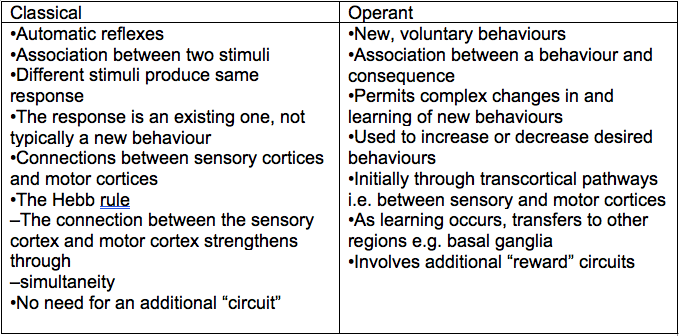
- Underpins secondary reinforcers? - 34What are the differences between classical and operant conditioning?
- 35What are the similarities between classical and operant conditioning?- Both involve associative learning between 2 events
- Both can lead to generalisation
- The response in CC has been said to be operantly reinforced - 36What is long-term memory?Atkinson and Shiffrin model
- LTM is single store for all kinds of info
- Huge variation in the type of info - 37What is declarative vs non-declarative memory?Declarative: conscious recollection "explicit memory"
Non-declarative: doesn't require conscious recollection "implicit memory" - 38What is retrograde and Anterograde amnesia?Retrograde: problems remembering things from before the event/injury
Anterograde: problems learning things after the onset of amnesia (more common) - 39What are the processes of memory?1. Encoding = i.e. perception
2. Storage = storing learned material in some kind of memory system
3. Retrieval = recovering stored information from memory - 40What is the multi-store model of memory?Atkison and Shiffrin
Sensory stores (attention) -> short-term store (rehearsal) -> long-term store
- Decay, displacement, interference - 41What is sensory memory?- Information is held briefly in distinct sensory stores
- Each sensory modality has a separate store e.g. iconic or echoic
- Can persist longer than the stimulus - 42What research is there into iconic memory?(Vision memory)
Sperling:
- Flashed letters on screen for varying short periods of time
- Ps on av remembered 4-5 of the letters
- Free recall - 4 or 5/12
- Cued recall (told to remember letters from one row) typically remembered whole row - 43What is short term memory?- Info that is selected from sensory memory passes to STM
- Limited capacity and duration
- Millers magic number: 7+/- 2
- Duration from few seconds to few minutes
- Chunking - 44What is rehearsal, interference and decay?Rehearsal = maintenance of info in STM, also associated with transfer to LTM
Decay = without rehearsal, items fade away
Interference = new or otherwise distracting info displaced already learned info - 45What are criticisms of the MSM?- Implies each level of model is unitary process
- Implies each process is gateway to next one
- Implies only consciously selected info is retained
- Assumed rehearsal is required to transfer to LTM
- Linear model - 46Who proposed the working memory model?Baddeley and Hitch
- 47What is the phonological loop?- Used for briefly storing and processing speech like phonological info
- Passive phonological store primarily concerned with perception
- An articulatory process concerned with production - 48What is the visuo-spatial sketchpad?Visual cache = stores info about shape and colour
Inner scribe = process spatial and movement info - 49What is the central executive?- A central, attention allocating system
- Doesn't actually store anything
- A collection of distinct processes - 50What is the episodic buffer?- Temporary storage for integration of info from other WM components
- Stores details of specific events - specific combinations of info
- Helps interface with LTM - 51What is the main evidence for the working memory model?- Dual task approach
- Assumption that different system components work relatively independently
- If 2 tasks use same component they cannot be performed as well together as separately
- If 2 tasks use different components it is possible to do them well at the same time - 52What are the 3 levels of processing?- Shallow = simple judgement of visual characteristics
- Intermediate = judgement of how the word sounds
- Deep = understanding the meaning of the word and sentence - 53What are some reasons for amnesia?- Closed brain injury
- Chronic conditions
- Strokes
- Medical procedures
- Trouble explicitly learning new things or forming declarative memories but non-declarative procedural tasks are easier to show improvements - 54What do Schachter and Tulving say the 4 long-term memory systems are?1. Episodic memory
2. Semantic memory
3. Procedural memory
4. Perceptual representation system - 55What is episodic memory?Explicit recollection of a thing that has happened to you, e.g. what you had for breakfast
- 56What is semantic memory?Knowledge about things and meanings of things e.g. names of food, general knowledge
- 57How is object knowledge organised hierarchically?Superordinate level = animal
Basic level = dog
Subordinate level = border collie - 58What is procedural learning?Also called implicit memory
- Improvements in performance are seen without conscious knowledge of what has been learnt - 59What is repetition priming?Repeated exposure to a stimulus facilitates subsequent processing of that stimulus?
- 60What is autobiographical memory?- Memory for the events of your own life
- Distinct from episodic
- More about the narrative of life - 61What are factors that influence explicit but not implicit memory?Semantic elaboration and divided attention
- 62What are factors which reduce implicit but nor explicit memory?Study-test changes in modality, surface features
- 63How does H.M's case show the connection between amnesia and memory?- Bilateral medial temporal lobectomy
- Retained intellect
- Intact immediate memory
- Retained knowledge of earlier life
- Profound anterograde amnesia
- 3-year retrograde amnesia
- Normal implicit memory - 64What are some other causes of temporal lobe dysfunction?- Temporal lobe epilepsy
- Korsakoff's syndrome
- Alzheimers
- Stroke
- Head injury - 65What is single dissociation?When performance on task A is impaired but performance on task B is normal
- 66What is double dissociation?When a patient is impaired on task A but performs normally on task B - whereas a different patient performs normally on task A but is impaired on task B
- 67What are some limitations of lesion studies?- Generalising from primates
- Lesion studies do not identify specific processes
- Lesion can disrupt multiple neural systems
- Compensatory operations
- Individual variation - 68What is familiarity in recognition memory?Context-free memory recognised items feel familiar
- 69What is recollection in recognition memory?Context-dependent memory remembering specific details of the event
- 70What is Ribot's law?There is a time gradient in retrograde amnesia, so that recent memories are more likely to be lost than the older memories
- 71What changes occur in the brain in Alzheimer's disease?- Cortical and subcortical changes
- Neuronal loss (particularly large neurons)
= Neurofibrillary tangles
- Neurotransmitter depletion - 72What is semantic dementia?- Progressive deterioration of people, objects, facts, word meaning and conceptual knowledge
- Better memory for recent (~4 years) than remote events - 73What is the relationship between memory and the frontal lobes?- Medial temporal lobe plays an associative role in memory function
- Classical studies don't emphasise memory impairment in frontal lobe patients - 74What is the hemispheric encoding and retrieval asymmetry model of memory?Tulving et al
Encoding = left -> right
Retrieval = right -> left
Información
- Descripción
- Psychology Fichas sobre Learning and Memory, creado por Holly Marshall el 16/05/2018.
- Creado por
- Holly Marshall
- Visitas
- 1
- Valoración