
Fichas
Memory
Fichas del conjunto (54)
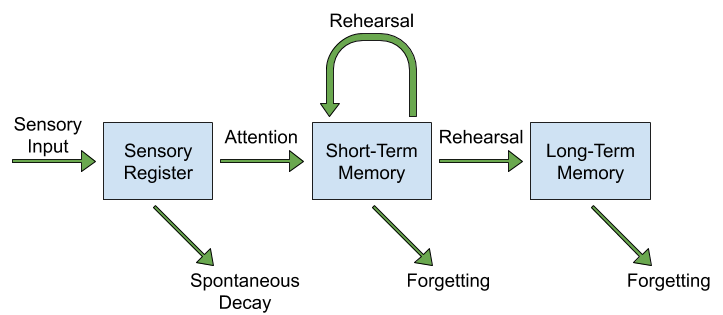
- 1Sensory registerTemporarily stores information from our senses
Has a limited capacity and a very limited duration (will spontaneously decay unless we pay attention to it)
Information is coded depending on the sense that has picked it up - 2Short-term memoryHas a limited capacity and a limited duration
Coding is usually acoustic - 3Long-term memoryHas almost unlimited capacity and is theoretically permanent in duration
Coding is usually semantic
Consists of episodic memory, semantic memory and procedural memory - 4Episodic memoryStores information about events that you've actually experienced
The memories are declarative, meaning they can be consciously recalled - 5Semantic memoryStores facts and knowledge
Can be consciously recalled - 6Procedural memoryStores the knowledge of how to do things, such as walking
Cannot be consciously recalled - 7Sperling (1960)After participants were shown a grid with three rows of four letters for 0.05 seconds and asked to recall either the whole grid or a certain row (indicated by a tone), those recalling the whole grid managed 4 or 5 letters on average and those recalling a row managed 3 letters on average (no matter the row), suggesting the whole grid was in their sensory register but the trace faded before recall ended
- 8Evaluation of Sperling's (1960) studyGood control of variables
Replicable
Bad ecological validity - 9Peterson and Peterson (1959)Participants were shown nonsense trigrams and asked to recall them after 3, 6, 9, 12, 15 or 18 seconds while they has to count backwards in threes from a given number during the pause
After 3 seconds, recall was correct 80% of the time whereas only about 10% was recalled correctly after 18 seconds - 10Evaluation of Peterson and Peterson's (1960) studyGood control of variables
Lack of ecological validity
Participants could have gotten confused due to repeats where they saw different trigrams - 11Bahrick et al. (1975)392 people were asked to complete free-recall, photo recognition and name recognition tests for their ex-classmates periodically through their life
Within 15 years of leaving school, free-recall was 60% accurate and photo and name recognition was 90% accurate
After 30 years, free recall had declined to about 30% accuracy
After 48 years, name recognition was about 80% accurate and photo recognition was about 40% accurate - 12Evaluation of Bahrick et al.'s (1975) studyHigh ecological validity (it was a field study)
Hard to control variables, such as amount of rehearsal - 13Jacobs (1887)Participants were asked to recall a string of letters and digits and the length of the sequence increased until it was recalled wrong
On average, participants recalled 9 digits and about 7 letters but the capacity increased with age during childhood - 14Evaluation of Jacobs' (1887) studyLack of ecological validity
Participants could have been confused by previous sequences during repeats - 15Miller (1956)Said the capacity of STM is 7 ± 2 items
Suggested chunking can increase the capacity - 16Baddeley (1966)Participants were asked to recall a set of words either immediately or after a ten minute task where the set of words was either acoustically similar or dissimilar or semantically similar or dissimilar
Those recalling immediately struggled with acoustically similar words whereas those recalling from the LTM struggled with semantically similar words - 17Evaluation of Baddeley's (1966) studyLack of ecological validity
Doesn't consider the types of LTM and other types of coding - 18Atkinson and Shiffrin's (1968) multi-store model of memory
- 19Evaluation of Atkinson and Shiffrin's (1968) multi-store model of memorySupported by studies
Oversimplified - 20Primacy effectPeople are able to recall the first few items from a list better than those from the middle (because they'll have been rehearsed better and transferred to LTM)
- 21Recency effectPeople tend to recall items from the end of a list better than those from the middle (because the middle words have been displaced)
- 22Milner et al. (1957) - Patient HMHad his hippocampus removed to treat epilepsy and found he could then only form new short-term memories rather than new long-term memories as well
- 23Baddeley and Hitch's (1974) working memory model
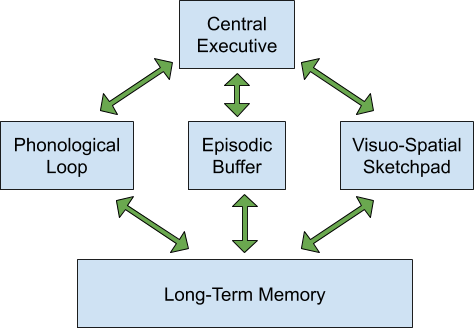
- 24Central executiveCan be described as attention
Has a limited capacity and controls 'slave' systems that also have a limited capacity - 25Phonological loopHolds speech-based information
Made up of a phonological store (inner ear) and an articulatory process (inner voice) - 26Visuo-spatial sketchpadDeals with temporary storage of visual and spatial information
- 27Episodic bufferStores information from the other subsystems and integrates it together to make complete scenes
- 28Shallice and Warrington (1974) - Patient KFHe had an impaired STM due to brain damage but his issue was only with immediate recall of words presented verbally rather than with visual information
- 29Evaluation of Baddeley and Hitch's (1974) working memory modelHas support from studies
The idea of the central executive is oversimplified
Doesn't explain how information is transferred to LTM
Experimental support typically lacks ecological validity - 30DisplacementWhen information is pushed out of the memory
Occurs in STM - 31DecayWhen information fades away
Occurs in STM and LTM - 32Retrieval failureWhen information still exists in the memory but isn't accessible due to an absence of appropriate cues
Occurs in LTM - 33Retroactive interferenceWhere new information interferes with the ability to recall older information
Occurs in LTM - 34Underwood and Postman (1960)Participants were given a list of paired words (e.g. cat-tree) and then later given a second list with the first word of the pair the same (e.g. cat-dirt)
They were asked to recall the first list and their performance was worse than a control group who didn't have to learn a second list - 35Proactive interferenceWhere older information interferes with the ability to recall new information
Occurs in LTM - 36Underwood (1957)Studies into forgetting over a 24 hour period showed that if people has learnt 15 or more word lists, their recall for the last list a day later was around 20% but if they had only learned the last list, recall a day later was around 80%
- 37Cue-dependent memorySomething that can be either internal (e.g. mood) or external (e.g. context) that sparks recall
- 38Tulving and Psotka (1971)Found that free cued recall was about 70% no matter the amount of lists of 24 words (between 1 and 6) a participant had whereas those who completed total free recall showed evidence of retroactive interference because participants with less lists performed better
- 39Evaluation of Tulving and Psotka's (1971) studyGood control of variables
Lack of ecological validity - 40Leading questionA certain answer is implied within the question
- 41Loftus and Palmer (1974)The verb within the question "how fast do you think the cars were going when they __?" is a key to the testimony given
The verb used was one of hit, smashed, collided, bumped or contacted
When the given word was smashed the highest estimate was given of 41mph and the lowest estimate of 32mph was given when the word contacted was used - 42Loftus and Zanni (1975)Participants were shown a film of a car crash and then asked whether they saw "the" broken headlight or "a" broken headlight
17% of the group with the word "the" said they did compared to only 7% in the other group, suggesting even the smallest words can make a question leading and affect EWT - 43Evaluation of Loftus and Palmer's (1974) studyHelpful implications in police interviews
The experiment was artificial so might not be accurate
Potential demand characteristics - 44Evaluation of Loftus and Zanni's (1975) studyHelpful implications in police interviews
Good control of variables
Lack of ecological validity - 45Shaw et al. (1997)A pairing of a participant and a confederate watched a staged robbery and were then interviewed together afterwards
If the participant responded first, recall was 58% accurate
If the confederate answered first and gave accurate responses, the participants recall was accurate 67% of the time
If the confederate responded first and gave inaccurate answers, the participants recall was 42% accurate - 46Post-event discussionA conversation between co-witnesses or an interviewer and an eyewitness after a crime has taken place which may contaminate a witness' memory for the event
- 47Valentine and Coxon (1997)3 groups of participants (children, young adults and the elderly) watched a video of a kidnapping and then asked a series of leading and non-leading questions about what they'd seen
Both the elderly and children gave more incorrect answers to non-leading questions
Children were misled more by leading questions that adults or the elderly - 48Evaluation of Valentine and Coxon's (1997) studyGood implications in law
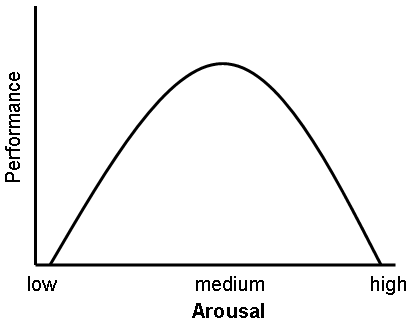
Lacks ecological validity - 49Yerkes-Dodson curveA graph that suggests that optimal performance occurs when the levels of anxiety and stress are neither low nor high
- 50Johnson and Scott (1976)Participants were asked to identify a man from 50 photographs
Those in condition 1 (when the man came out after an argument with a pen and greasy hands) were 49% accurate
Those in condition 2 (when the man came out with a knife and bloody hands) were 33% accurate - 51Evaluation of Johnson and Scott's (1976) studyHigh ecological validity
Ethics: deception, informed consent - 52Cognitive interview technique1) The interviewer makes the witness relaxed and tailors his/her language to suit them
2) The witness mentally recreates the environmental and internal context
3) The witness reports everything
4) The witness is asked to recall details in a different order
5) The witness is asked to recall details from a different perspective
6) The interview avoids any judgement - 53Geiselman et al. (1986)Participants were questioned about a classroom robbery 2 days after it had happened either using the cognitive interview or standard interview
Early in the questioning, everyone was asked "was the guy with the green backpack nervous?" even though the perpetrator had a blue backpack
Later, the participants were asked to recall what colour the backpack was and those in the cognitive interview condition were less likely to recall the backpack as green - 54Evaluation of Geiselman et al.'s (1986) studyHigh ecological validity
Didn't account for individual differences
Información
- Descripción
- A level Psychology Fichas sobre Memory, creado por Emma KEMP el 06/03/2020.
- Creado por
- Emma KEMP
- Visitas
- 0
- Valoración