
Fichas
1.2 investigating populations
Fichas del conjunto (17)
- 1what is abundance?the number of individuals of a species in a given space
- 2what are the two sampling techniques?random sampling using quadrats or point quadrats
- 3what are the three factors to consider when using quadrats?the size - depends on size of organism and their distribution
number of samples - more = more reliable
position of quadrat - random to produce statistically significant results. - 4why must sampling be random?to avoid bias and give valid data.
- 5what is the method of random sampling?1) lay out 2 tape measures at right angles along 2 sides of the study area
2) obtain coordinates by using a random number generator/table
3) place a quadrat at the intersection of each pair of coordinates and record species within. - 6when is systematic sampling better?when there is a transition in the communities present.
- 7What method shows the stages of zonation?transects
- 8how does a line transect work?a string or tape stretched along the ground in a straight line, any organism it passes over is recorded. can also be done as a belt transect across 1m
- 9what are two ways to measure abundance?frequency
percentage cover - 10what is good about using frequency?useful when species is hard to count e.g. grass
gives a quick idea of species present and their general distribution - 11what is bad about using frequency to measure abundance?no info on density or details of distribution
- 12what is good about using percentage cover?useful when species is particularly abundant/difficult to count
rapid collection of data - 13when is percentage cover less useful?when organisms occur in several overlapping layers
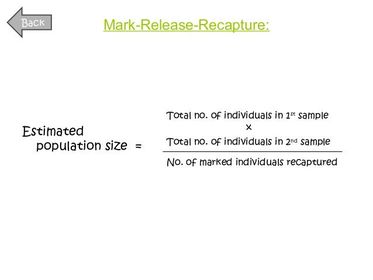
- 14what is the process of this technique?animals caught, counted, marked and released. some time later, more are collected randomly and counted, and number of marked is recorded.
- 15how do you calculate the size of a population?
- 16what does this technique assume?- proportion of marked to unmarked is same in sample as population.
- marked distribute in given time
- population has boundary, no migration
- few if any births/deaths
-marking doesn't affect survival
- mark not lost/removed - 17—
Información
- Descripción
- A-Level (1. populations ) A2 BIOL4 Fichas sobre 1.2 investigating populations, creado por Charlotte Hewson el 08/03/2016.
- Creado por
- Charlotte Hewson
- Visitas
- 12
- Etiquetas
- Valoración