
Fichas
memory
Fichas del conjunto (51)
- 1what is memory?the ability to retain info + demonstrate retention through behaviour
- 2encoding definition?creating an internal representation
- 3storage definition?retention and integration of representation
- 4retrieval definition?re-accessing the representation
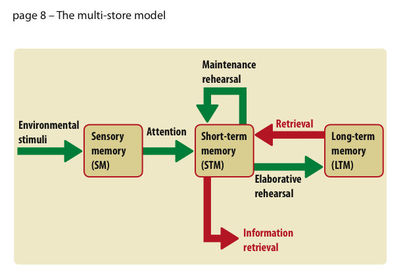
- 5what is the structural memory model?-memory is seen as being traces that have distinct stores in the brain
-each store holds different types of info, have different capacities + hold info for different times - 6what is the multi store modelexplanation of memory based on three separate memory
- 7describe the multi store model?
- 8describe the sensory store?-when info comes in through the senses, it initially comes into the sensory
-if we don't pay attention to certain info, then it is lost
-two main senses; visual (iconic trace- 1/4 second) + auditory (echoic trace- 2 seconds) - 9describe the short term memory store?-any info that we continue to pay attention to should go into the short term memory
-storage (20-30 seconds)
-capacity (7+-2 seconds)
-mode of forgetting- decay (lack of rehearsal)
-displacement (new info pushes out old info) - 10what is displacement?when new info pushes out old info
- 11what is decay?lack of rehersal
- 12describe short term memory?-mode of storage is acoustic
-limited duration - 13long term memory?-if rehearsal of info occurs a STM, it goes to LTM
-storage time/capacity -unlimited
-some argue some memories are never truly lost, just hard to access
-mode of storage is dependent on meaningfulness
-understanding increases chance of recall - 14sensory store? experiment to demonstrate it?-george sperling
1) 3 rows of numbers/letters are flashed on a screen for 1/10 second
2) viewers asked what they saw (average remembered 3 1/2 letters/numbers)
3)if sperling pointed at a row before displaying it, the recall was more successful
4) if he delayed pointing by a fraction of a second nothing was recalled (the stimuli had decayed in sensory register) - 15experiment demonstrating short term memory?-lloyd and margaret peterson
-shows how displacement/decay are methods of forgetting from STM
1) students remembered 3 lettered combination
2) told them to count backwards in 3's from a number
3) students told to stop counting + report sequence of letters aftr various intervals
-percentage of recell fell within seconds
4) after 18 seconds the sequence had been displaced in almost every student
5) the greater the gap before recalling the worst the recell - 16evidence STM+LTM are seperate stores-serial postiton effect;
-glanzer + cunitiz
-more likely to remember first and last
-first items are rehearsed into LTM
-last items are still in STM + still available for recell - 17psychological evidence for STM+LTM-brain wave activity of people whilst recalling info
-different brain wave patterns for STM + LTM - 18Evidence from amnesiac studies for STM+LTM-Milner et al + clive wearing
-lost his STM but retained LTM - 19how has rehearsal of the modal model been criticised?-not everything that is rehearsed seems to be transferred to LTM
-info can also go into LTM without being rehearsed - 20how has having a single STM been criticised?-baddely & hitch says we have multiple STM stores (acoustic + visual stores)
- 21types of LTM?-tulving
-episodic
-semantic
-procedural
-declarative - 22what is tulving LTM?episodic + semantic memory
- 23what is episodic LTM? example?-record of past experiences
-e.g. "i rode my first bike when i was 7" - 24what is semantic LTM? example?-Store of general, factual knowledge about the world
-e.g. "i know that bikes have 2 wheels" - 25what is procedural LTM? example?-info from the LTM which cannot be inspected consciously (non-declarative)
-e.g. "i know how to ride a bike" - 26what is declarative LTM?-memory you can put into words
- 27what is implicit memory?-not consciously aware of this memory
-not aware but do have affect on recall - 28example of semantic memory?i can remember the theory part of the driving test
- 29example of procedural memory?i can remember how to change gear without thinking
- 30how did baddely&hitch challenge the multi store model?-changed the concept of a unitary
-adopted a functional approach
-asked 'what is memory for' rather than 'what does memory hold' - 31describe the working memory model?
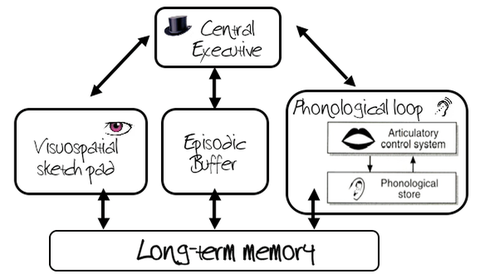
- 32describe central executive?-controls/directs activities of 3 other components
-limited capacity - 33phonological loop?-articulatory control system
-phonological store - 34articulatory control system?-verbal rehearsal system
-inner voice
-keeps auditory info alive in primary acoustic store
-the faster you recite info the more it holds
-time based capacity - 35phonological store?-primary acoustic store
-deals with auditory info (fades after 2 sec)
-sound based system
-inner ear - 36visuo-spacial scratch pad?-inner eye
-can rehearse info but also deals with visual/spacial info
-limited capacity - 37testing the working memory model?-using a duel task method
-if two tasks make use of the same component, they cannot be performed successfully together
-if two tasks make use of different components, it should perform them as well as together as separately - 38Aim of baddely&hitch wm investigation?-to se if participants can use different parts of wm at the same time
- 39method of baddely&hitch wm investigation?-participants asked to perform two tasks at same time (duel task technique)
-a digit span task (required repeating list of numbers) + verbal reasoning task (required answering questions true or false to questions) - 40results of baddely&hitch wm investigation?-as number of digits increased in the digit span task; participants took longer to answer reasoning questions (by fraction of a second
-didn't make any more errors in the verbal reasoning tasks as number of digits increased - 41conclusion of baddley&hitch investigation?-verbal reasoning task made use of central executive
-digit span made use of the phonological loop - 42robins et al investigation aim + method?-test the visuo spacial task of memorising chess pieces on board
-20 males
-uni chess players asked to memorise position of 16 pieces from a game
-shown the board for 10 sec + then asked to recreate the positions on another board - 43Aim of pavlescu et al investigation of the WMM?To investigate the phonological loop
- 44method of pavlescu et al investigation of the WMM?-P's had to memorise either series of letters or rehearse the sound of letters in their heads
-brain activity was monitored at the same time - 45results of pavlescu et al investigation of the WMM?-different types of blood flow was found for each task
-sound rehearsal showed activity in brocas areas - 46conclusion of pavlescu et al investigation of the WMM?-phonological loop appears to have two components
1)one stores sound (primary acoustic store)
2)one involves mental rehearsal (articulatory loop) - 47evaluation of the WMM?-detailed account of STM
-sees STM as active rather than passive
-explains link between cognitive processes e.g. memory, perception, attention-central executive)
-BUT little is known about central executive
-doesn't explain LTM - 48interference-when one memory blocks another
1) proactive
2)retroactive - 49proactive-old memory interferes with new
-e.g. calling new partner by an old - 50retroactive-new memory interferes with past learning
-e.g. a teacher forgetting the names of her past students because she has so many new ones - 51—
Información
- Descripción
- AS - Level Psychology Fichas sobre memory, creado por hanna akhrass el 09/03/2016.
- Creado por
- hanna akhrass
- Visitas
- 0
- Valoración