
Fichas
Chapter 5
Fichas del conjunto (52)
- 1What is taste aversion learning?Conditioning explanation for taste aversions. Easily learned and highly resistant to extinction
- 2What are problems with classical conditioning explanations of taste aversion?One trial acquisition of taste aversion and it is powerful and quickly learned.
- 3What is blocking?Conditioning to a specific stimulus becomes difficult or impossible as a result of prior conditioning to another stimulus.
- 4What mathematical model was developed to explain conditioning phenomena like blocking?The Rescorla-Wagner Model
- 5What is the term for when something important happens to an animal, it searches its memory to see what events could have been used to predict the occurenceBiological Explanation
- 6Conditioning as a biological adaption means what?learning is adaptive
- 7What is the defining characteristic of evolutionary psychology?its attention to biology and genetics as sources of explanation for human learning and behavior, development of the human mind, and the development of cultures
- 8What are Learned responses that are part of the organisms repertoire?Autoshaping
- 9Autoshaping is remarkable persistent and resistant to what?Extinction
- 10What is an example of autoshaping?Pecking Pigeons--they will peck no matter what.
- 11What results when there is competition between biologically based behavior and a learned response.instinctive drift
- 12Instinctive drift refers to the tendency of organisms to…?to revert to instinctual unlearned behaviors
- 13What is an example of instinctual drift?The Brelands (the IQ zoo we watched in class)
- 14What term refers to Limitations on learning that results from biological factors not from experiencesBiological Constraints
- 15What is the general principle of biological constraints?it will favor behaviors that have survival value and discourage those detrimental to survival.
- 16What is a precursor of evolutionary Psychology?sociobiology
- 17What is sociobiology?the study of the biological determination of social behavior amend all species.
- 18What is social behavior?any form of behavior that requires the interaction of two or more individuals.
- 19Alturism among humans is a ____ ordained by ____biologically based characteristic ordained by years of successful evolution
- 20What is an altruistic act in its purest form?An altruistic act is one that presents some sacrifice to the doer but results in a net genetic advantage to the species.
- 21A procedure where individuals are given info about their biological functioning, they are trained to control/change their functioning.Biofeedback
- 22A specific kind of biofeedback that involves feedback about neurological functioningNeurofeedback
- 23Biofeedback and neurofeedback: alleviate ____; reduces ____; controls _____; and treats ____.Alleviates migraine headaches; reduces blood pressure and heart rate; controls asthma and urinary incontinence; and treats ADD and learning disabilities.
- 24—
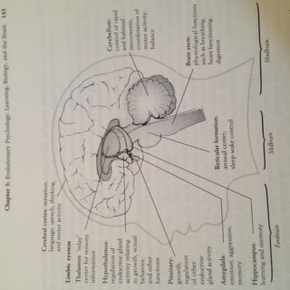
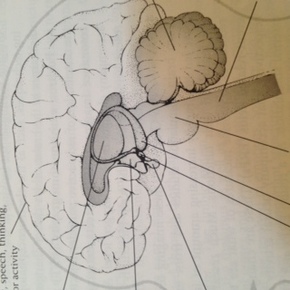
- 25Emotion, aggression, memory (part of the brain)Amygdala
- 26control of rapid and habitual movements coordination of motor activity; balance (part of the brain)Cerebellum
- 27Growth; regulation of other endocrine gland activity (part of the brain)Pituitary
- 28Physiological functions such as breathing, heart functioning, digestion (part of the brain)Brain Stem
- 29"relay" center for sensory info (part of the brain)Thalamus
- 30Learning and memory (part of the brain)Hippocampus
- 31Arousal center; sleep-wake control (part of the brain)Reticular formation
- 32Regulation of endocrine gland activity relating to growth, sexual behavior, and other functions (part of the brain)Hypothalamus
- 33Sensation, language, speech, thinking, and motor activity (part of the brain)Cerebral cortex
- 34The lower brain stem (part of the brain)Hindbrain
- 35The upper brain stem (part of the brain)Midbrain
- 36Brain stem responsible for regulating waking and sleeping and for controlling general arousalMidbrain
- 37The largest and most complex brain structurethe forebrain
- 38The brain stem responsible for basic physiological functions such as respiration and heart rate.the Hindbrain
- 39What is centrally involved in locomotion and balance?The Cerebellum
- 40What is associated with movement?Nerve fibers
- 41What is the forebrain's most important structures?The hypothalamus, thalamus, and other structures of the limbic system, as well as the cerebrum and cerebral cortex
- 42—
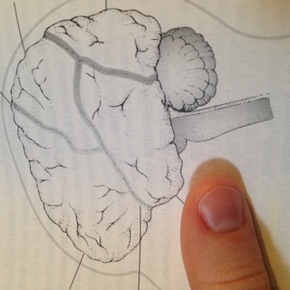
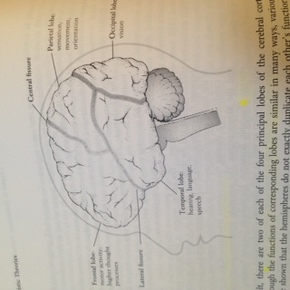
- 43Sensation, movement, orientation (Lobe of the cerebral cortex)Parietal lobe
- 44Vision (Lobe of the cerebral cortex)Occipital lobe
- 45Motor activity; higher thought processes (Lobe of the cerebral cortex)Frontal lobe
- 46Hearing, language, speech (Lobe of the cerebral cortex)Temporal lobe
- 47Learning depends on the formation of connections among what?Among neurons in the brain
- 48All info enters the brain through what?Our senses
- 49All sensory info except ____ goes through the ____ and then to the appropriate sections of the brainExcept smell goes through the thalamus
- 50Important info having to do with nonemotional facts and events goes through the ___ into ____Goes through the hippocampus into long term memory
- 51important emotional info goes through the ____ for processing into ____Thalamus into long term memory
- 52Actual processing, examination of info for meaning and associations happens in the ___Cerebral cortex
Información
- Descripción
- (Theories of Learning) Fichas sobre Chapter 5, creado por kellybrickell el 04/03/2014.
- Creado por
- kellybrickell
- Visitas
- 45
- Etiquetas
- Valoración