
Diagrama de flujo
Multi-store model
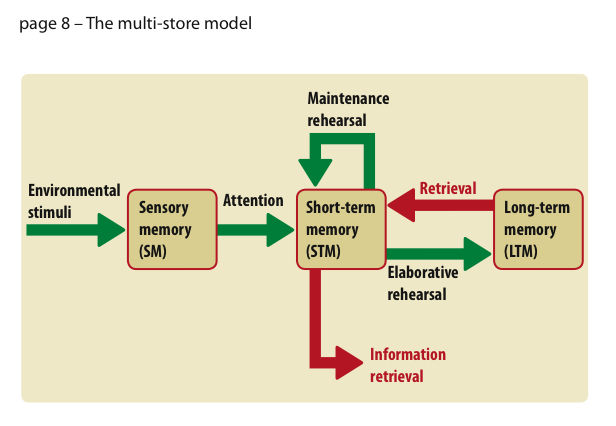
Contenido del diagrama
Memory
Multi-store model = Atkinson and Shiffrin
Sensory memory
Long-term memory
Short-term memory
Encoding =
Haptic = touch
Olfactory = smell
Iconic = eye
Echoic = hear
Gustatory = Taste
Evidence 1 = Crowder
Different senses store for different amounts but usually 2-3 seconds
Sparklers stay for a few secs
Capacity = large, receives constant flow of info.
Sperling 1 = 3x4 grid of letters, asked participants to recall, could only recall 4 before the rest faded from their sensory memory
Sperling 2 = Added tones and trained participants to distinguish between the tones, flashed grid and then played tone, participants had to recall that line, on average they recalled 3/4 which shows info was in sensory memory
Duration = 2-3 seconds
Sperling 3 = delayed playing tone, 50% after 0.3secs, 33% after 1secs
Evolutionary support = we focus on info that has immediate survival value so don't remember not useful info
Encoding =
Mainly acoustically
Baddeley 1 =
Acoustically similar words like cat fat rat were easier to recall than semantically similar words such as beautiful, pretty, this shows participants were encoding mainly acoustically
Capacity = limited, 5-9 digits
Jacobs = serial digit span test, participants could only remember 5-9 digits
Miller = magic number = 7 + or - 2
Duration = limited, max. 30 seconds
Peterson and Peterson = Gave participants trigrams (like BVT) then gave them an interference task, then asked for recall, he delayed asking from 3-18 seconds, 90% after 3 secs, 5% after 18, so upper limit is 20 - 30
Coding = mainly semantically, coding is stronger so it is easier to remember
Baddeley 2 = Participants mixed up words with similar meanings but no similar sounds
Capacity = very large
Wagenaar = Diary with 2400 events over 6 years, tested himself on recall and found it was excellent
Huang = tried to remember his 560 past students and he was correct 80% of the time so capacity is large
Duration = long
Bahrick = looked at recall of students who studied spanish, found a rapid decline in the first 3 years but good recall after that
Schmidt et al = investigated incident material, looked at recall of childhood streets, lost a lot in the first few years but good recall after that
Further evaluation
Murdock = Two main memory stores STM and LTM and they are separate and distinct
Serial position effect = people remember words from the beginning and end of word lists = primary regency effect
Wiswede et al = used brain scans that showed that different parts of the brain were active during primary regency effect, shows us where STM and LTM are
HM = a severe epileptic, neurosurgeon took out hippocampus which reduced his seizures but left him with severe memory impairment, could not learn new things, only motor
Información
- Descripción
- AS level (Memory) Psychology Diagrama sobre Multi-store model, creado por Daisy Westwood el 01/02/2017.
- Creado por
- Daisy Westwood
- Visitas
- 1
- Valoración