
Mapa mental
Attachment
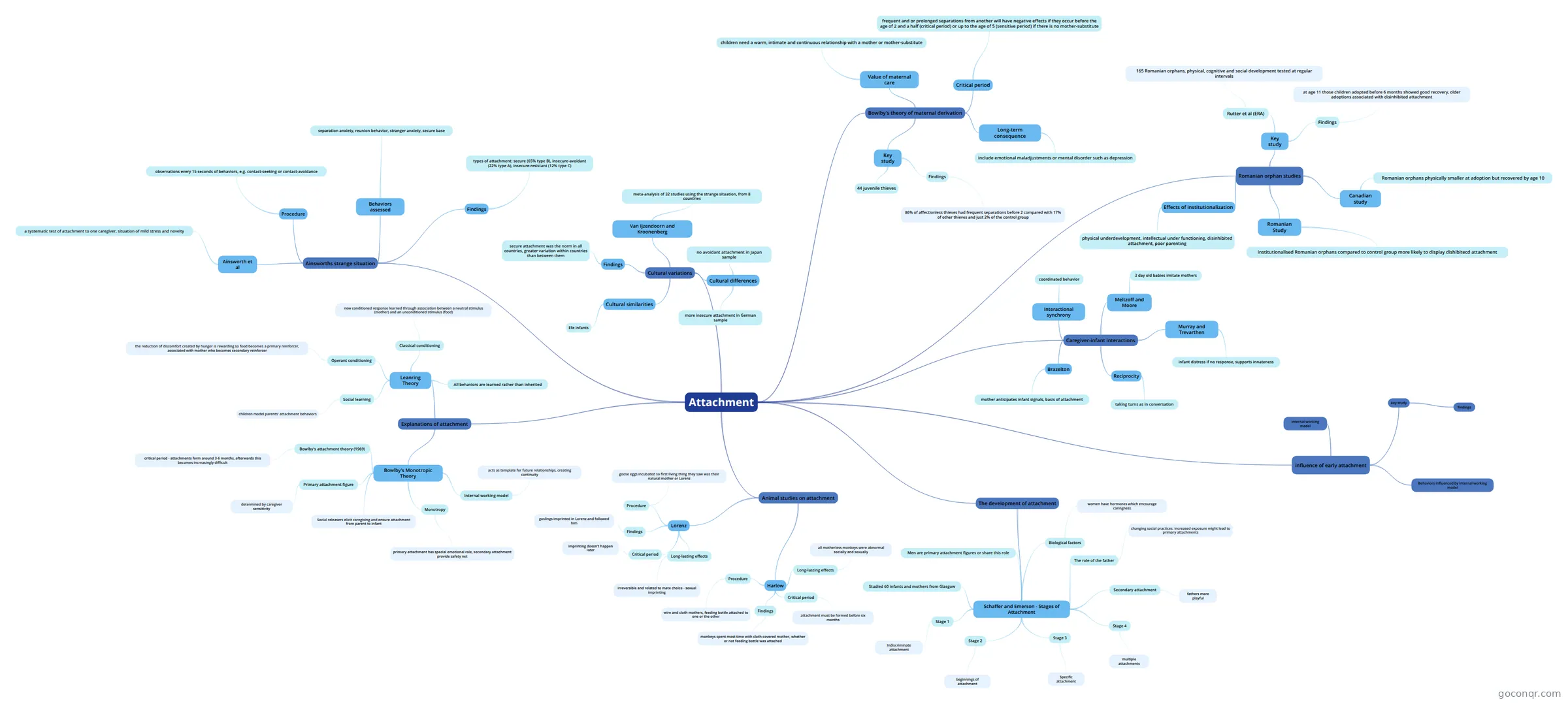
Mind map: Attachment psychology
Contenido del mapa
Attachment
Caregiver-infant interactions
- Reciprocity
- taking turns as in conversation
- Brazelton
- mother anticipates infant signals, basis of attachment
- Interactional synchrony
- coordinated behavior
- Meltzoff and Moore
- 3 day old babies imitate mothers
- Murray and Trevarthen
- infant distress if no response, supports innateness
- Reciprocity
The development of attachment
- Schaffer and Emerson - Stages of Attachment
- Studied 60 infants and mothers from Glasgow
- Stage 1
- Indiscriminate attachment
- Stage 2
- beginnings of attachment
- Stage 3
- Specific attachment
- Stage 4
- multiple attachments
- The role of the father
- changing social practices: increased exposure might lead to primary attachments
- Biological factors
- women have hormones which encourage caringness
- Men are primary attachment figures or share this role
- Secondary attachment
- fathers more playful
- Schaffer and Emerson - Stages of Attachment
Animal studies on attachment
- Lorenz
- Procedure
- goose eggs incubated so first living thing they saw was their natural mother or Lorenz
- Findings
- goslings imprinted in Lorenz and followed him
- Critical period
- imprinting doesn't happen later
- Long-lasting effects
- irreversible and related to mate choice - sexual imprinting
- Procedure
- Harlow
- Procedure
- wire and cloth mothers, feeding bottle attached to one or the other
- Findings
- monkeys spent most time with cloth-covered mother, whether or not feeding bottle was attached
- Critical period
- attachment must be formed before six months
- Long-lasting effects
- all motherless monkeys were abnormal socially and sexually
- Procedure
- Lorenz
Explanations of attachment
- Leanring Theory
- All behaviors are learned rather than inherited
- Classical conditioning
- new conditioned response learned through association between a neutral stimulus (mother) and an unconditioned stimulus (food)
- Operant conditioning
- the reduction of discomfort created by hunger is rewarding so food becomes a primary reinforcer, associated with mother who becomes secondary reinforcer
- Social learning
- children model parents' attachment behaviors
- Bowlby's Monotropic Theory
- Bowlby's attachment theory (1969)
- critical period - attachments form around 3-6 months, afterwards this becomes increasingly difficult
- Primary attachment figure
- determined by caregiver sensitivity
- Social releasers elicit caregiving and ensure attachment from parent to infant
- Monotropy
- primary attachment has special emotional role, secondary attachment provide safety net
- Internal working model
- acts as template for future relationships, creating continuity
- Bowlby's attachment theory (1969)
- Leanring Theory
Ainsworths strange situation
- Ainsworth et al
- a systematic test of attachment to one caregiver, situation of mild stress and novelty
- Procedure
- observations every 15 seconds of behaviors, e.g. contact-seeking or contact-avoidance
- Behaviors assessed
- separation anxiety, reunion behavior, stranger anxiety, secure base
- Findings
- types of attachment: secure (65% type B), insecure-avoidant (22% type A), insecure-resistant (12% type C)
- Ainsworth et al
Cultural variations
- Van Ijzendoorn and Kroonenberg
- meta-analysis of 32 studies using the strange situation, from 8 countries
- Findings
- secure attachment was the norm in all countries, greater variation within countries than between them
- Cultural similarities
- Efe infants
- Cultural differences
- more insecure attachment in German sample
- no avoidant attachment in Japan sample
- Van Ijzendoorn and Kroonenberg
Bowlby's theory of maternal derivation
- Value of maternal care
- children need a warm, intimate and continuous relationship with a mother or mother-substitute
- Critical period
- frequent and or prolonged separations from another will have negative effects if they occur before the age of 2 and a half (critical period) or up to the age of 5 (sensitive period) if there is no mother-substitute
- Long-term consequence
- include emotional maladjustments or mental disorder such as depression
- Key study
- Findings
- 86% of affectionless thieves had frequent separations before 2 compared with 17% of other thieves and just 2% of the control group
- 44 juvenile thieves
- Findings
- Value of maternal care
Romanian orphan studies
- Key study
- Findings
- at age 11 those children adopted before 6 months showed good recovery, older adoptions associated with disinhibited attachment
- Rutter et al (ERA)
- 165 Romanian orphans, physical, cognitive and social development tested at regular intervals
- Findings
- Canadian study
- Romanian orphans physically smaller at adoption but recovered by age 10
- Romanian Study
- institutionalised Romanian orphans compared to control group more likely to display dishibitecd attachment
- Effects of institutionalization
- physical underdevelopment, intellectual under functioning, disinhibited attachment, poor parenting
- Key study
influence of early attachment
- internal working model
- key study
- findings
- Behaviors influenced by internal working model
Información
- Descripción
- A level (Full Topic) Psychology Mapa Mental sobre Attachment, creado por Elisha Burgess el 19/02/2018.
- Creado por
- Elisha Burgess
- Visitas
- 2
- Valoración