
Mapa mental
Working Memory Model Evaluation
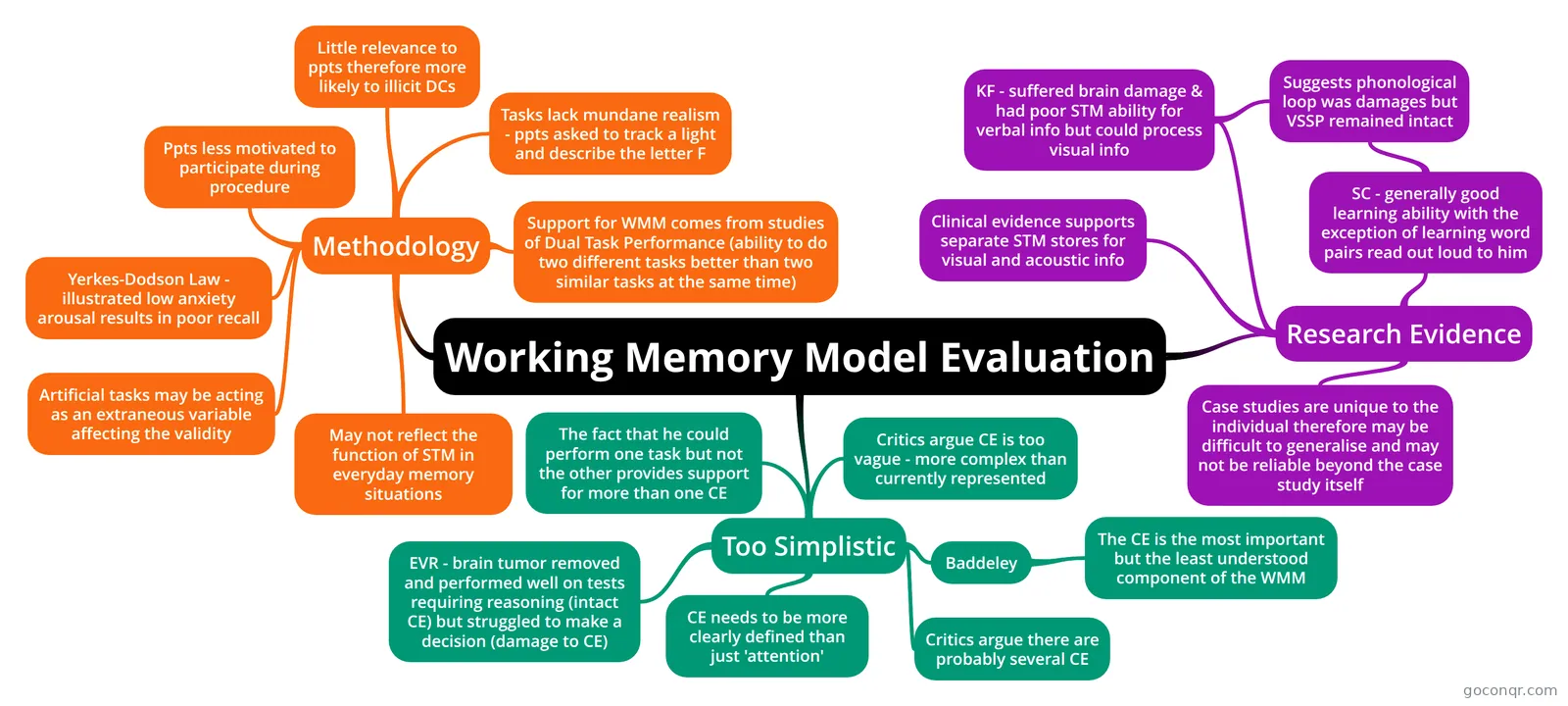
Mind map: Working memory model evaluation
Contenido del mapa
Working Memory Model Evaluation
Research Evidence
- Clinical evidence supports separate STM stores for visual and acoustic info
- KF - suffered brain damage & had poor STM ability for verbal info but could process visual info
- Suggests phonological loop was damages but VSSP remained intact
- SC - generally good learning ability with the exception of learning word pairs read out loud to him
- Suggests phonological loop was damages but VSSP remained intact
- Case studies are unique to the individual therefore may be difficult to generalise and may not be reliable beyond the case study itself
Too Simplistic
- Critics argue CE is too vague - more complex than currently represented
- Baddeley
- The CE is the most important but the least understood component of the WMM
- CE needs to be more clearly defined than just 'attention'
- Critics argue there are probably several CE
- EVR - brain tumor removed and performed well on tests requiring reasoning (intact CE) but struggled to make a decision (damage to CE)
- The fact that he could perform one task but not the other provides support for more than one CE
Methodology
- Support for WMM comes from studies of Dual Task Performance (ability to do two different tasks better than two similar tasks at the same time)
- Tasks lack mundane realism - ppts asked to track a light and describe the letter F
- Little relevance to ppts therefore more likely to illicit DCs
- Ppts less motivated to participate during procedure
- Yerkes-Dodson Law - illustrated low anxiety arousal results in poor recall
- Artificial tasks may be acting as an extraneous variable affecting the validity
- May not reflect the function of STM in everyday memory situations
Información
- Descripción
- A2 (P1 Memory) Psychology Mapa Mental sobre Working Memory Model Evaluation, creado por Abigail Taylor el 12/05/2018.
- Creado por
- Abigail Taylor
- Visitas
- 0
- Valoración