
Mapa mental
Memory
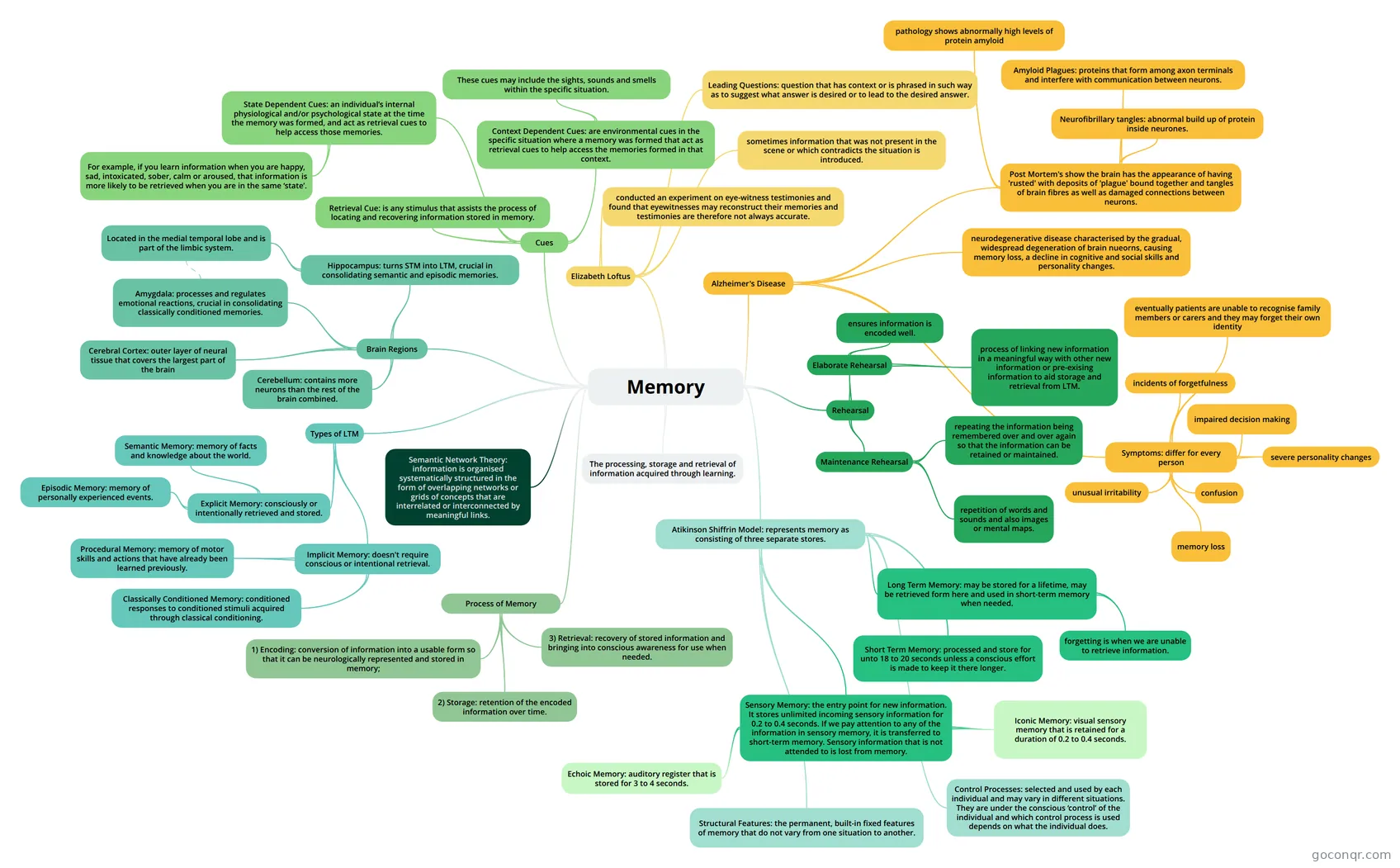
Mind map: Memory
Contenido del mapa
Memory
Rehearsal
- Maintenance Rehearsal
- repeating the information being remembered over and over again so that the information can be retained or maintained.
- repetition of words and sounds and also images or mental maps.
- Elaborate Rehearsal
- process of linking new information in a meaningful way with other new information or pre-exising information to aid storage and retrieval from LTM.
- ensures information is encoded well.
- Maintenance Rehearsal
Brain Regions
- Cerebral Cortex: outer layer of neural tissue that covers the largest part of the brain
- Cerebellum: contains more neurons than the rest of the brain combined.
- Amygdala: processes and regulates emotional reactions, crucial in consolidating classically conditioned memories.
- Hippocampus: turns STM into LTM, crucial in consolidating semantic and episodic memories.
- Located in the medial temporal lobe and is part of the limbic system.
Cues
- Retrieval Cue: is any stimulus that assists the process of locating and recovering information stored in memory.
- Context Dependent Cues: are environmental cues in the specific situation where a memory was formed that act as retrieval cues to help access the memories formed in that context.
- These cues may include the sights, sounds and smells within the specific situation.
- State Dependent Cues: an individual’s internal physiological and/or psychological state at the time the memory was formed, and act as retrieval cues to help access those memories.
- For example, if you learn information when you are happy, sad, intoxicated, sober, calm or aroused, that information is more likely to be retrieved when you are in the same ‘state’.
Elizabeth Loftus
- conducted an experiment on eye-witness testimonies and found that eyewitnesses may reconstruct their memories and testimonies are therefore not always accurate.
- sometimes information that was not present in the scene or which contradicts the situation is introduced.
- Leading Questions: question that has context or is phrased in such way as to suggest what answer is desired or to lead to the desired answer.
Types of LTM
- Explicit Memory: consciously or intentionally retrieved and stored.
- Episodic Memory: memory of personally experienced events.
- Semantic Memory: memory of facts and knowledge about the world.
- Implicit Memory: doesn't require conscious or intentional retrieval.
- Procedural Memory: memory of motor skills and actions that have already been learned previously.
- Classically Conditioned Memory: conditioned responses to conditioned stimuli acquired through classical conditioning.
- Explicit Memory: consciously or intentionally retrieved and stored.
Semantic Network Theory: information is organised systematically structured in the form of overlapping networks or grids of concepts that are interrelated or interconnected by meaningful links.
Atikinson Shiffrin Model: represents memory as consisting of three separate stores.
- Sensory Memory: the entry point for new information. It stores unlimited incoming sensory information for 0.2 to 0.4 seconds. If we pay attention to any of the information in sensory memory, it is transferred to short-term memory. Sensory information that is not attended to is lost from memory.
- Iconic Memory: visual sensory memory that is retained for a duration of 0.2 to 0.4 seconds.
- Echoic Memory: auditory register that is stored for 3 to 4 seconds.
- Short Term Memory: processed and store for unto 18 to 20 seconds unless a conscious effort is made to keep it there longer.
- Long Term Memory: may be stored for a lifetime, may be retrieved form here and used in short-term memory when needed.
- forgetting is when we are unable to retrieve information.
- Structural Features: the permanent, built-in fixed features of memory that do not vary from one situation to another.
- Control Processes: selected and used by each individual and may vary in different situations. They are under the conscious ‘control’ of the individual and which control process is used depends on what the individual does.
- Sensory Memory: the entry point for new information. It stores unlimited incoming sensory information for 0.2 to 0.4 seconds. If we pay attention to any of the information in sensory memory, it is transferred to short-term memory. Sensory information that is not attended to is lost from memory.
Process of Memory
- 1) Encoding: conversion of information into a usable form so that it can be neurologically represented and stored in memory;
- 2) Storage: retention of the encoded information over time.
- 3) Retrieval: recovery of stored information and bringing into conscious awareness for use when needed.
The processing, storage and retrieval of information acquired through learning.
Alzheimer's Disease
- Post Mortem's show the brain has the appearance of having 'rusted' with deposits of 'plague' bound together and tangles of brain fibres as well as damaged connections between neurons.
- Amyloid Plagues: proteins that form among axon terminals and interfere with communication between neurons.
- Neurofibrillary tangles: abnormal build up of protein inside neurones.
- pathology shows abnormally high levels of protein amyloid
- neurodegenerative disease characterised by the gradual, widespread degeneration of brain nueorns, causing memory loss, a decline in cognitive and social skills and personality changes.
- Symptoms: differ for every person
- memory loss
- confusion
- unusual irritability
- impaired decision making
- incidents of forgetfulness
- severe personality changes
- eventually patients are unable to recognise family members or carers and they may forget their own identity
- Post Mortem's show the brain has the appearance of having 'rusted' with deposits of 'plague' bound together and tangles of brain fibres as well as damaged connections between neurons.
Información
- Descripción
- Year 11 Psychology Mapa Mental sobre Memory, creado por Morgan Hunt el 17/05/2018.
- Creado por
- Morgan Hunt
- Visitas
- 1
- Valoración