
Mapa mental
Developmental Psychology
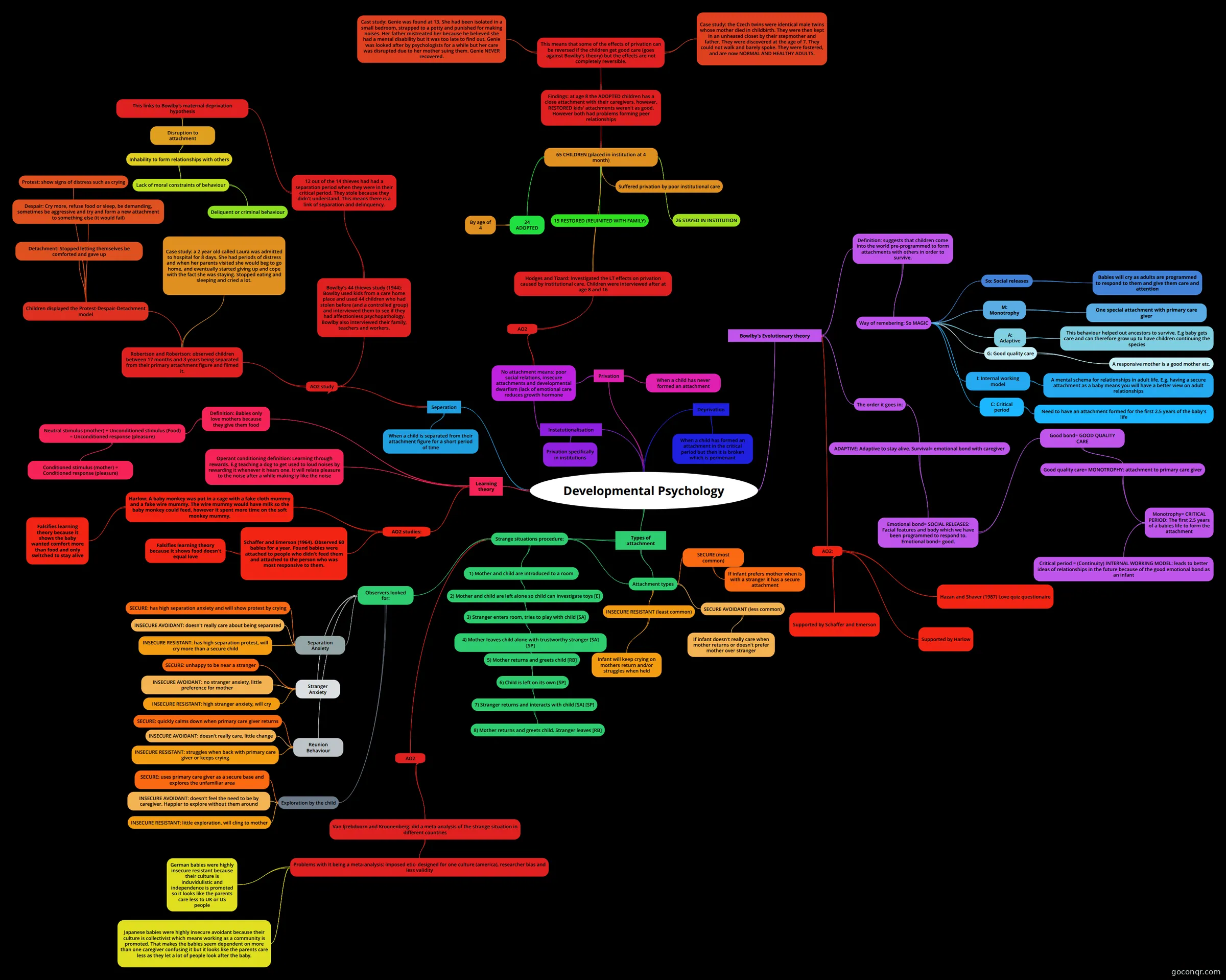
Mind map: Developmental psychology
Contenido del mapa
Developmental Psychology
Learning theory
- Definition: Babies only love mothers because they give them food
- Neutral stimulus (mother) + Unconditioned stimulus (Food) = Unconditioned response (pleasure)
- Conditioned stimulus (mother) = Conditioned response (pleasure)
- Neutral stimulus (mother) + Unconditioned stimulus (Food) = Unconditioned response (pleasure)
- Operant conditioning definition: Learning through rewards. E.g teaching a dog to get used to loud noises by rewarding it whenever it hears one. It will relate pleasure to the noise after a while making iy like the noise
- AO2 studies:
- Schaffer and Emerson (1964). Observed 60 babies for a year. Found babies were attached to people who didn't feed them and attached to the person who was most responsive to them.
- Falsifies learning theory because it shows food doesn't equal love
- Harlow: A baby monkey was put in a cage with a fake cloth mummy and a fake wire mummy. The wire mummy would have milk so the baby monkey could feed, however it spent more time on the soft monkey mummy.
- Falsifies learning theory because it shows the baby wanted comfort more than food and only switched to stay alive
- Schaffer and Emerson (1964). Observed 60 babies for a year. Found babies were attached to people who didn't feed them and attached to the person who was most responsive to them.
- Definition: Babies only love mothers because they give them food
Bowlby's Evolutionary theory
- Definition: suggests that children come into the world pre-programmed to form attachments with others in order to survive.
- Way of remebering: So MAGIC
- So: Social releases
- Babies will cry as adults are programmed to respond to them and give them care and attention
- M: Monotrophy
- One special attachment with primary care giver
- A: Adaptive
- This behaviour helped out ancestors to survive. E.g baby gets care and can therefore grow up to have children continuing the species
- G: Good quality care
- A responsive mother is a good mother etc.
- I: Internal working model
- A mental schema for relationships in adult life. E.g. having a secure attachment as a baby means you will have a better view on adult relationships
- C: Critical period
- Need to have an attachment formed for the first 2.5 years of the baby's life
- So: Social releases
- Way of remebering: So MAGIC
- The order it goes in:
- ADAPTIVE: Adaptive to stay alive. Survival= emotional bond with caregiver
- Emotional bond= SOCIAL RELEASES: Facial features and body which we have been programmed to respond to. Emotional bond= good.
- Good bond= GOOD QUALITY CARE
- Good quality care= MONOTROPHY: attachment to primary care giver
- Monotrophy= CRITICAL PERIOD: The first 2.5 years of a babies life to form the attachment
- Critical period = (Continuity) INTERNAL WORKING MODEL: leads to better ideas of relationships in the future because of the good emotional bond as an infant
- Monotrophy= CRITICAL PERIOD: The first 2.5 years of a babies life to form the attachment
- Good quality care= MONOTROPHY: attachment to primary care giver
- Good bond= GOOD QUALITY CARE
- Emotional bond= SOCIAL RELEASES: Facial features and body which we have been programmed to respond to. Emotional bond= good.
- ADAPTIVE: Adaptive to stay alive. Survival= emotional bond with caregiver
- AO2:
- Supported by Schaffer and Emerson
- Supported by Harlow
- Hazan and Shaver (1987) Love quiz questionaire
- Definition: suggests that children come into the world pre-programmed to form attachments with others in order to survive.
Types of attachment
- Strange situations procedure:
- 1) Mother and child are introduced to a room
- 2) Mother and child are left alone so child can investigate toys [E]
- 3) Stranger enters room, tries to play with child [SA]
- 4) Mother leaves child alone with trustworthy stranger [SA] [SP]
- 5) Mother returns and greets child [RB]
- 6) Child is left on its own [SP]
- 7) Stranger returns and interacts with child [SA] [SP]
- 8) Mother returns and greets child. Stranger leaves [RB]
- 7) Stranger returns and interacts with child [SA] [SP]
- 6) Child is left on its own [SP]
- 5) Mother returns and greets child [RB]
- 4) Mother leaves child alone with trustworthy stranger [SA] [SP]
- 3) Stranger enters room, tries to play with child [SA]
- 2) Mother and child are left alone so child can investigate toys [E]
- Observers looked for:
- Separation Anxiety
- SECURE: has high separation anxiety and will show protest by crying
- INSECURE AVOIDANT: doesn't really care about being separated
- INSECURE RESISTANT: has high separation protest, will cry more than a secure child
- Reunion Behaviour
- SECURE: quickly calms down when primary care giver returns
- INSECURE AVOIDANT: doesn't really care, little change
- INSECURE RESISTANT: struggles when back with primary care giver or keeps crying
- Stranger Anxiety
- SECURE: unhappy to be near a stranger
- INSECURE AVOIDANT: no stranger anxiety, little preference for mother
- INSECURE RESISTANT: high stranger anxiety, will cry
- Exploration by the child
- SECURE: uses primary care giver as a secure base and explores the unfamiliar area
- INSECURE AVOIDANT: doesn't feel the need to be by caregiver. Happier to explore without them around
- INSECURE RESISTANT: little exploration, will cling to mother
- Separation Anxiety
- AO2
- Van Ijzebdoorn and Kroonenberg: did a meta-analysis of the strange situation in different countries
- Problems with it being a meta-analysis: imposed etic- designed for one culture (america), researcher bias and less validity
- German babies were highly insecure resistant because their culture is induvidulistic and independence is promoted so it looks like the parents care less to UK or US people
- Japanese babies were highly insecure avoidant because their culture is collectivist which means working as a community is promoted. That makes the babies seem dependent on more than one caregiver confusing it but it looks like the parents care less as they let a lot of people look after the baby.
- Problems with it being a meta-analysis: imposed etic- designed for one culture (america), researcher bias and less validity
- Van Ijzebdoorn and Kroonenberg: did a meta-analysis of the strange situation in different countries
- 1) Mother and child are introduced to a room
- Attachment types
- SECURE (most common)
- If infant prefers mother when is with a stranger it has a secure attachment
- INSECURE RESISTANT (least common)
- Infant will keep crying on mothers return and/or struggles when held
- SECURE AVOIDANT (less common)
- If infant doesn't really care when mother returns or doesn't prefer mother over stranger
- SECURE (most common)
- Strange situations procedure:
Deprivation
- When a child has formed an attachment in the critical period but then it is broken which is permenant
Privation
- When a child has never formed an attachment
- No attachment means: poor social relations, insecure attachments and developmental dwarfism (lack of emotional care reduces growth hormone
- AO2
- Hodges and Tizard: Investigated the LT effects on privation caused by institutional care. Children were interviewed after at age 8 and 16
- 65 CHILDREN (placed in institution at 4 month)
- 24 ADOPTED
- By age of 4
- 26 STAYED IN INSTITUTION
- 15 RESTORED (REUINITED WITH FAMILY)
- Suffered privation by poor institutional care
- Findings: at age 8 the ADOPTED children has a close attachment with their caregivers, however, RESTORED kids' attachments weren't as good. However both had problems forming peer relationships
- This means that some of the effects of privation can be reversed if the children get good care (goes against Bowlby's theory) but the effects are not completely reversible.
- Cast study: Genie was found at 13. She had been isolated in a small bedroom, strapped to a potty and punished for making noises. Her father mistreated her because he believed she had a mental disability but it was too late to find out. Genie was looked after by psychologists for a while but her care was disrupted due to her mother suing them. Genie NEVER recovered.
- Case study: the Czech twins were identical male twins whose mother died in childbirth. They were then kept in an unheated closet by their stepmother and father. They were discovered at the age of 7. They could not walk and barely spoke. They were fostered, and are now NORMAL AND HEALTHY ADULTS.
- This means that some of the effects of privation can be reversed if the children get good care (goes against Bowlby's theory) but the effects are not completely reversible.
- 24 ADOPTED
- 65 CHILDREN (placed in institution at 4 month)
- Hodges and Tizard: Investigated the LT effects on privation caused by institutional care. Children were interviewed after at age 8 and 16
- AO2
Instatutionalisation
- Privation specifically in institutions
Seperation
- When a child is separated from their attachment figure for a short period of time
- AO2 study
- Robertson and Robertson: observed children between 17 months and 3 years being separated from their primary attachment figure and filmed it.
- Case study: a 2 year old called Laura was admitted to hospital for 8 days. She had periods of distress and when her parents visited she would beg to go home, and eventually started giving up and cope with the fact she was staying. Stopped eating and sleeping and cried a lot.
- Children displayed the Protest-Despair-Detachment model
- Protest: show signs of distress such as crying
- Despair: Cry more, refuse food or sleep, be demanding, sometimes be aggressive and try and form a new attachment to something else (it would fail)
- Detachment: Stopped letting themselves be comforted and gave up
- Bowlby's 44 thieves study (1944): Bowlby used kids from a care home place and used 44 children who had stolen before (and a controlled group) and interviewed them to see if they had affectionless psychopathology. Bowlby also interviewed their family, teachers and workers.
- 12 out of the 14 thieves had had a separation period when they were in their critical period. They stole because they didn't understand. This means there is a link of separation and delinquency.
- This links to Bowlby's maternal deprivation hypothesis
- Disruption to attachment
- Inhability to form relationships with others
- Lack of moral constraints of behaviour
- Deliquent or criminal behaviour
- Lack of moral constraints of behaviour
- Inhability to form relationships with others
- Disruption to attachment
- This links to Bowlby's maternal deprivation hypothesis
- 12 out of the 14 thieves had had a separation period when they were in their critical period. They stole because they didn't understand. This means there is a link of separation and delinquency.
- Robertson and Robertson: observed children between 17 months and 3 years being separated from their primary attachment figure and filmed it.
Información
- Descripción
- A-Level (PSYA1) Psychology Mapa Mental sobre Developmental Psychology, creado por anni.dewsbury el 23/12/2014.
- Creado por
- anni.dewsbury
- Visitas
- 5
- Valoración