
Mapa mental
Interviewing children
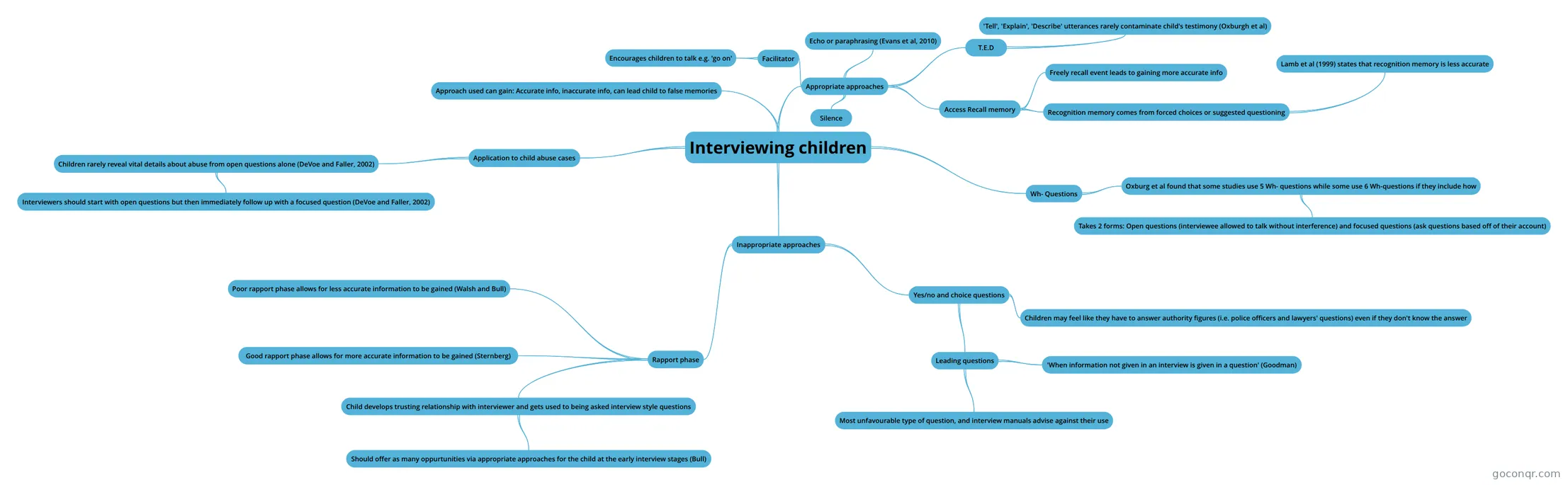
Mind map: Interviewing children
Contenido del mapa
Interviewing children
Approach used can gain: Accurate info, inaccurate info, can lead child to false memories
Appropriate approaches
- Silence
- Facilitator
- Encourages children to talk e.g. 'go on'
- Echo or paraphrasing (Evans et al, 2010)
- T.E.D
- 'Tell', 'Explain', 'Describe' utterances rarely contaminate child's testimony (Oxburgh et al)
- Access Recall memory
- Freely recall event leads to gaining more accurate info
- Recognition memory comes from forced choices or suggested questioning
- Lamb et al (1999) states that recognition memory is less accurate
Wh- Questions
- Oxburg et al found that some studies use 5 Wh- questions while some use 6 Wh-questions if they include how
- Takes 2 forms: Open questions (interviewee allowed to talk without interference) and focused questions (ask questions based off of their account)
- Oxburg et al found that some studies use 5 Wh- questions while some use 6 Wh-questions if they include how
Inappropriate approaches
- Yes/no and choice questions
- Children may feel like they have to answer authority figures (i.e. police officers and lawyers' questions) even if they don't know the answer
- Leading questions
- 'When information not given in an interview is given in a question' (Goodman)
- Most unfavourable type of question, and interview manuals advise against their use
- Rapport phase
- Child develops trusting relationship with interviewer and gets used to being asked interview style questions
- Should offer as many oppurtunities via appropriate approaches for the child at the early interview stages (Bull)
- Good rapport phase allows for more accurate information to be gained (Sternberg)
- Poor rapport phase allows for less accurate information to be gained (Walsh and Bull)
- Child develops trusting relationship with interviewer and gets used to being asked interview style questions
- Yes/no and choice questions
Application to child abuse cases
- Children rarely reveal vital details about abuse from open questions alone (DeVoe and Faller, 2002)
- Interviewers should start with open questions but then immediately follow up with a focused question (DeVoe and Faller, 2002)
- Children rarely reveal vital details about abuse from open questions alone (DeVoe and Faller, 2002)