
Mapa mental
Attachment
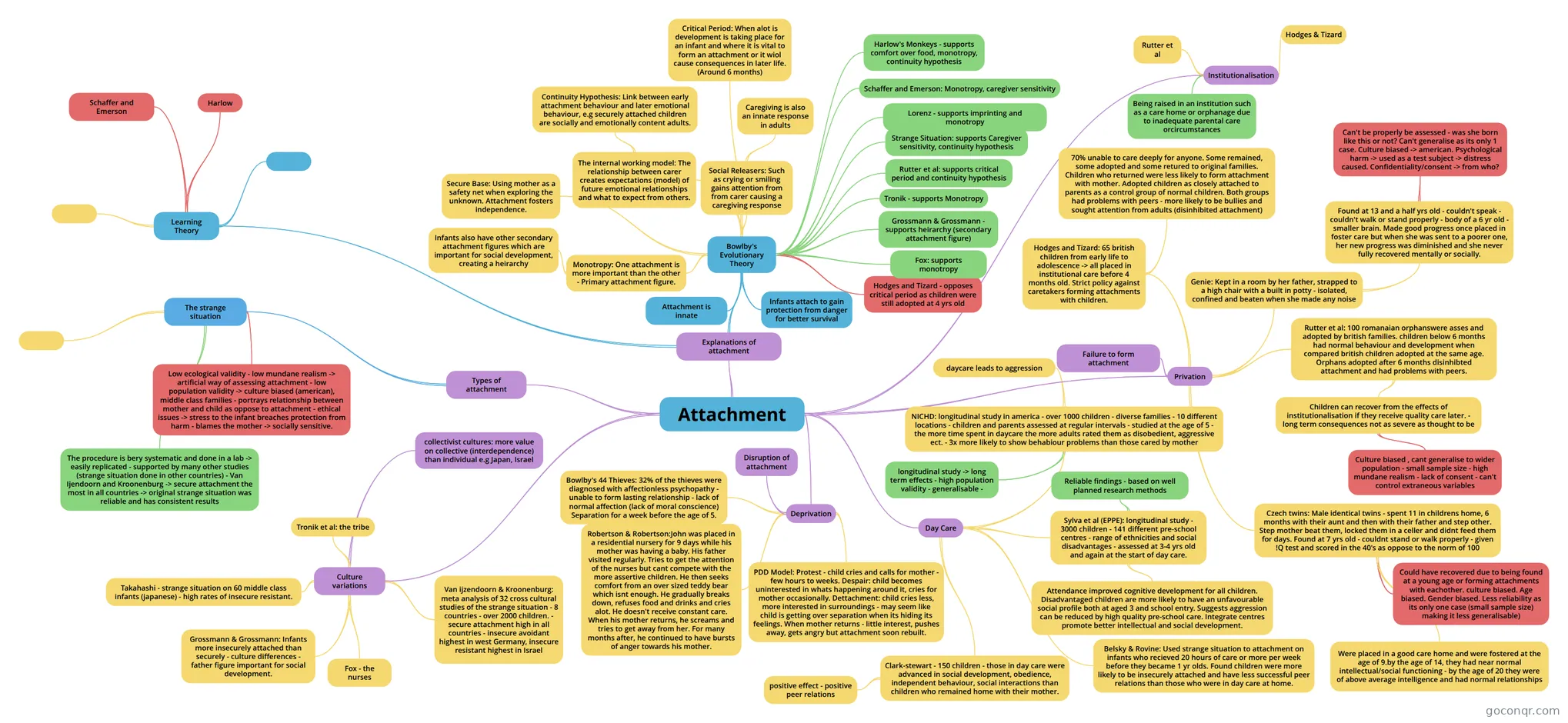
Mind map: Attachment: Theories and Cultural Variations
Contenido del mapa
Attachment
Deprivation
- Disruption of attachment
- Bowlby's 44 Thieves: 32% of the thieves were diagnosed with affectionless psychopathy - unable to form lasting relationship - lack of normal affection (lack of moral conscience) Separation for a week before the age of 5.
- PDD Model: Protest - child cries and calls for mother - few hours to weeks. Despair: child becomes uninterested in whats happening around it, cries for mother occasionally. Dettachment: child cries less, more interested in surroundings - may seem like child is getting over separation when its hiding its feelings. When mother returns - little interest, pushes away, gets angry but attachment soon rebuilt.
- Robertson & Robertson:John was placed in a residential nursery for 9 days while his mother was having a baby. His father visited regularly. Tries to get the attention of the nurses but cant compete with the more assertive children. He then seeks comfort from an over sized teddy bear which isnt enough. He gradually breaks down, refuses food and drinks and cries alot. He doesn't receive constant care. When his mother returns, he screams and tries to get away from her. For many months after, he continued to have bursts of anger towards his mother.
Explanations of attachment
- Learning Theory
- Harlow
- Schaffer and Emerson
- Bowlby's Evolutionary Theory
- Social Releasers: Such as crying or smiling gains attention from from carer causing a caregiving response
- Caregiving is also an innate response in adults
- Harlow's Monkeys - supports comfort over food, monotropy, continuity hypothesis
- Hodges and Tizard - opposes critical period as children were still adopted at 4 yrs old
- Lorenz - supports imprinting and monotropy
- Attachment is innate
- Infants attach to gain protection from danger for better survival
- Monotropy: One attachment is more important than the other - Primary attachment figure.
- Infants also have other secondary attachment figures which are important for social development, creating a heirarchy
- Critical Period: When alot is development is taking place for an infant and where it is vital to form an attachment or it wiol cause consequences in later life. (Around 6 months)
- Secure Base: Using mother as a safety net when exploring the unknown. Attachment fosters independence.
- The internal working model: The relationship between carer creates expectations (model) of future emotional relationships and what to expect from others.
- Continuity Hypothesis: Link between early attachment behaviour and later emotional behaviour, e.g securely attached children are socially and emotionally content adults.
- Grossmann & Grossmann - supports heirarchy (secondary attachment figure)
- Tronik - supports Monotropy
- Strange Situation: supports Caregiver sensitivity, continuity hypothesis
- Rutter et al: supports critical period and continuity hypothesis
- Fox: supports monotropy
- Schaffer and Emerson: Monotropy, caregiver sensitivity
- Social Releasers: Such as crying or smiling gains attention from from carer causing a caregiving response
- Learning Theory
Privation
- Failure to form attachment
- Hodges and Tizard: 65 british children from early life to adolescence -> all placed in institutional care before 4 months old. Strict policy against caretakers forming attachments with children.
- 70% unable to care deeply for anyone. Some remained, some adopted and some retured to original families. Children who returned were less likely to form attachment with mother. Adopted children as closely attached to parents as a control group of normal children. Both groups had problems with peers - more likely to be bullies and sought attention from adults (disinhibited attachment)
- Rutter et al: 100 romanaian orphanswere asses and adopted by british families. children below 6 months had normal behaviour and development when compared british children adopted at the same age. Orphans adopted after 6 months disinhibted attachment and had problems with peers.
- Children can recover from the effects of institutionalisation if they receive quality care later. - long term consequences not as severe as thought to be
- Culture biased , cant generalise to wider population - small sample size - high mundane realism - lack of consent - can't control extraneous variables
- Children can recover from the effects of institutionalisation if they receive quality care later. - long term consequences not as severe as thought to be
- Genie: Kept in a room by her father, strapped to a high chair with a built in potty - isolated, confined and beaten when she made any noise
- Found at 13 and a half yrs old - couldn't speak - couldn't walk or stand properly - body of a 6 yr old - smaller brain. Made good progress once placed in foster care but when she was sent to a poorer one, her new progress was diminished and she never fully recovered mentally or socially.
- Can't be properly be assessed - was she born like this or not? Can't generalise as its only 1 case. Culture biased -> american. Psychological harm -> used as a test subject -> distress caused. Confidentiality/consent -> from who?
- Found at 13 and a half yrs old - couldn't speak - couldn't walk or stand properly - body of a 6 yr old - smaller brain. Made good progress once placed in foster care but when she was sent to a poorer one, her new progress was diminished and she never fully recovered mentally or socially.
- Czech twins: Male identical twins - spent 11 in childrens home, 6 months with their aunt and then with their father and step other. Step mother beat them, locked them in a celler and didnt feed them for days. Found at 7 yrs old - couldnt stand or walk properly - given !Q test and scored in the 40's as oppose to the norm of 100
- Were placed in a good care home and were fostered at the age of 9.by the age of 14, they had near normal intellectual/social functioning - by the age of 20 they were of above average intelligence and had normal relationships
- Could have recovered due to being found at a young age or forming attachments with eachother. culture biased. Age biased. Gender biased. Less reliability as its only one case (small sample size) making it less generalisable)
Types of attachment
- The strange situation
- Low ecological validity - low mundane realism -> artificial way of assessing attachment - low population validity -> culture biased (american), middle class families - portrays relationship between mother and child as oppose to attachment - ethical issues -> stress to the infant breaches protection from harm - blames the mother -> socially sensitive.
- The procedure is bery systematic and done in a lab -> easily replicated - supported by many other studies (strange situation done in other countries) - Van Ijendoorn and Kroonenburg -> secure attachment the most in all countries -> original strange situation was reliable and has consistent results
- The strange situation
Culture variations
- Van ijzendoorn & Kroonenburg: meta analysis of 32 cross cultural studies of the strange situation - 8 countries - over 2000 children. - secure attachment high in all countries - insecure avoidant highest in west Germany, insecure resistant highest in Israel
- Takahashi - strange situation on 60 middle class infants (japanese) - high rates of insecure resistant.
- Fox - the nurses
- Tronik et al: the tribe
- Grossmann & Grossmann: Infants more insecurely attached than securely - culture differences - father figure important for social development.
- collectivist cultures: more value on collective (interdependence) than individual e.g Japan, Israel
Day Care
- Clark-stewart - 150 children - those in day care were advanced in social development, obedience, independent behaviour, social interactions than children who remained home with their mother.
- positive effect - positive peer relations
- NICHD: longitudinal study in america - over 1000 children - diverse families - 10 different locations - children and parents assessed at regular intervals - studied at the age of 5 - the more time spent in daycare the more adults rated them as disobedient, aggressive ect. - 3x more likely to show behabiour problems than those cared by mother
- daycare leads to aggression
- longitudinal study -> long term effects - high population validity - generalisable -
- Belsky & Rovine: Used strange situation to attachment on infants who recieved 20 hours of care or more per week before they became 1 yr olds. Found children were more likely to be insecurely attached and have less successful peer relations than those who were in day care at home.
- Sylva et al (EPPE): longitudinal study - 3000 children - 141 different pre-school centres - range of ethnicities and social disadvantages - assessed at 3-4 yrs old and again at the start of day care.
- Attendance improved cognitive development for all children. Disadvantaged children are more likely to have an unfavourable social profile both at aged 3 and school entry. Suggests aggression can be reduced by high quality pre-school care. Integrate centres promote better intellectual and social development.
- Reliable findings - based on well planned research methods
- Clark-stewart - 150 children - those in day care were advanced in social development, obedience, independent behaviour, social interactions than children who remained home with their mother.
Institutionalisation
- Hodges & Tizard
- Rutter et al
- Being raised in an institution such as a care home or orphanage due to inadequate parental care orcircumstances
Información
- Descripción
- A level Psychology Mapa Mental sobre Attachment, creado por cutyprincess_zk el 06/05/2015.
- Creado por
- cutyprincess_zk
- Visitas
- 0
- Valoración