
Mapa mental
Attachment
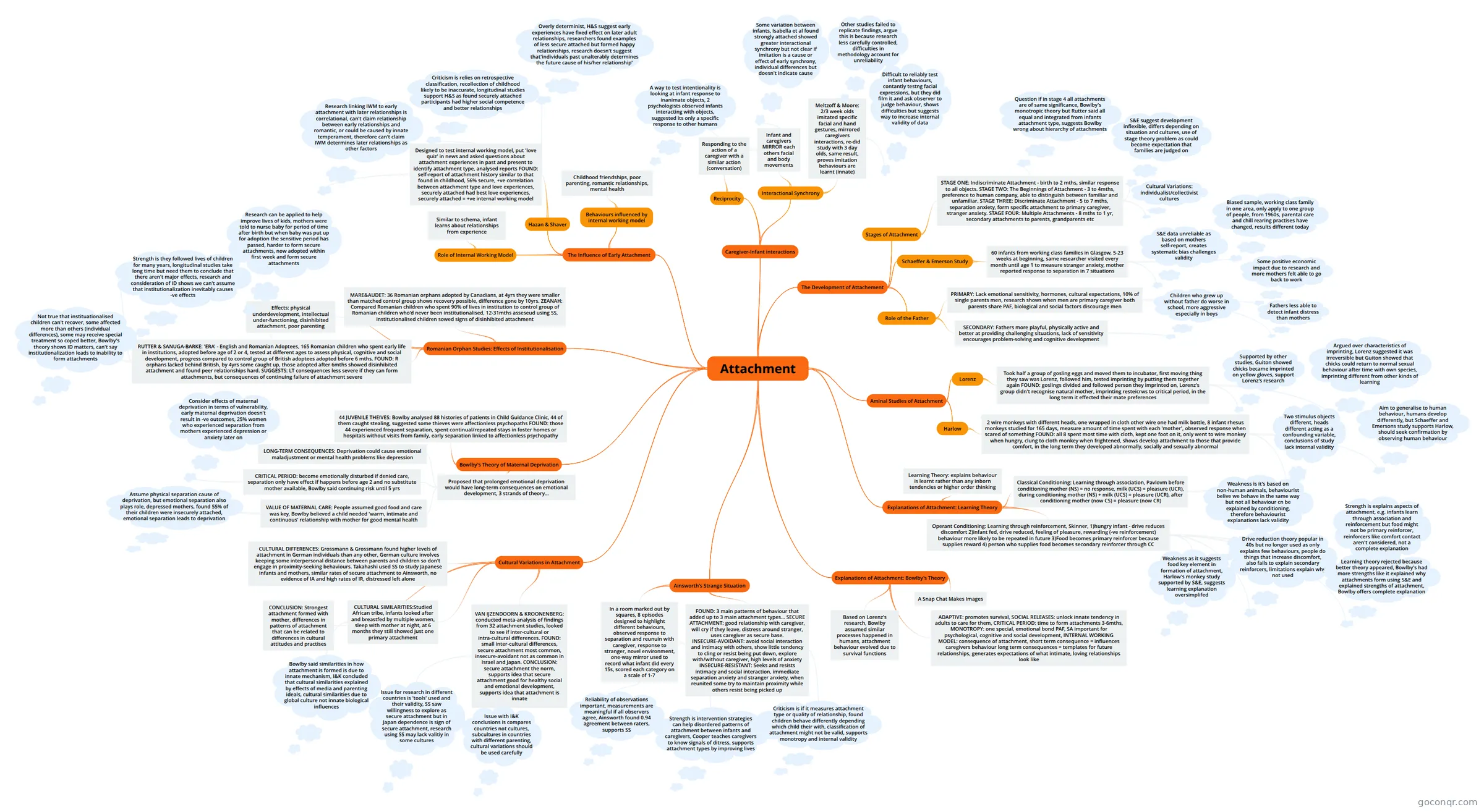
Mind map: Attachment psychology
Contenido del mapa
Attachment
Caregiver-Infant interactions
- Reciprocity
- Responding to the action of a caregiver with a similar action (conversation)
- Interactional Synchrony
- Infant and caregivers MIRROR each others facial and body movements
- A way to test intentionality is looking at infant response to inanimate objects, 2 psychologists observed infants interacting with objects, suggested its only a specific response to other humans
- Some variation between infants, Isabella et al found strongly attached showed greater interactional synchrony but not clear if imitation is a cause or effect of early synchrony, individual differences but doesn't indicate cause
- Meltzoff & Moore: 2/3 week olds imitated specific facial and hand gestures, mirrored caregivers interactions, re-did study with 3 day olds, same result, proves imitation behaviours are learnt (innate)
- Difficult to reliably test infant behaviours, contantly testng facial expressions, but they did film it and ask observer to judge behaviour, shows difficulties but suggests way to increase internal validity of data
- Other studies failed to replicate findings, argue this is because research less carefully controlled, difficulties in methodology account for unreliability
- Infant and caregivers MIRROR each others facial and body movements
- Reciprocity
The Development of Attachement
- Stages of Attachment
- STAGE ONE: Indiscriminate Attachment - birth to 2 mths, similar response to all objects. STAGE TWO: The Beginnings of Attachment - 3 to 4mths, preference to human company, able to distinguish between familiar and unfamiliar. STAGE THREE: Discriminate Attachment - 5 to 7 mths, separation anxiety, form specific attachment to primary caregiver, stranger anxiety. STAGE FOUR: Multiple Attachments - 8 mths to 1 yr, secondary attachments to parents, grandparents etc
- Question if in stage 4 all attachments are of same significance, Bowlby's monotropic theory but Rutter said all equal and integrated from infants attachment type, suggests Bowlby wrong about hierarchy of attachments
- Cultural Variations: individualist/collectivist cultures
- S&E suggest development inflexible, differs depending on situation and cultures, use of stage theory problem as could become expectation that families are judged on
- STAGE ONE: Indiscriminate Attachment - birth to 2 mths, similar response to all objects. STAGE TWO: The Beginnings of Attachment - 3 to 4mths, preference to human company, able to distinguish between familiar and unfamiliar. STAGE THREE: Discriminate Attachment - 5 to 7 mths, separation anxiety, form specific attachment to primary caregiver, stranger anxiety. STAGE FOUR: Multiple Attachments - 8 mths to 1 yr, secondary attachments to parents, grandparents etc
- Schaeffer & Emerson Study
- 60 infants from working class families in Glasgow, 5-23 weeks at beginning, same researcher visited every month until age 1 to measure stranger anxiety, mother reported response to separation in 7 situations
- S&E data unreliable as based on mothers self-report, creates systematic bias challenges validity
- Biased sample, working class family in one area, only apply to one group of people, from 1960s, parental care and chill rearing practises have changed, results different today
- 60 infants from working class families in Glasgow, 5-23 weeks at beginning, same researcher visited every month until age 1 to measure stranger anxiety, mother reported response to separation in 7 situations
- Role of the Father
- PRIMARY: Lack emotional sensitivity, hormones, cultural expectations, 10% of single parents men, research shows when men are primary caregiver both parents share PAF, biological and social factors discourage men
- Fathers less able to detect infant distress than mothers
- Some positive economic impact due to research and more mothers felt able to go back to work
- SECONDARY: Fathers more playful, physically active and better at providing challenging situations, lack of sensitivity encourages problem-solving and cognitive development
- Children who grew up without father do worse in school, more aggressive especially in boys
- PRIMARY: Lack emotional sensitivity, hormones, cultural expectations, 10% of single parents men, research shows when men are primary caregiver both parents share PAF, biological and social factors discourage men
- Stages of Attachment
Aminal Studies of Attachment
- Lorenz
- Took half a group of gosling eggs and moved them to incubator, first moving thing they saw was Lorenz, followed him, tested imprinting by putting them together again FOUND: goslings divided and followed person they imprinted on, Lorenz's group didn't recognise natural mother, imprinting resteicrws to critical period, in the long term it effected their mate preferences
- Supported by other studies, Guiton showed chicks became imprinted on yellow gloves, support Lorenz's research
- Argued over characteristics of imprinting, Lorenz suggested it was irreversible but Guiton showed that chicks could return to normal sexual behaviour after time with own species, imprinting different from other kinds of learning
- Took half a group of gosling eggs and moved them to incubator, first moving thing they saw was Lorenz, followed him, tested imprinting by putting them together again FOUND: goslings divided and followed person they imprinted on, Lorenz's group didn't recognise natural mother, imprinting resteicrws to critical period, in the long term it effected their mate preferences
- Harlow
- 2 wire monkeys with different heads, one wrapped in cloth other wire one had milk bottle, 8 infant rhesus monkeys studied for 165 days, measure amount of time spent with each 'mother', observed response when scared of something FOUND: all 8 spent most time with cloth, kept one foot on it, only went to wire monkey when hungry, clung to cloth monkey when frightened, shows develop attachment to those that provide comfort, in the long term they developed abnormally, socially and sexually abnormal
- Two stimulus objects different, heads different acting as a confounding variable, conclusions of study lack internal validity
- Aim to generalise to human behaviour, humans develop differently, but Schaeffer and Emersons study supports Harlow, should seek confirmation by observing human behaviour
- 2 wire monkeys with different heads, one wrapped in cloth other wire one had milk bottle, 8 infant rhesus monkeys studied for 165 days, measure amount of time spent with each 'mother', observed response when scared of something FOUND: all 8 spent most time with cloth, kept one foot on it, only went to wire monkey when hungry, clung to cloth monkey when frightened, shows develop attachment to those that provide comfort, in the long term they developed abnormally, socially and sexually abnormal
- Lorenz
Explanations of Attachment: Learning Theory
- Learning Theory: explains behaviour is learnt rather than any inborn tendencies or higher order thinking
- Classical Conditioning: Learning through association, Pavlovm before conditioning mother (NS) = no response, milk (UCS) = pleasure (UCR), during conditioning mother (NS) + milk (UCS) = pleasure (UCR), after conditioning mother (now CS) = pleasure (now CR)
- Weakness is it's based on non-human animals, behaviourist belive we behave in the same way but not all behaviour cn be explained by conditioning, therefore behaviourist explanations lack validity
- Operant Conditioning: Learning through reinforcement, Skinner, 1)hungry infant - drive reduces discomfort 2)infant fed, drive reduced, feeling of pleasure, rewarding (-ve reinforcement) behaviour more likely to be repeated in future 3)Food becomes primary reinforcer because supplies reward 4) person who supplies food becomes secondary reinforcer through CC
- Weakness as it suggests food key element in formation of attachment, Harlow's monkey study supported by S&E, suggests learning explanation oversimplifed
- Strength is explains aspects of attachment, e.g. infants learn through association and reinforcement but food might not be primary reinforcer, reinforcers like comfort contact aren't considered, not a complete explanation
- Drive reduction theory popular in 40s but no longer used as only explains few behaviours, people do things that increase discomfort, also fails to explain secondary reinforcers, limitations explain why not used
- Learning theory rejected because better theory appeared, Bowlby's had more strengths like it explained why attachments form using S&E and explained strengths of attachment, Bowlby offers complete explanation
Explanations of Attachment: Bowlby's Theory
- Based on Lorenz's research, Bowlby assumed similar processes happened in humans, attachment behaviour evolved due to survival functions
- A Snap Chat Makes Images
- ADAPTIVE: promotes survival, SOCIAL RELEASES: unlock innate tendency in adults to care for them, CRITICAL PERIOD: time to form attachments 3-6mths, MONOTROPY: one special, emotional bond PAF, SA important for psychological, cognitive and social development, INTERNAL WORKING MODEL: consequence of attachment, short term consequence = influences caregivers behaviour long term consequences = templates for future relationships, generates expectations of what intimate, loving relationships look like
Ainsworth's Strange Situation
- In a room marked out by squares, 8 episodes designed to highlight different behaviours, observed response to separation and reunuin with caregiver, response to stranger, novel environment, one-way mirror used to record what infant did every 15s, scored each category on a scale of 1-7
- Reliability of observations important, measurements are meaningful if all observers agree, Ainsworth found 0.94 agreement between raters, supports SS
- Strength is intervention strategies can help disordered patterns of attachment between infants and caregivers, Cooper teaches caregivers to know signals of ditress, supports attachment types by improving lives
- FOUND: 3 main patterns of behaviour that added up to 3 main attachment types... SECURE ATTACHMENT: good relationship with caregiver, will cry if they leave, distress around stranger, uses caregiver as secure base. INSECURE-AVOIDANT: avoid social interaction and intimacy with others, show little tendency to cling or resist being put down, explore with/without caregiver, high levels of anxiety INSECURE-RESISTANT: Seeks and resists intimacy and social interaction, immediate separation anxiety and stranger anxiety, when reunited some try to maintain proximity while others resist being picked up
- Criticism is if it measures attachment type or quality of relationship, found children behave differently depending which child their with, classification of attachment might not be valid, supports monotropy and internal validity
- In a room marked out by squares, 8 episodes designed to highlight different behaviours, observed response to separation and reunuin with caregiver, response to stranger, novel environment, one-way mirror used to record what infant did every 15s, scored each category on a scale of 1-7
Cultural Variations in Attachment
- VAN IJZENDOORN & KROONENBERG: conducted meta-analysis of findings from 32 attachment studies, looked to see if inter-cultural or intra-cultural differences. FOUND: small inter-cultural differences, secure attachment most common, insecure-avoidant not as common in Israel and Japan. CONCLUSION: secure attachment the norm, supports idea that secure attachment good for healthy social and emotional development, supports idea that attachment is innate
- Issue with I&K conclusions is compares countries not cultures, subcultures in countries with different parenting, cultural variations should be used carefully
- Issue for research in different countries is 'tools' used and their validity, SS saw willingness to explore as secure attachment but in Japan dependence is sign of secure attachment, research using SS may lack valitiy in some cultures
- CULTURAL SIMILARITIES:Studied African tribe, infants looked after and breastfed by multiple women, sleep with mother at night, at 6 months they still showed just one primary attachment
- Bowlby said similarities in how attachment is formed is due to innate mechanism, I&K concluded that cultural similarities explained by effects of media and parenting ideals, cultural similarities due to global culture not innate biological influences
- CULTURAL DIFFERENCES: Grossmann & Grossmann found higher levels of attachment in German individuals than any other, German culture involves keeping some interpersonal distance between parents and children so don't engage in proximity-seeking behaviours. Takahashi used SS to study Japanese infants and mothers, similar rates of secure attachment to Ainsworth, no evidence of IA and high rates of IR, distressed left alone
- CONCLUSION: Strongest attachment formed with mother, differences in patterns of attachment that can be related to differences in cultural attitudes and practises
- VAN IJZENDOORN & KROONENBERG: conducted meta-analysis of findings from 32 attachment studies, looked to see if inter-cultural or intra-cultural differences. FOUND: small inter-cultural differences, secure attachment most common, insecure-avoidant not as common in Israel and Japan. CONCLUSION: secure attachment the norm, supports idea that secure attachment good for healthy social and emotional development, supports idea that attachment is innate
Bowlby's Theory of Maternal Deprivation
- Proposed that prolonged emotional deprivation would have long-term consequences on emotional development, 3 strands of theory...
- VALUE OF MATERNAL CARE: People assumed good food and care was key, Bowlby believed a child needed 'warm, intimate and continuous' relationship with mother for good mental health
- Assume physical separation cause of deprivation, but emotional separation also plays role, depressed mothers, found 55% of their children were insecurely attached, emotional separation leads to deprivation
- CRITICAL PERIOD: become emotionally disturbed if denied care, separation only have effect if happens before age 2 and no substitute mother available, Bowlby said continuing risk until 5 yrs
- Consider effects of maternal deprivation in terms of vulnerability, early maternal deprivation doesn't result in -ve outcomes, 25% women who experienced separation from mothers experienced depression or anxiety later on
- LONG-TERM CONSEQUENCES: Deprivation could cause emotional maladjustment or mental health problems like depression
- VALUE OF MATERNAL CARE: People assumed good food and care was key, Bowlby believed a child needed 'warm, intimate and continuous' relationship with mother for good mental health
- 44 JUVENILE THEIVES: Bowlby analysed 88 histories of patients in Child Guidance Clinic, 44 of them caught stealing, suggested some thieves were affectionless psychopaths FOUND: those 44 experienced frequent separation, spent continual/repeated stays in foster homes or hospitals without visits from family, early separation linked to affectionless psychopathy
- Proposed that prolonged emotional deprivation would have long-term consequences on emotional development, 3 strands of theory...
Romanian Orphan Studies: Effects of Institutionalisation
- RUTTER & SANUGA-BARKE: 'ERA' - English and Romanian Adoptees, 165 Romanian children who spent early life in institutions, adopted before age of 2 or 4, tested at different ages to assess physical, cognitive and social development, progress compared to control group of British adoptees adopted before 6 mths. FOUND: R orphans lacked behind British, by 4yrs some caught up, those adopted after 6mths showed disinhibited attachment and found peer relationships hard. SUGGESTS: LT consequences less severe if they can form attachments, but consequences of continuing failure of attachment severe
- Not true that instituationalised children can't recover, some affected more than others (individual differences), some may receive special treatment so coped better, Bowlby's theory shows ID matters, can't say institutionalization leads to inability to form attachments
- Research can be applied to help improve lives of kids, mothers were told to nurse baby for period of time after birth but when baby was put up for adoption the sensitive period has passed, harder to form secure attachments, now adopted within first week and form secure attachments
- Strength is they followed lives of children for many years, longitudinal studies take long time but need them to conclude that there aren't major effects, research and consideration of ID shows we can't assume that institutionalization inevitably causes -ve effects
- MARE&AUDET: 36 Romanian orphans adopted by Canadians, at 4yrs they were smaller than matched control group shows recovery possible, difference gone by 10yrs. ZEANAH: Compared Romanian children who spent 90% of lives in institution to control group of Romanian children who'd never been institutionalised, 12-31mths asseseud using SS, institutionalised children sowed signs of disinhibited attachment
- Effects: physical underdevelopment, intellectual under-functioning, disinhibited attachment, poor parenting
- RUTTER & SANUGA-BARKE: 'ERA' - English and Romanian Adoptees, 165 Romanian children who spent early life in institutions, adopted before age of 2 or 4, tested at different ages to assess physical, cognitive and social development, progress compared to control group of British adoptees adopted before 6 mths. FOUND: R orphans lacked behind British, by 4yrs some caught up, those adopted after 6mths showed disinhibited attachment and found peer relationships hard. SUGGESTS: LT consequences less severe if they can form attachments, but consequences of continuing failure of attachment severe
The Influence of Early Attachment
- Role of Internal Working Model
- Similar to schema, infant learns about relationships from experience
- Hazan & Shaver
- Designed to test internal working model, put 'love quiz' in news and asked questions about attachment experiences in past and present to identify attachment type, analysed reports FOUND: self-report of attachment history similar to that found in childhood, 56% secure, +ve correlation between attachment type and love experiences, securely attached had best love experiences, securely attached = +ve internal working model
- Research linking IWM to early attachment with later relationships is correlational, can't claim relationship between early relationships and romantic, or could be caused by innate temperament, therefore can't claim IWM determines later relationships as other factors
- Criticism is relies on retrospective classification, recollection of childhood likely to be inaccurate, longitudinal studies support H&S as found securely attached participants had higher social competence and better relationships
- Overly determinist, H&S suggest early experiences have fixed effect on later adult relationships, researchers found examples of less secure attached but formed happy relationships, research doesn't suggest that'individuals past unalterably determines the future cause of his/her relationship'
- Designed to test internal working model, put 'love quiz' in news and asked questions about attachment experiences in past and present to identify attachment type, analysed reports FOUND: self-report of attachment history similar to that found in childhood, 56% secure, +ve correlation between attachment type and love experiences, securely attached had best love experiences, securely attached = +ve internal working model
- Behaviours influenced by internal working model
- Childhood friendships, poor parenting, romantic relationships, mental health
- Role of Internal Working Model
Información
- Descripción
- AS level (Attachment) Psychology Mapa Mental sobre Attachment, creado por Alice Billing el 28/10/2020.
- Creado por
- Alice Billing
- Visitas
- 1
- Valoración