
Mapa mental
Ethics
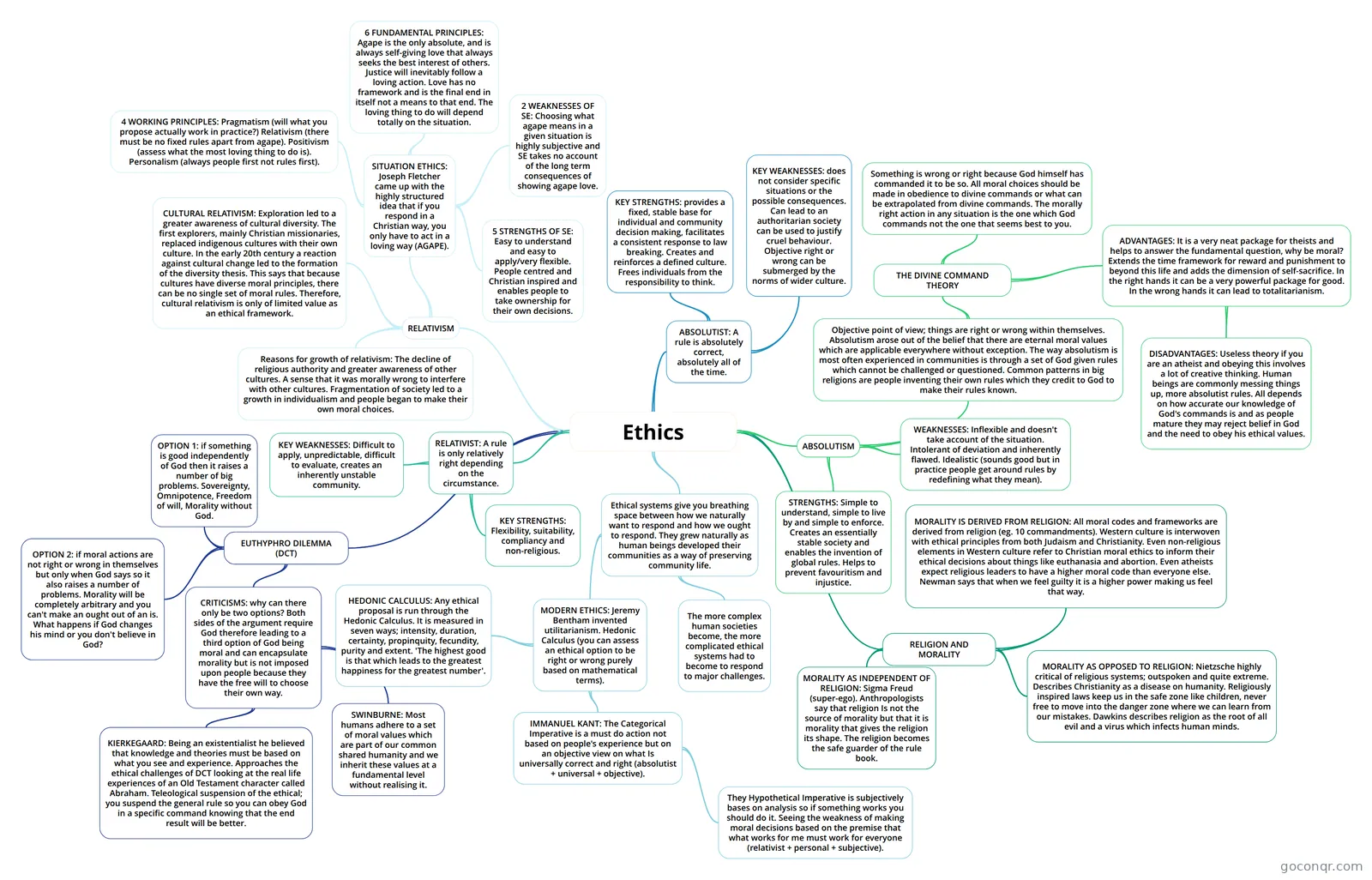
Mind map: ethics
Contenido del mapa
Ethics
Ethical systems give you breathing space between how we naturally want to respond and how we ought to respond. They grew naturally as human beings developed their communities as a way of preserving community life.
- The more complex human societies become, the more complicated ethical systems had to become to respond to major challenges.
- MODERN ETHICS: Jeremy Bentham invented utilitarianism. Hedonic Calculus (you can assess an ethical option to be right or wrong purely based on mathematical terms).
- HEDONIC CALCULUS: Any ethical proposal is run through the Hedonic Calculus. It is measured in seven ways; intensity, duration, certainty, propinquity, fecundity, purity and extent. 'The highest good is that which leads to the greatest happiness for the greatest number'.
- IMMANUEL KANT: The Categorical Imperative is a must do action not based on people's experience but on an objective view on what Is universally correct and right (absolutist + universal + objective).
- They Hypothetical Imperative is subjectively bases on analysis so if something works you should do it. Seeing the weakness of making moral decisions based on the premise that what works for me must work for everyone (relativist + personal + subjective).
ABSOLUTIST: A rule is absolutely correct, absolutely all of the time.
- KEY STRENGTHS: provides a fixed, stable base for individual and community decision making, facilitates a consistent response to law breaking. Creates and reinforces a defined culture. Frees individuals from the responsibility to think.
- KEY WEAKNESSES: does not consider specific situations or the possible consequences. Can lead to an authoritarian society can be used to justify cruel behaviour. Objective right or wrong can be submerged by the norms of wider culture.
RELATIVIST: A rule is only relatively right depending on the circumstance.
- KEY STRENGTHS: Flexibility, suitability, compliancy and non-religious.
- KEY WEAKNESSES: Difficult to apply, unpredictable, difficult to evaluate, creates an inherently unstable community.
RELATIVISM
- Reasons for growth of relativism: The decline of religious authority and greater awareness of other cultures. A sense that it was morally wrong to interfere with other cultures. Fragmentation of society led to a growth in individualism and people began to make their own moral choices.
- CULTURAL RELATIVISM: Exploration led to a greater awareness of cultural diversity. The first explorers, mainly Christian missionaries, replaced indigenous cultures with their own culture. In the early 20th century a reaction against cultural change led to the formation of the diversity thesis. This says that because cultures have diverse moral principles, there can be no single set of moral rules. Therefore, cultural relativism is only of limited value as an ethical framework.
- SITUATION ETHICS: Joseph Fletcher came up with the highly structured idea that if you respond in a Christian way, you only have to act in a loving way (AGAPE).
- 4 WORKING PRINCIPLES: Pragmatism (will what you propose actually work in practice?) Relativism (there must be no fixed rules apart from agape). Positivism (assess what the most loving thing to do is). Personalism (always people first not rules first).
- 6 FUNDAMENTAL PRINCIPLES: Agape is the only absolute, and is always self-giving love that always seeks the best interest of others. Justice will inevitably follow a loving action. Love has no framework and is the final end in itself not a means to that end. The loving thing to do will depend totally on the situation.
- 5 STRENGTHS OF SE: Easy to understand and easy to apply/very flexible. People centred and Christian inspired and enables people to take ownership for their own decisions.
- 2 WEAKNESSES OF SE: Choosing what agape means in a given situation is highly subjective and SE takes no account of the long term consequences of showing agape love.
ABSOLUTISM
- Objective point of view; things are right or wrong within themselves. Absolutism arose out of the belief that there are eternal moral values which are applicable everywhere without exception. The way absolutism is most often experienced in communities is through a set of God given rules which cannot be challenged or questioned. Common patterns in big religions are people inventing their own rules which they credit to God to make their rules known.
- THE DIVINE COMMAND THEORY
- Something is wrong or right because God himself has commanded it to be so. All moral choices should be made in obedience to divine commands or what can be extrapolated from divine commands. The morally right action in any situation is the one which God commands not the one that seems best to you.
- ADVANTAGES: It is a very neat package for theists and helps to answer the fundamental question, why be moral? Extends the time framework for reward and punishment to beyond this life and adds the dimension of self-sacrifice. In the right hands it can be a very powerful package for good. In the wrong hands it can lead to totalitarianism.
- DISADVANTAGES: Useless theory if you are an atheist and obeying this involves a lot of creative thinking. Human beings are commonly messing things up, more absolutist rules. All depends on how accurate our knowledge of God's commands is and as people mature they may reject belief in God and the need to obey his ethical values.
- THE DIVINE COMMAND THEORY
- STRENGTHS: Simple to understand, simple to live by and simple to enforce. Creates an essentially stable society and enables the invention of global rules. Helps to prevent favouritism and injustice.
- WEAKNESSES: Inflexible and doesn't take account of the situation. Intolerant of deviation and inherently flawed. Idealistic (sounds good but in practice people get around rules by redefining what they mean).
- Objective point of view; things are right or wrong within themselves. Absolutism arose out of the belief that there are eternal moral values which are applicable everywhere without exception. The way absolutism is most often experienced in communities is through a set of God given rules which cannot be challenged or questioned. Common patterns in big religions are people inventing their own rules which they credit to God to make their rules known.
RELIGION AND MORALITY
- MORALITY IS DERIVED FROM RELIGION: All moral codes and frameworks are derived from religion (eg. 10 commandments). Western culture is interwoven with ethical principles from both Judaism and Christianity. Even non-religious elements in Western culture refer to Christian moral ethics to inform their ethical decisions about things like euthanasia and abortion. Even atheists expect religious leaders to have a higher moral code than everyone else. Newman says that when we feel guilty it is a higher power making us feel that way.
- MORALITY AS INDEPENDENT OF RELIGION: Sigma Freud (super-ego). Anthropologists say that religion Is not the source of morality but that it is morality that gives the religion its shape. The religion becomes the safe guarder of the rule book.
- MORALITY AS OPPOSED TO RELIGION: Nietzsche highly critical of religious systems; outspoken and quite extreme. Describes Christianity as a disease on humanity. Religiously inspired laws keep us in the safe zone like children, never free to move into the danger zone where we can learn from our mistakes. Dawkins describes religion as the root of all evil and a virus which infects human minds.
EUTHYPHRO DILEMMA (DCT)
- OPTION 1: if something is good independently of God then it raises a number of big problems. Sovereignty, Omnipotence, Freedom of will, Morality without God.
- OPTION 2: if moral actions are not right or wrong in themselves but only when God says so it also raises a number of problems. Morality will be completely arbitrary and you can't make an ought out of an is. What happens if God changes his mind or you don't believe in God?
- CRITICISMS: why can there only be two options? Both sides of the argument require God therefore leading to a third option of God being moral and can encapsulate morality but is not imposed upon people because they have the free will to choose their own way.
- SWINBURNE: Most humans adhere to a set of moral values which are part of our common shared humanity and we inherit these values at a fundamental level without realising it.
- KIERKEGAARD: Being an existentialist he believed that knowledge and theories must be based on what you see and experience. Approaches the ethical challenges of DCT looking at the real life experiences of an Old Testament character called Abraham. Teleological suspension of the ethical; you suspend the general rule so you can obey God in a specific command knowing that the end result will be better.
Información
- Descripción
- Mapa Mental sobre Ethics, creado por lvabooboo el 18/05/2015.
- Creado por
- lvabooboo
- Visitas
- 0
- Valoración
Más sobre Moral Absolutism and Relativism