
Mapa mental
attachment
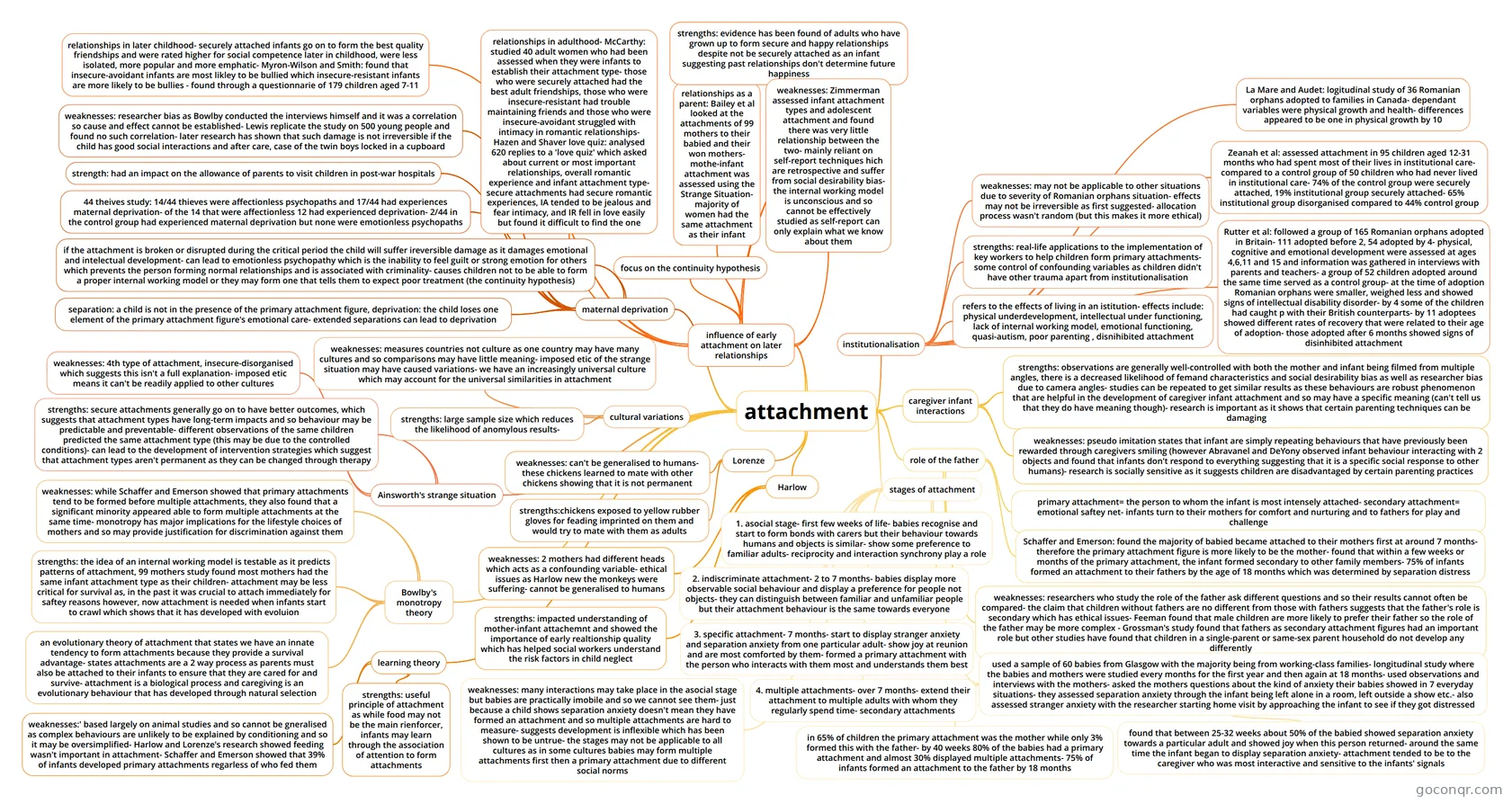
Mind map: Attachment psychology
Contenido del mapa
attachment
caregiver infant interactions
- strengths: observations are generally well-controlled with both the mother and infant being filmed from multiple angles, there is a decreased likelihood of femand characteristics and social desirability bias as well as researcher bias due to camera angles- studies can be repeated to get similar results as these behaviours are robust phenomenon that are helpful in the development of caregiver infant attachment and so may have a specific meaning (can't tell us that they do have meaning though)- research is important as it shows that certain parenting techniques can be damaging
- weaknesses: pseudo imitation states that infant are simply repeating behaviours that have previously been rewarded through caregivers smiling (however Abravanel and DeYony observed infant behaviour interacting with 2 objects and found that infants don't respond to everything suggesting that it is a specific social response to other humans)- research is socially sensitive as it suggests children are disadvantaged by certain parenting practices
role of the father
- primary attachment= the person to whom the infant is most intensely attached- secondary attachment= emotional saftey net- infants turn to their mothers for comfort and nurturing and to fathers for play and challenge
- Schaffer and Emerson: found the majority of babied became attached to their mothers first at around 7 months- therefore the primary attachment figure is more likely to be the mother- found that within a few weeks or months of the primary attachment, the infant formed secondary to other family members- 75% of infants formed an attachment to their fathers by the age of 18 months which was determined by separation distress
- weaknesses: researchers who study the role of the father ask different questions and so their results cannot often be compared- the claim that children without fathers are no different from those with fathers suggests that the father's role is secondary which has ethical issues- Feeman found that male children are more likely to prefer their father so the role of the father may be more complex - Grossman's study found that fathers as secondary attachment figures had an important role but other studies have found that children in a single-parent or same-sex parent household do not develop any differently
stages of attachment
- used a sample of 60 babies from Glasgow with the majority being from working-class families- longitudinal study where the babies and mothers were studied every months for the first year and then again at 18 months- used observations and interviews with the mothers- asked the mothers questions about the kind of anxiety their babies showed in 7 everyday situations- they assessed separation anxiety through the infant being left alone in a room, left outside a show etc.- also assessed stranger anxiety with the researcher starting home visit by approaching the infant to see if they got distressed
- found that between 25-32 weeks about 50% of the babied showed separation anxiety towards a particular adult and showed joy when this person returned- around the same time the infant began to display separation anxiety- attachment tended to be to the caregiver who was most interactive and sensitive to the infants' signals
- in 65% of children the primary attachment was the mother while only 3% formed this with the father- by 40 weeks 80% of the babies had a primary attachment and almost 30% displayed multiple attachments- 75% of infants formed an attachment to the father by 18 months
- 1. asocial stage- first few weeks of life- babies recognise and start to form bonds with carers but their behaviour towards humans and objects is similar- show some preference to familiar adults- reciprocity and interaction synchrony play a role
- 2. indiscriminate attachment- 2 to 7 months- babies display more observable social behaviour and display a preference for people not objects- they can distinguish between familiar and unfamiliar people but their attachment behaviour is the same towards everyone
- 3. specific attachment- 7 months- start to display stranger anxiety and separation anxiety from one particular adult- show joy at reunion and are most comforted by them- formed a primary attachment with the person who interacts with them most and understands them best
- 4. multiple attachments- over 7 months- extend their attachment to multiple adults with whom they regularly spend time- secondary attachments
- weaknesses: many interactions may take place in the asocial stage but babies are practically imobile and so we cannot see them- just because a child shows separation anxiety doesn't mean they have formed an attachment and so multiple attachments are hard to measure- suggests development is inflexible which has been shown to be untrue- the stages may not be applicable to all cultures as in some cultures babies may form multiple attachments first then a primary attachment due to different social norms
- used a sample of 60 babies from Glasgow with the majority being from working-class families- longitudinal study where the babies and mothers were studied every months for the first year and then again at 18 months- used observations and interviews with the mothers- asked the mothers questions about the kind of anxiety their babies showed in 7 everyday situations- they assessed separation anxiety through the infant being left alone in a room, left outside a show etc.- also assessed stranger anxiety with the researcher starting home visit by approaching the infant to see if they got distressed
Harlow
- strengths: impacted understanding of mother-infant attachemnt and showed the importance of early realtionship quality which has helped social workers understand the risk factors in child neglect
- weaknesses: 2 mothers had different heads which acts as a confounding variable- ethical issues as Harlow new the monkeys were suffering- cannot be generalised to humans
Lorenze
- strengths:chickens exposed to yellow rubber gloves for feading imprinted on them and would try to mate with them as adults
- weaknesses: can't be generalised to humans- these chickens learned to mate with other chickens showing that it is not permanent
learning theory
- strengths: useful principle of attachment as while food may not be the main rienforcer, infants may learn through the association of attention to form attachments
- weaknesses:' based largely on animal studies and so cannot be gneralised as complex behaviours are unlikely to be explained by conditioning and so it may be oversimplified- Harlow and Lorenze's research showed feeding wasn't important in attachment- Schaffer and Emerson showed that 39% of infants developed primary attachments regarless of who fed them
Bowlby's monotropy theory
- an evolutionary theory of attachment that states we have an innate tendency to form attachments because they provide a survival advantage- states attachments are a 2 way process as parents must also be attached to their infants to ensure that they are cared for and survive- attachment is a biological process and caregiving is an evolutionary behaviour that has developed through natural selection
- strengths: the idea of an internal working model is testable as it predicts patterns of attachment, 99 mothers study found most mothers had the same infant attachment type as their children- attachment may be less critical for survival as, in the past it was crucial to attach immediately for saftey reasons however, now attachment is needed when infants start to crawl which shows that it has developed with evoluion
- weaknesses: while Schaffer and Emerson showed that primary attachments tend to be formed before multiple attachments, they also found that a significant minority appeared able to form multiple attachments at the same time- monotropy has major implications for the lifestyle choices of mothers and so may provide justification for discrimination against them
Ainsworth's strange situation
- strengths: secure attachments generally go on to have better outcomes, which suggests that attachment types have long-term impacts and so behaviour may be predictable and preventable- different observations of the same children predicted the same attachment type (this may be due to the controlled conditions)- can lead to the development of intervention strategies which suggest that attachment types aren't permanent as they can be changed through therapy
- weaknesses: 4th type of attachment, insecure-disorganised which suggests this isn't a full explanation- imposed etic means it can't be readily applied to other cultures
cultural variations
- strengths: large sample size which reduces the likelihood of anomylous results-
- weaknesses: measures countries not culture as one country may have many cultures and so comparisons may have little meaning- imposed etic of the strange situation may have caused variations- we have an increasingly universal culture which may account for the universal similarities in attachment
maternal deprivation
- separation: a child is not in the presence of the primary attachment figure, deprivation: the child loses one element of the primary attachment figure's emotional care- extended separations can lead to deprivation
- if the attachment is broken or disrupted during the critical period the child will suffer ireversible damage as it damages emotional and intelectual development- can lead to emotionless psychopathy which is the inability to feel guilt or strong emotion for others which prevents the person forming normal relationships and is associated with criminality- causes children not to be able to form a proper internal working model or they may form one that tells them to expect poor treatment (the continuity hypothesis)
- 44 theives study: 14/44 thieves were affectionless psychopaths and 17/44 had experiences maternal deprivation- of the 14 that were affectionless 12 had experienced deprivation- 2/44 in the control group had experienced maternal deprivation but none were emotionless psychopaths
- strength: had an impact on the allowance of parents to visit children in post-war hospitals
- weaknesses: researcher bias as Bowlby conducted the interviews himself and it was a correlation so cause and effect cannot be established- Lewis replicate the study on 500 young people and found no such correlation- later research has shown that such damage is not irreversible if the child has good social interactions and after care, case of the twin boys locked in a cupboard
influence of early attachment on later relationships
- focus on the continuity hypothesis
- relationships in later childhood- securely attached infants go on to form the best quality friendships and were rated higher for social competence later in childhood, were less isolated, more popular and more emphatic- Myron-Wilson and Smith: found that insecure-avoidant infants are most likley to be bullied which insecure-resistant infants are more likely to be bullies - found through a questionnarie of 179 children aged 7-11
- relationships in adulthood- McCarthy: studied 40 adult women who had been assessed when they were infants to establish their attachment type- those who were securely attached had the best adult friendships, those who were insecure-resistant had trouble maintaining friends and those who were insecure-avoidant struggled with intimacy in romantic relationships- Hazen and Shaver love quiz: analysed 620 replies to a 'love quiz' which asked about current or most important relationships, overall romantic experience and infant attachment type- secure attachments had secure romantic experiences, IA tended to be jealous and fear intimacy, and IR fell in love easily but found it difficult to find the one
- relationships as a parent: Bailey et al looked at the attachments of 99 mothers to their babied and their won mothers- mothe-infant attachment was assessed using the Strange Situation- majority of women had the same attachment as their infant
- strengths: evidence has been found of adults who have grown up to form secure and happy relationships despite not be securely attached as an infant suggesting past relationships don't determine future happiness
- weaknesses: Zimmerman assessed infant attachment types and adolescent attachment and found there was very little relationship between the two- mainly reliant on self-report techniques hich are retrospective and suffer from social desirability bias- the internal working model is unconscious and so cannot be effectively studied as self-report can only explain what we know about them
institutionalisation
- refers to the effects of living in an istitution- effects include: physical underdevelopment, intellectual under functioning, lack of internal working model, emotional functioning, quasi-autism, poor parenting , disnihibited attachment
- Rutter et al: followed a group of 165 Romanian orphans adopted in Britain- 111 adopted before 2, 54 adopted by 4- physical, cognitive and emotional development were assessed at ages 4,6,11 and 15 and information was gathered in interviews with parents and teachers- a group of 52 children adopted around the same time served as a control group- at the time of adoption Romanian orphans were smaller, weighed less and showed signs of intellectual disability disorder- by 4 some of the children had caught p with their British counterparts- by 11 adoptees showed different rates of recovery that were related to their age of adoption- those adopted after 6 months showed signs of disinhibited attachment
- Zeanah et al: assessed attachment in 95 children aged 12-31 months who had spent most of their lives in institutional care- compared to a control group of 50 children who had never lived in institutional care- 74% of the control group were securely attached, 19% institutional group securely attached- 65% institutional group disorganised compared to 44% control group
- La Mare and Audet: logitudinal study of 36 Romanian orphans adopted to families in Canada- dependant variables were physical growth and health- differences appeared to be one in physical growth by 10
- strengths: real-life applications to the implementation of key workers to help children form primary attachments- some control of confounding variables as children didn't have other trauma apart from institutionalisation
- weaknesses: may not be applicable to other situations due to severity of Romanian orphans situation- effects may not be irreversible as first suggested- allocation process wasn't random (but this makes it more ethical)
Información
- Descripción
- A level psychology Mapa Mental sobre attachment, creado por harriet bagguley el 19/02/2021.
- Creado por
- harriet bagguley
- Visitas
- 3
- Valoración